If you are quoting wire harnesses in Excel, you are not alone. Most manufacturers have built quoting processes over years, sometimes decades, using complex spreadsheets, custom macros, and tribal know-how. Those spreadsheets represent real investment and institutional knowledge.
But the reality is that what worked before is not working anymore. In today's market, quote speed, accuracy, and scalability decide whether you win or lose business. This article shows where Excel falls short for wire harness quoting and what a purpose-built platform does differently.
The risks of Excel-based quoting
1. Slow turnaround kills deals
The average quoting turnaround time in this industry is one to three weeks. But the market has moved. Customers expect same-day or next-day responses. Competitors are investing in quoting speed. Quote timing alone can win or lose you the job. The WHMA survey shows 73.81% of manufacturers still describe quoting as manual and time-intensive. If you can quote in half the time of your competitors, you capture business they cannot respond to fast enough.
2. Manual effort from your most valuable people
The Excel process relies on your most experienced estimators, engineers, and purchasing staff. People who should be driving margin and winning new business, not formatting cells and chasing part data. With the average non-automotive win rate for new business sitting around 20%, you are spending 80% of your quoting time and energy on jobs you will not win, using your most expensive people to do it.
3. Accuracy issues
Inaccurate quotes happen for predictable reasons: relying on outdated ERP data, missing critical details from customer drawings, guessing on missing components or units of measure, and no standardized part alternatives or tribal rules baked into the process. Quote too high and you lose the deal. Quote too low and you lose your margin. Both outcomes hurt the same.
Excel vs Cableteque: head to head
BOM Creation: Hours in Excel, Minutes in Cableteque
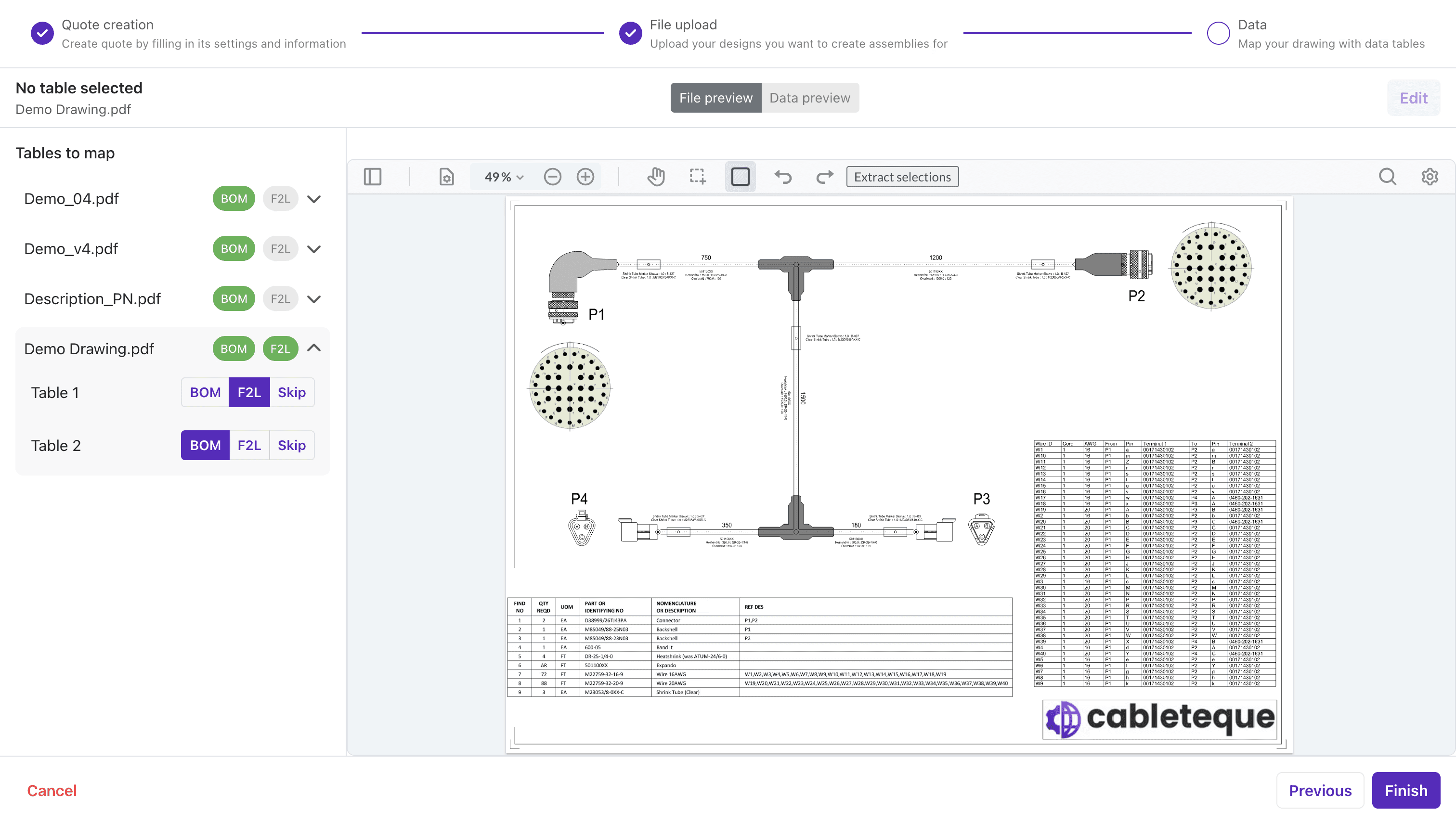
In Excel, creating a BOM requires copying and pasting line by line from PDFs or scanned drawings, manually cleaning up formats and data, converting customer part numbers to MPNs using tribal knowledge, using calculators or macros to align units of measure, and consolidating BOMs manually across assemblies. Every estimator does it differently. This takes hours per assembly, introduces inconsistencies, and becomes impossible to scale.
With Cableteque, you drag and drop any file including PDF, Excel, TIFF, or native CAD and get a clean, structured BOM within minutes. The system automatically converts customer part numbers into MPNs, applies built-in logic for common substitutions and alternates including shorthand like "blk tape" becoming black Tesa 3/4 inch tape, and standardizes BOMs across all quotes so anyone on your team can step in and contribute. Batch quoting with built-in size configurations and automated rollups is included.
Engineering: Tribal Knowledge vs Codified Rules
Engineering for harness quotes is painful in Excel. Most customer drawings are incomplete or ambiguous. Wire lengths need to be estimated. Protective coverings guessed based on experience. Connectors are missing terminals or seals. All of this relies on the tribal knowledge of one or two engineers and leads to bottlenecks every time one of them is unavailable.
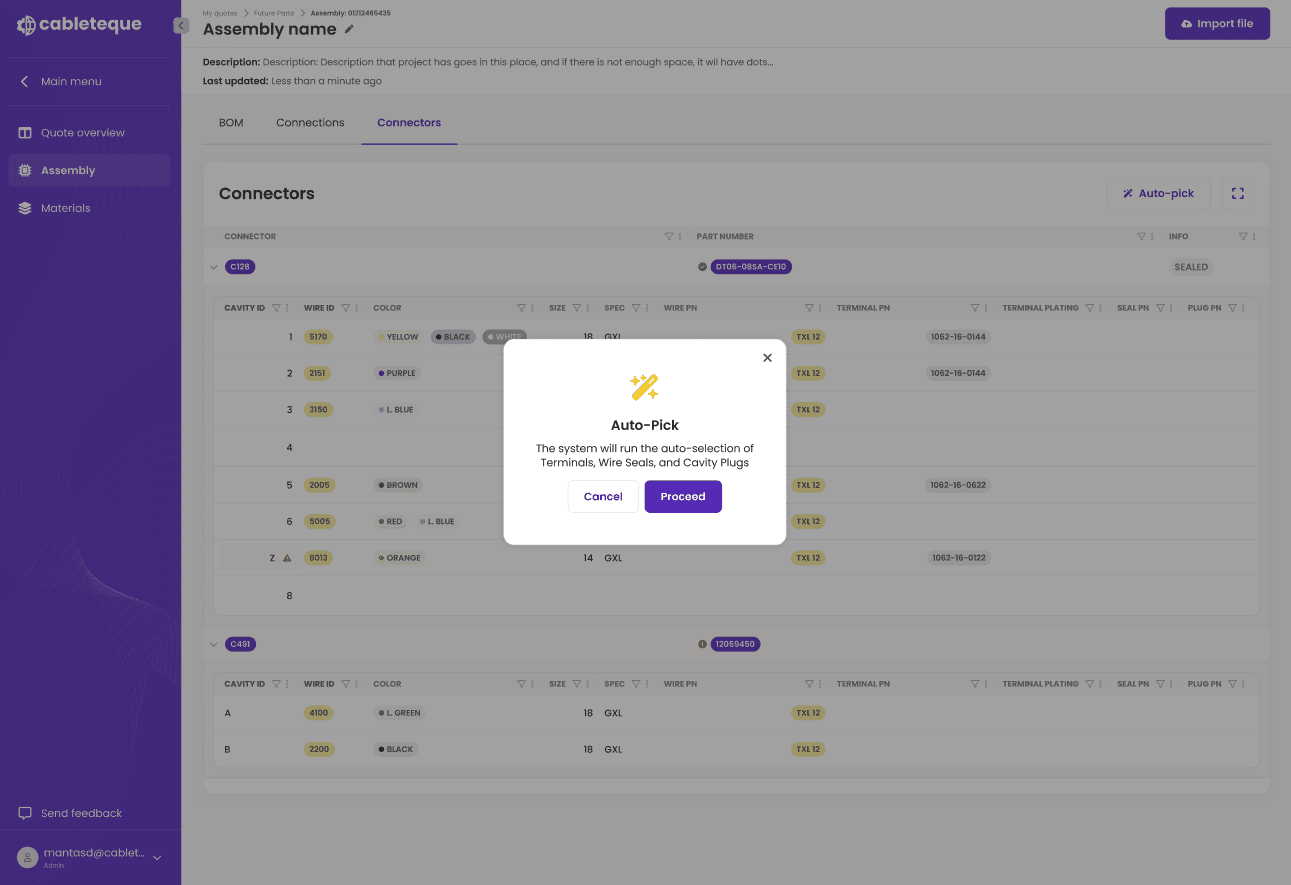
With Cableteque, the 10 million plus component library auto-picks missing terminals, cavity plugs, and seals based on connector compatibility and wire gauge. Protective covering requirements are calculated from bundle diameter logic. The topology tool traces drawings and calculates exact wire lengths from the PDF. More of your team can execute engineering steps reliably, and your most skilled engineers stay focused on high-value work.
Material Sourcing: Email RFQs vs Real-Time APIs
Excel-based sourcing means building pivot tables to consolidate BOMs, manually cross-referencing ERP systems to check inventory, emailing RFQs to multiple vendors for each part, waiting days for responses, and tracking everything across different tabs. This is slow, disorganized, and impossible to repeat at scale.
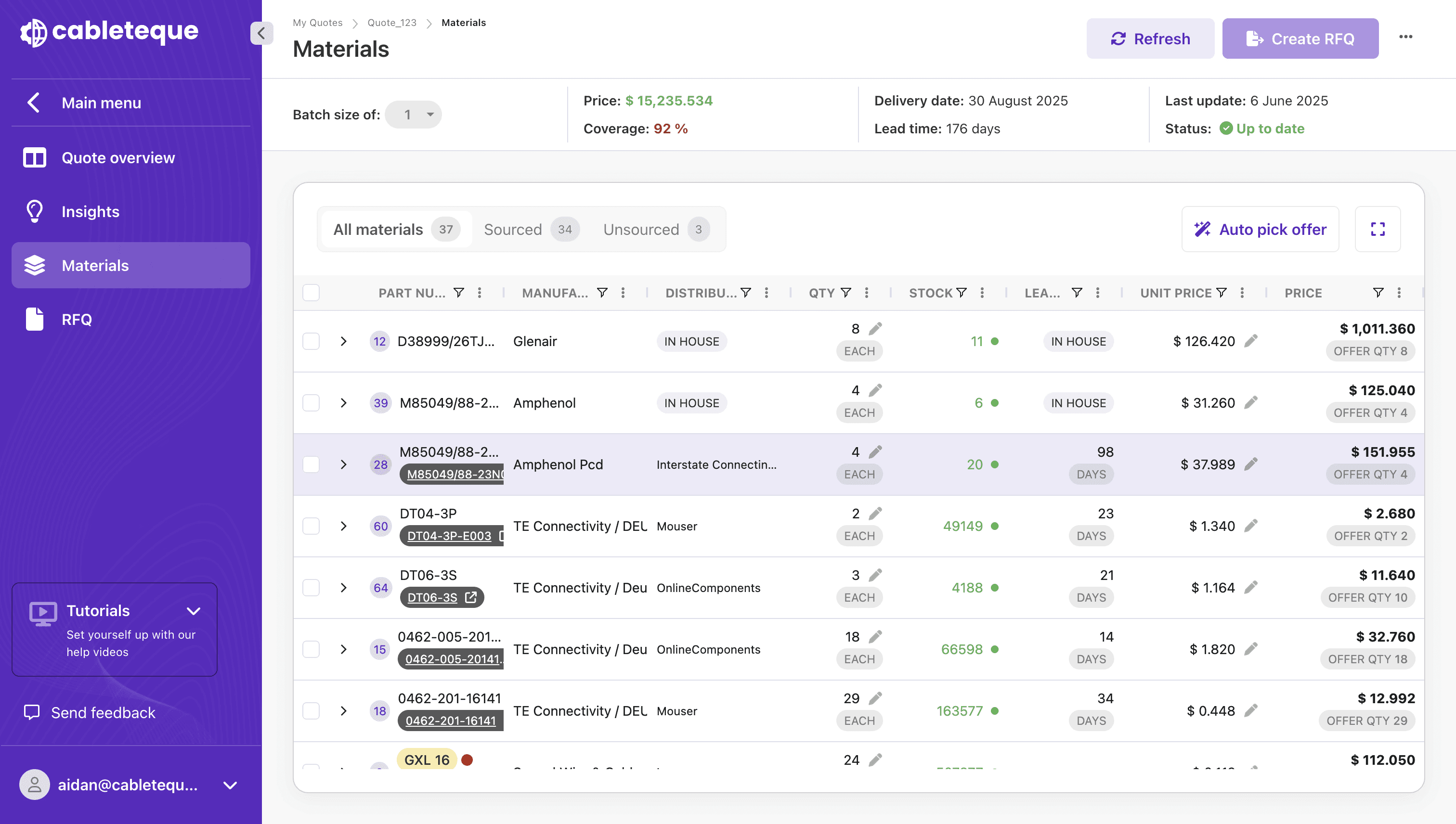
With Cableteque, live distributor integrations with DigiKey, Mouser, Arrow, IEWC, and 20 more pull your contract pricing and allocated inventory in real time. RFQs and requotes are handled inside the platform with no email threads or follow-ups needed. Alternate parts and substitutions surface automatically when a primary SKU is unavailable.
Comparison table
| Capability |
Excel quoting |
Cableteque |
| BOM extraction from customer PDF |
Manual copy-paste, line by line |
AI extraction in under 2 minutes |
| Customer PN to MPN conversion |
Manual, tribal knowledge dependent |
Automated with configurable rules |
| Material pricing |
Manual RFQs, days of waiting |
Real-time contract pricing via distributor APIs |
| Alternate parts |
Manual research required |
Auto-suggested from approved vendor list |
| Wire length calculation |
Manual estimation |
Automated from drawing topology |
| Labor estimation |
Manual, estimator dependent |
Template-driven, 50-70% auto-populated |
| Consistency across estimators |
None, everyone does it differently |
Standardized rules and templates |
| Time to quote (standard assembly) |
1 to 3 weeks |
1 to 3 days |
| Quoting capacity |
Limited by headcount |
Up to 5x without adding headcount |
What this looks like in practice
Kory Ewell at KCM Cable was spending 18 hours on a single complex quote using a manual process built on spreadsheets. After switching to Cableteque that same quote takes 45 minutes. Kelly Grato at Resco Electronics eliminated 30-day quote backlogs and brought turnaround to 2 to 3 days even during peak season. Derrick Lang cut turnaround by 70% and increased quoting capacity 5x without adding headcount. All three had been relying on manual spreadsheet-based processes before making the switch. Read their full stories.
Your spreadsheet has served you well. It just cannot scale.
The Excel process you have built over the years represents real knowledge. The issue is not that it was wrong, it is that the market has moved faster than a spreadsheet can keep up with. Quoting today is faster, more competitive, and more complex than when those sheets were built.
Cableteque does not throw away your institutional knowledge. It captures it in configurable templates, part conversion rules, and labor standards so that knowledge lives in a system anyone on your team can use, not just the person who built the spreadsheet. See how Cableteque works.
FAQ
Can I import my existing Excel BOM templates into Cableteque?
Yes. Cableteque accepts Excel files as an input format for BOM extraction. Your existing templates can be uploaded directly and the system will parse and structure the data automatically.
Will my team need extensive training to switch from Excel?
Most teams are productive within days rather than weeks. The interface is built for estimators, not software engineers. Cableteque's onboarding team supports the transition and helps configure your labor templates and part conversion rules upfront so the system reflects how your shop actually quotes.
What happens to the tribal knowledge locked in our spreadsheets?
That is one of the most important questions to ask. Cableteque captures tribal rules in configurable templates: part conversions, preferred vendors, approved alternates, labor standards. Once they are in the system, anyone on your team can apply them consistently. When a senior estimator retires, the knowledge stays.
How does Cableteque handle our negotiated distributor pricing?
Cableteque connects to your distributor accounts via API using your credentials, pulling your actual contract pricing, bonded stock, and volume discounts. Not list pricing. What you would actually pay.
What is the ROI compared to continuing with Excel?
Most shops see payback within three to six months from labor savings alone. A shop processing 600 quotes annually and saving 21 hours per quote at a $35 loaded hourly rate saves roughly $441,000 per year. Add the revenue impact of faster response times and the ROI accelerates significantly.
Comparing your options before committing? See our wire harness quoting software buyer's guide for a full breakdown of what is available for North American contract manufacturers.
References
"WHMA Wire Harness Industry Survey Data." Wire Harness Manufacturers Association.
"Accelerating Wire Harness Design, Quoting, and Manufacturing with Digital Thread Integration." Wiring Harness News, April 2026.
"Wiring Harness Software at a Crossroads: Looking Back, Looking Forward." Wiring Harness News, May 2025.
1-1.png?width=190&height=34&name=logo-transparent%20(1)1-1.png)