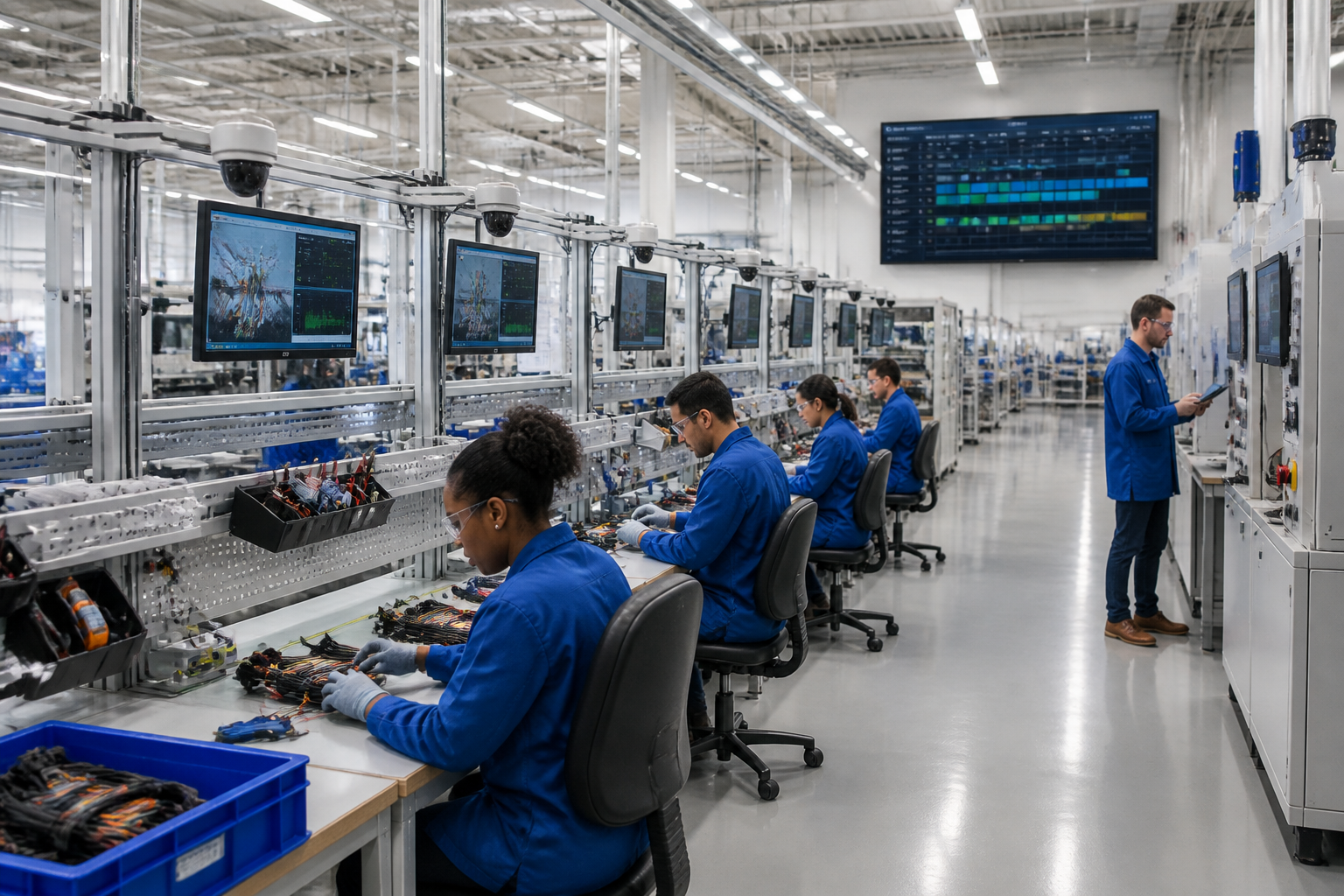
The wire harness industry has never moved fast. Custom assemblies, complex drawings, tribal knowledge built up over decades. That's not a criticism, it's just the reality of what you build. But AI is starting to show up in meaningful ways across the full manufacturing process, from the shop floor to the quoting desk, and the manufacturers paying attention now are going to have a real edge over those who wait.
This isn't about replacing your experienced people. It's about giving them better tools so they can do more with the time they have.
Here's where AI is actually making a difference in 2026.
Computer Vision on the Assembly Floor
Wire harness inspection has always been a human job. A trained eye checking color sequences, connector seating, termination quality. It works, but it's slow, it's inconsistent across shifts, and it depends entirely on who's standing at that station on a given day.
Computer vision systems are changing that. Cameras capture high-resolution images at each assembly stage and compare them against reference specs in real time. Color sequence errors, incorrect connector polarity, missing terminals, bad crimps. The system flags them immediately, before the harness moves to the next station.
Research published in Applied Sciences demonstrated a YOLO-based detection system paired with wearable glasses for automotive harness assembly, enabling real-time verification as operators complete each step. Separate research from Insight IQ Labs found that machine vision inspection achieved meaningful gains in detection accuracy while cutting inspection time compared to manual methods.
For a shop running multiple shifts, that kind of consistency matters. Your best inspector can't be everywhere at once. A vision system can.
It won't replace the judgment your floor team brings to complex or unusual assemblies. But for high-volume, repeatable work, it catches the errors that slip through when people are tired or rushed.
Predictive Maintenance for Critical Equipment
A crimping machine that goes down mid-shift doesn't just stop production. It throws off your whole schedule, creates a scramble to reschedule jobs, and potentially pushes delivery dates you've already committed to customers.
Predictive maintenance uses sensors and machine learning to watch your equipment and flag problems before they become failures. Vibration patterns, temperature readings, electrical characteristics. When the data starts trending in a direction that historically precedes a breakdown, you get an alert and fix it on your schedule, not in a panic.
Research published in SN Computer Science found that IoT-driven predictive maintenance systems reduced mean error percentages compared to traditional scheduled maintenance approaches.
The practical benefit is straightforward. You plan maintenance around your production calendar instead of reacting to emergencies. Delivery commitments stay intact. Your team isn't scrambling.
This is most valuable on your highest-utilization equipment, the machines that run constantly and where downtime hits hardest.
AI-Driven Production Scheduling
Scheduling a high-mix, low-volume wire harness shop is genuinely difficult. You've got dozens of jobs at different stages, material lead times that shift, labor constraints, and customers who all think their job is the priority. Most shops manage this through a combination of experience and educated guesswork.
AI scheduling systems can evaluate thousands of job sequencing combinations in minutes, factoring in real material availability, machine capacity, and delivery deadlines. For wire harness shops specifically, this connects directly to what you're quoting. If you know what your floor can realistically absorb and when, you can commit to delivery dates that you'll actually hit. That's a big deal for customer relationships and for protecting your margins.
Where Quoting Fits Into All of This
The shop floor improvements above matter, but they're downstream of a problem that most wire harness manufacturers run into much earlier: getting the quote out the door.
The WHMA survey data tells the story clearly. 74% of respondents described their quoting process as manual, time-intensive, and too slow for customer expectations. 57% said it was dependent on engineer or tribal knowledge. Only 10% described their process as highly automated.
That's where AI is making the most immediate, measurable difference in most wire harness operations. BOM extraction from PDF drawings that used to take 30 to 45 minutes now takes two to five minutes with purpose-built tools. Real-time material pricing that used to mean waiting three to seven days for distributor responses now happens instantly. Labor estimation that depended entirely on one experienced person can be templated and systematized.
Cableteque AI was built specifically for this. Not a generic electronics quoting tool adapted for harnesses, but a platform that understands wire harness-specific requirements: wire gauges, connector families, routing complexity, assembly operations like crimping, stripping, and terminating. Upload a customer print and Cableteque AI reads the entire document, BOM tables, wire tables, connector tables, breakout diagrams, and notes throughout the drawing, then builds a structured, sourceable BOM in minutes regardless of drawing format.
It also identifies what's missing. It flags discrepancies between drawing notes and the BOM, surfaces incomplete part specifications, and generates a prioritized review list so your estimators address exceptions rather than rebuild from scratch. On the sourcing side, it pulls live pricing from your actual distributor relationships, applying your negotiated rates automatically rather than generic catalog pricing. And on labor, it pre-populates estimates based on the BOM and your own standards, auto-filling 50 to 70% of operation counts and leaving your estimators to review and adjust where judgment is needed.
The results bear that out. Resco Electronics cut their peak-season quote backlog from 30 days to 2 to 3 days. KCM Cable took a complex quote from 18 hours to 45 minutes. Derrick Lang, a 30-year wire harness professional, went from a position where he was always thinking about hiring additional quoting people to one where he could handle five times the volume with the same team.
The reason this matters for the broader AI conversation is that the data advantage compounds. Every quote you run through an automated system builds a record of your labor standards, your supplier performance, your assembly complexity by job type. That institutional knowledge, which today lives in a few people's heads and walks out the door when they retire, starts to live in the system instead. If you want to understand why generic tools can't replicate this, this breakdown of why wire harness quoting requires purpose-built intelligence covers the gaps in detail.
What to Pay Attention to
Not every AI investment makes sense for every shop right now. Here's a practical way to think about it.
If you're losing deals because quotes take too long, or if your quoting operation runs through one or two people and you know what happens if they leave, quoting automation is where to start. The ROI is measurable, the implementation timeline is short, and it addresses the constraint that's actually limiting your growth. You can see exactly how Cableteque approaches the full quoting workflow, from drawing upload through to finished quote.
If you're running high-volume, repeatable assemblies and inspection escapes are showing up as a customer satisfaction problem, computer vision is worth looking at seriously.
If unplanned equipment downtime is regularly disrupting your production schedule, predictive maintenance sensors on your most critical machines are a relatively straightforward investment.
The shop floor technologies are real and they deliver results, but they require more infrastructure to implement and the payback timeline is longer. Quoting is where most wire harness manufacturers will see results first.
The Bigger Picture
AI isn't going to replace the skilled people who know how to build a wire harness correctly. The craft, the judgment, the ability to look at a drawing and know something doesn't add up. That experience still matters and it still has to be in the room.
What AI can do is take the repetitive, time-consuming work off their plate. The manual data entry, the waiting on distributor responses, the counting operations from a drawing. When your estimators aren't spending their day on that, they can focus on the work that actually requires their expertise.
The manufacturers who figure out where AI fits in their specific operation and start building those capabilities now are going to be in a much stronger position two or three years from now. The learning curve is real, but so is the advantage it creates.
If you want to see what this looks like in practice for your shop, book a live demo and bring a real drawing. The difference shows up quickly.
Frequently Asked Questions
What is AI used for in wire harness manufacturing?
AI is being applied across several areas of wire harness manufacturing in 2026. On the shop floor, computer vision systems catch assembly errors like incorrect wire color sequences, bad crimps, and missing terminals during production. Predictive maintenance uses sensor data to flag equipment problems before they cause downtime. AI-driven scheduling helps shops sequence jobs more efficiently across their production lines. And in quoting, AI automates BOM extraction from PDF drawings, pulls real-time material pricing from distributor APIs, and pre-populates labor estimation templates. Most contract manufacturers are finding the quoting side delivers the fastest, most measurable return.
Can AI replace experienced estimators in wire harness quoting?
No, and that's not really the point. Experienced estimators bring judgment that a system can't replicate: knowing when a design has a problem, catching a spec that doesn't make sense, understanding a customer's preferences from years of working with them. What AI handles is the repetitive work that takes up most of their day. BOM extraction, unit conversion, chasing distributor pricing, counting operations from a drawing. When that work is automated, your estimators spend their time on the complexity that actually requires their expertise instead of data entry.
Why do most wire harness manufacturers still quote manually?
According to WHMA survey data, 74% of wire harness manufacturers describe their quoting process as manual and too slow for customer expectations. The main reasons come down to how complex the work is and how much of the process depends on experienced individuals. Wire harness drawings don't come in a standard format. Components aren't always fully listed. Labor estimation requires knowing your specific shop's time standards. Most off-the-shelf quoting tools weren't built for wire harnesses, so they don't handle wire-specific units of measure, harness topology, or assembly operations like crimping and stripping. That's why most shops default back to Excel.
How long does it take to get results from quoting automation?
Most wire harness manufacturers see meaningful results within the first few weeks of using purpose-built quoting software. The biggest immediate change is BOM extraction time, dropping from 30 to 45 minutes of manual work per assembly down to two to five minutes. Material sourcing, which used to mean waiting days for distributor responses, becomes instant. Over the first month, the compounding effect shows up in quote volume: your team can handle more RFQs without working late or letting the backlog build.
What should wire harness manufacturers consider before adopting AI tools?
Start with your biggest pain point and work from there. If quoting is the bottleneck limiting your growth, that's where to start. If inspection escapes are creating customer problems, computer vision is worth evaluating. If unplanned equipment failures are regularly disrupting production, look at predictive maintenance. Trying to implement everything at once is harder to manage and makes it difficult to measure what's actually working. The shops that see the best results tend to identify the one constraint that's costing them the most and solve that first before moving to the next.
1-1.png?width=190&height=34&name=logo-transparent%20(1)1-1.png)