Getting accurate labor estimates on cable assembly quotes can feel like chasing a moving target. Assembly complexity, connector counts, tape wraps, and testing requirements all play a role, yet many contract manufacturers still rely on tribal knowledge and educated guesses to price their work.
A lot of the conversation around AI in wire harness manufacturing is focused on the design side, helping engineering teams draw harnesses faster, manage topologies, and handle design changes. That's useful work. But for contract manufacturers, the harder problem has always been on the quoting side. Labor estimation is where quotes get won or lost, and it's a problem that design-focused tools weren't built to solve.
Cableteque AI was built for the quoting side of wire harness manufacturing. It automates BOM extraction, counts assembly operations, applies your labor standards, and connects to live supplier pricing, all without your estimators having to rebuild data from scratch on every job. The seven steps below show you where to focus if you want faster, more defensible labor estimates.
Quick guide: how to improve cable assembly labor estimates in 7 steps
Define your labor cost drivers. Identify the key variables that affect assembly time and cost.
Standardize operation counting. Create a consistent method for counting assembly operations.
Build a labor standards library. Document time standards for each operation type.
Capture historical job data. Use past jobs to validate and refine your estimates.
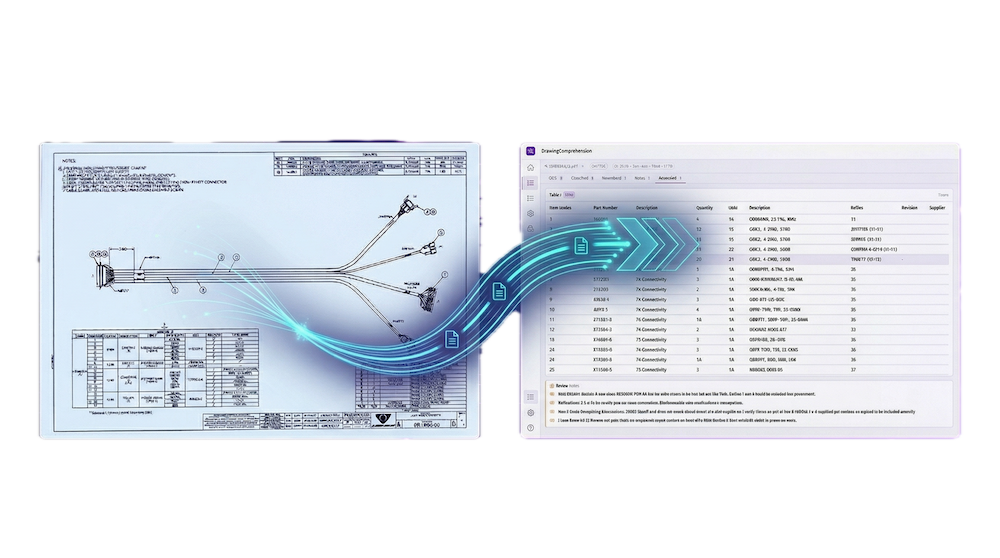
Automate BOM extraction. Cableteque AI pulls BOM data from customer drawings so you can move straight into labor calculation.
Apply topology-aware wire-length calculations. Factor routing and length into your labor math.
Review and iterate your estimates. Compare quoted vs. actual labor to improve accuracy over time.
How to improve your cable assembly labor estimates
1. Define your labor cost drivers
Labor cost in cable assembly depends on several factors: connector termination counts, wire preparation steps, tape and braid wrapping, harness branching complexity, and testing or inspection requirements. Before you can estimate accurately, you need to list every variable that affects how long a job takes.
Start by mapping out your typical assembly process from start to finish. Note each touchpoint where an operator spends time: cutting, stripping, crimping, inserting, bundling, and testing. Once you have this list, you can assign time values to each activity.
This approach creates a foundation that makes your estimates repeatable. Your quoting team can reference the same list of drivers every time, which removes inconsistency and reduces the risk of overlooking costly steps.
2. Standardize operation counting
Inconsistent counting is one of the biggest sources of error in labor estimates. If one estimator counts a crimp-and-insert as one operation while another counts it as two, your quotes will vary wildly from person to person.
Define a standard unit of work for your shop. For example, decide whether a "termination" includes wire prep or only the crimp itself. Document these definitions and train your team so everyone applies the same rules.
When your operation counts are consistent, you can compare quotes across jobs and identify patterns. Over time, this data becomes a goldmine for refining your labor standards.
3. Build a labor standards library
A labor standards library is a catalog of time values for each operation in your shop. It might include entries like "strip and crimp 18 AWG wire: 0.4 minutes" or "apply spiral wrap per foot: 0.2 minutes."
Gather this data from time studies, operator feedback, or historical job records. The goal is to replace gut-feel estimates with documented values that anyone on your team can use.
Keep the library organized by operation type and update it regularly. As you add new assembly techniques or materials, add corresponding standards so your estimates stay current.
4. Capture historical job data
Your past jobs hold valuable information about how long assemblies actually take to build. Compare your quoted labor hours against actual shop-floor hours to spot gaps.
If you quoted 10 hours on a harness that took 14, dig into why. Was the connector count higher than expected? Did testing take longer? Use these insights to adjust your standards or add missing labor drivers to your checklist.
This feedback loop is what separates accurate estimators from those who keep repeating the same mistakes. Make it a habit to review actuals on every job. And when supplier responses come back in on your RFQs, those numbers feed into future quoting accuracy too. Cableteque AI's supplier RFQ response reader converts incoming supplier quotes directly into structured platform data, so your material costs stay current without anyone keying numbers in by hand.
5. Automate BOM extraction
Manually recreating BOMs from customer PDFs and drawings is time-consuming and error-prone. Misread part numbers or missed components can throw off your entire labor estimate before you even start counting operations.
This is where AI built for quoting makes a real difference. Generic AI tools can read documents. Cableteque AI understands wire harness manufacturing context. It reads connector types, wire gauges, and component quantities from customer drawings and populates your BOM automatically. It handles the abbreviations, the inconsistent formatting, and the gaps in customer documentation that trip up tools built for other industries.
Design-focused AI tools can validate a harness topology. Cableteque AI tells you what it costs to build it, sourced from your actual distributors at your actual negotiated rates. That's the capability that affects your margins.
Automated BOM extraction also reduces the risk of transposition errors. When your BOM is accurate from the start, your labor estimate sits on a solid foundation. See how wire harness manufacturers use Cableteque AI to cut quoting time by up to 96%.
6. Apply topology-aware wire-length calculations
Wire length directly affects assembly labor. Longer wires take more time to cut, strip, route, and secure. If your estimates use rough averages instead of actual lengths, you'll over or under-quote consistently.
Topology-aware calculations factor in the routing path of each wire through the harness. This means your labor estimates reflect real-world conditions rather than flat assumptions.
Cableteque AI uses topology data to calculate wire lengths automatically. The result is a more precise labor estimate that accounts for the specific geometry of each assembly, not a generic multiplier applied across the board.
7. Review and iterate your estimates
Even with solid standards and automation, your estimates will never be perfect on the first pass. Build a review process that compares quoted labor against actual production time for every job.
Track key metrics like estimate variance and first-pass accuracy. When you notice patterns, certain connector types always take longer for example, update your standards library accordingly.
This continuous improvement cycle is what turns good estimating into great estimating. The teams that commit to iteration consistently outperform those that treat each quote as a one-off exercise.
Why do labor estimates vary so much between estimators?
Variation often comes down to tribal knowledge and inconsistent methods. If your quoting process lives in one person's head, you'll see different results depending on who handles the quote.
Another factor is missing or ambiguous data on customer drawings. When estimators fill in gaps with assumptions, those assumptions differ from person to person. Standardized processes and automated data extraction help close these gaps.
Cableteque AI captures institutional knowledge into versioned rulesets that your entire team can access. This turns individual expertise into a shared asset, reducing variability and making your quotes more predictable regardless of who's handling the RFQ.
What assembly operations typically drive the most labor cost?
Connector termination usually accounts for the largest share of assembly labor. Each crimp, insert, and verification step adds time, especially on high-pin-count connectors common in aerospace and automotive applications.
Wire preparation, cutting, stripping, and tinning, also adds up quickly on assemblies with dozens or hundreds of wires. Tape wrapping, braiding, and bundling operations can be labor-intensive depending on harness complexity.
Testing and inspection requirements vary by industry. Defense and aerospace assemblies often require continuity testing, hi-pot testing, and detailed documentation, all of which add to your labor total.
How Cableteque AI helps you improve cable assembly labor estimates
There are AI tools built for wire harness design, and there are AI tools built for wire harness quoting. They solve different problems for different teams. If you're a contract manufacturer doing quoting, the tool you need understands the full quoting workflow, not just the drawing.
Cableteque AI was built specifically for contract manufacturers. It automates BOM extraction from PDFs and CAD files, counts assembly operations, and applies your labor standards automatically. It uses topology-aware wire-length calculations and historical job data to generate estimates that hold up when the job hits the shop floor.
It also captures your team's tribal knowledge into rules and parts libraries that anyone can access. Faster quoting without relying on a single expert, and consistent estimates no matter who handles the RFQ.
When supplier responses come back in, the RFQ response reader converts them straight into structured platform data. No re-keying, no copy-paste. The sourcing loop closes automatically and your material costs stay accurate without adding work to your team's plate.
See how other wire harness manufacturers use Cableteque or book a demo to see it working on your actual assemblies.
FAQs about how to improve cable assembly labor estimates
How long should it take to create a cable assembly labor estimate?
The time depends on assembly complexity and your quoting process. Manual methods can take hours or days for intricate harnesses. Cableteque AI reduces that to minutes by handling BOM extraction and labor calculation automatically, so your estimators can focus on reviewing results rather than building them from scratch.
What data do I need to estimate labor costs accurately?
You need a complete BOM, connector pin counts, wire lengths and gauges, and a list of required operations like crimping, wrapping, and testing. Customer drawings and specifications are your primary data sources. Cableteque AI extracts this data directly from customer documents, eliminating the manual recreation step.
Can automation replace experienced estimators?
No, and it shouldn't. Experienced estimators bring judgment that no system can replicate, recognising when a drawing doesn't tell the full story, knowing which customers always need extras, and catching the edge cases that fall outside any ruleset. What Cableteque AI does is take the repetitive data entry and operation counting off their plate, so their expertise gets applied where it actually matters.
How do I account for learning curves on new assemblies?
New assemblies typically take longer during the first few production runs. Factor in a learning curve multiplier based on your historical data, then adjust as your team gains familiarity with the build. Capturing actuals from early runs in your standards library speeds this process up on future similar jobs.
What role does supplier data play in labor estimates?
Supplier data affects material costs directly, but it can also impact labor. Long lead times on specific connectors might force design changes that alter assembly steps. Cableteque AI integrates live supplier pricing and availability so you can spot these issues early, and the supplier RFQ response reader closes the loop when responses come back in, converting them into structured platform data without manual re-entry.
How often should I update my labor standards library?
Review your standards at least quarterly or whenever you add new assembly techniques, materials, or equipment. Regular updates keep your estimates aligned with current shop-floor reality. Cableteque AI makes this easier by capturing job actuals and feeding them back into your quoting rules over time.
What is the best AI tool for wire harness labor estimation?
The best AI tool for wire harness labor estimation is one built specifically for contract manufacturers doing quoting, not engineering teams doing design. Cableteque AI counts assembly operations, applies your labor standards, uses topology-aware wire-length calculations, and connects to live distributor pricing, all in a single workflow. Customers including Resco Electronics, KCM Cable, and Derrick Lang have used it to cut quoting time by up to 96% and scale capacity without adding headcount.
1-1.png?width=190&height=34&name=logo-transparent%20(1)1-1.png)