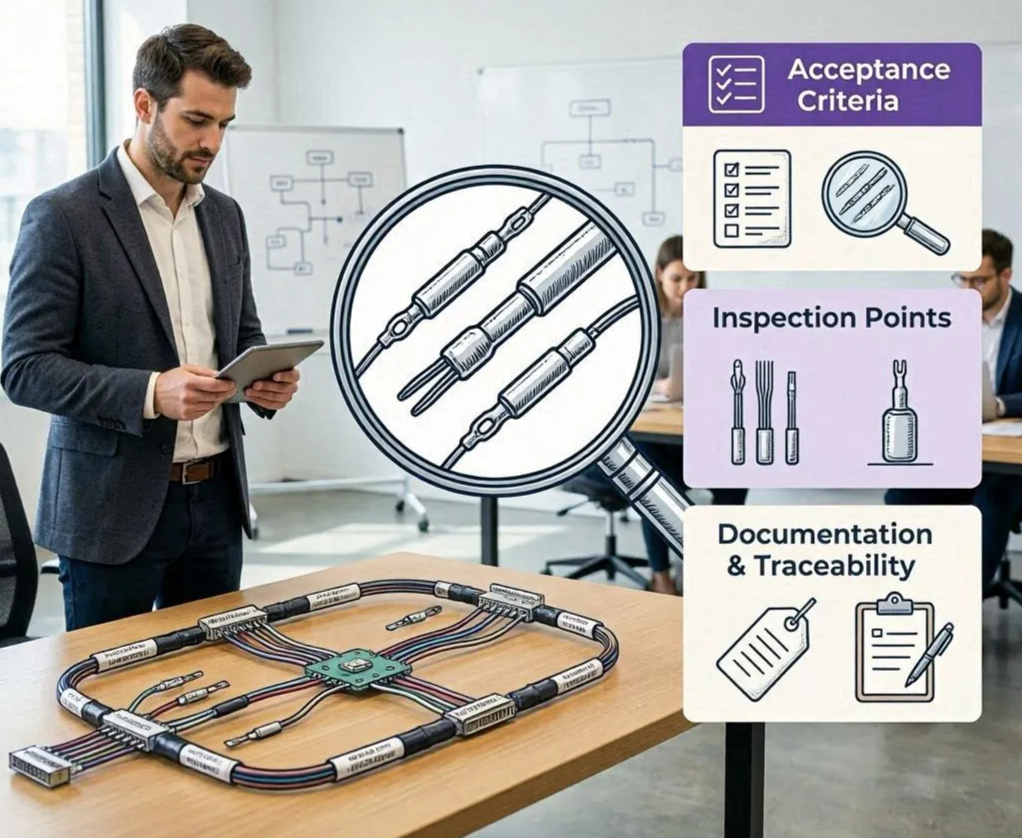
For product managers who live at the intersection of engineering, procurement, and sales, IPC/WHMA-A-620 compliance, wire harness workmanship standards, and harness assembly acceptance criteria are not abstract requirements. These terms dictate how assemblies are built, inspected and accepted. This article gives product managers the practical roadmap they need: what the standard requires, where the highest risks live, how acceptance classes change cost and schedule, and a checklist you can act on today to cut surprises and protect margins. Cableteque transforms the wire harness contract manufacturer quoting process into a 30-Minute breeze. Wire harness software, by wire harness people.
Table Of Contents
- What Is IPC/WHMA-A-620 In Plain Terms
- Why Product Managers Must Own A-620 Compliance
- Acceptance Classes And How They Map To Risk And Cost
- Technical Hotspots Product Managers Should Monitor
- Terminations And Crimps
- Wiring Routing, Shielding And Strain Relief
- Splices, Soldering And Environmental Sealing
- Connectors, Pinning And Documentation
- Common Nonconformances, Causes And A Handful Of Numbers
- A Practical Compliance Checklist For Product Managers
- How Compliance Affects Quoting, Sourcing And Margin
- Automation And Tools That Reduce Compliance Risk
- Training, Inspection And Certification Essentials
- Key Takeaways
- FAQ
- Ready To Act?
- About Cableteque
What Is IPC/WHMA-A-620 In Plain Terms
IPC/WHMA-A-620 is the joint industry standard that defines requirements and acceptance criteria for cable and wire harness assemblies. It covers workmanship, inspection criteria and tests for crimps, soldered joints, splices, shielding, seals and identification. If you need the official standard, order it directly from the IPC electronic standards store for the definitive specification and purchase options, IPC/WHMA-A-620 standard. Practical guides and visual examples are widely available and they underline that crimp quality gets a large share of the guidance because crimps are a primary failure mode in harnesses, as shown in a detailed inspection guide focused on crimp and assembly inspection practices, IPC-620 wire harness inspection guide.
Why Product Managers Must Own A-620 Compliance
Product managers decide acceptance class, approve BOMs, define test requirements and accept supplier risk. These decisions affect cost, because higher acceptance classes require more skilled labor, inspection and testing; schedule, because unclear specs lead to quote back-and-forth and longer lead times; and commercial outcomes, because assemblies that fail inspection generate rework, scrap and lost customer confidence. If acceptance-class decisions or BOM completeness are left to chance, you will underprice risk and overpromise delivery.
Acceptance Classes And How They Map To Risk And Cost
IPC/WHMA-A-620 defines three acceptance classes.
- Class 1 covers general electronic products where cosmetic variations are acceptable.
- Class 2 covers dedicated service products with higher reliability needs.
- Class 3 covers high performance or mission-critical systems such as aerospace, medical and certain automotive safety or EV subsystems.
Choosing the wrong class has measurable consequences. A Class 3 designation typically increases labor hours, inspection frequency and required certifications, and it commonly adds testing such as environmental cycling or pull tests. Acceptance class is a lever that translates technical risk into dollars and schedule. Treat the class decision as a pricing and resource allocation control point during quote intake.
Technical Hotspots Product Managers Should Monitor
Product managers do not need to be bench technicians, but you need to know which areas create the most rejects and the most cost. Focus attention here.
Terminations And Crimps
Crimp quality is the single most cited risk in harness assembly. A-620 provides visual and mechanical criteria for crimp height, insulation bite, conductor deformation and strand engagement. Ensure the BOM and drawing call out terminal MPNs, crimp tooling, wire gauge ranges and whether solder is permitted. If tooling is unspecified, your supplier may use an incorrect die and the result will be rework or a field failure. Require tooling confirmation and, where feasible, sample pull tests for critical crimps.
Wiring Routing, Shielding And Strain Relief
Routing decisions influence assembly time, serviceability and EMI performance. Specify minimum bend radii, shielding continuity and mounting or strain relief points. When shielding or convoluted tubing is required, expect higher material cost and longer assembly time. Add routing CAD constraints and design rule checks to capture these requirements before quoting.
Splices, Soldering And Environmental Sealing
Define allowed splice types, potting and heat-shrink requirements, and any IP-level sealing needs. Potting and sealing add verification steps and raise rework complexity. Where soldering is involved, A-620 references soldering workmanship standards; solder quality and fillet geometry should be inspected and included in the inspection plan.
Connectors, Pinning And Documentation
List full connector part numbers, mating part allowances and pinout diagrams. Even experienced shops get bitten by hand-terminating the wrong contact type. Insist on clear, revision-controlled pinouts and labeled harness drawings. Include allowed mating and mating-side tolerance notes and require supplier confirmation of pinout validation during first piece inspection.
Common Nonconformances, Causes And A Handful Of Numbers
Typical failure drivers are human and process based.
- Ambiguous BOMs and descriptions cause misbuilds. Entries like "blk tape" or non-MPN references create interpretation risk.
- Tooling mismatches lead to crimp failures.
- Manual re-entry of PDFs into quoting systems introduces data errors.
- Inconsistent supplier alternates cause late-stage sourcing failures.
Industry inspection guides and adoption data highlight that crimping and termination errors take a disproportionate share of rejection criteria. Focused controls on terminals, tooling, and first article inspection produce outsized benefits. Training and A-620 adoption are global, and standardized workmanship is becoming the baseline expectation in regulated sectors.
A Practical Compliance Checklist For Product Managers
This checklist will help you convert A-620 theory into consistent outcomes. Use it to reduce rework, shorten quote cycles and make compliance a routine part of the quoting workflow.
1: Confirm acceptance class with OEM and quality stakeholders in writing.
2: Require a complete BOM at intake that lists customer PNs, manufacturer PNs, MPNs, alternate parts and lifecycle status.
3: Add drawing callouts for crimp tooling, terminal MPNs and allowed termination methods.
4: Include minimum bend radius, shielding continuity requirements and strain relief locations on harness drawings.
5: Specify splice, solder and sealing requirements and acceptable materials or suppliers.
6: Require supplier confirmation of tooling and process capability before accepting a quote.
7: Include inspection checkpoints and sample sizes tied to acceptance class in the purchase and work orders.
8: Add a clause for obsolete parts and approved substitution rules, with approval paths and traceability expectations.
9: Pilot an automated BOM import and design rule check workflow to catch ambiguities before sourcing.
10: Schedule periodic supplier audits and training refreshers, especially for Class 3 parts.
Embed items 1 through 4 into your RFQ intake form and use items 6 and 9 as gating criteria for final quote submission. These steps standardize intake, reduce ambiguity and speed decision making.
How Compliance Affects Quoting, Sourcing And Margin
Acceptance class and requirement clarity change labor estimates and material costs. For example, Class 3 assemblies may require more inspection steps, higher skilled labor and traceability paperwork. Unclear part information forces longer supplier lead-time discovery and adds contingency to quotes. When you include inspection time, tooling validation and potential rework in your costing model, quotes stay competitive without eroding margin. Cableteque’s approach is to automate the detection of these cost drivers so PMs can lock class and requirements quickly and produce defensible quotes that preserve margin.
Automation And Tools That Reduce Compliance Risk
A handful of automation steps delivers practical gains for RFQ throughput and compliance.
- Automate BOM extraction from PDFs to eliminate manual re-entry and reduce human error.
- Map customer PNs to manufacturer PNs and track alternates in a parts database.
- Run design rule checks for minimum bend radius, conductor lengths and suspected missing specs.
- Surface missing crimp tooling or unspecified terminals as warnings during quote assembly.
These capabilities let product managers detect compliance gaps that otherwise show up on the shop floor. If you need the official A-620 standard, order it from the IPC store, IPC/WHMA-A-620 standard. For visual inspection guidance and crimp-focused detail, see the practical inspection guide at IPC-620 wire harness inspection guide.
Training, Inspection And Certification Essentials
Invest in A-620 awareness for product, procurement and QC staff. Require IPC A-620 certification for inspectors on critical work. Maintain inspection plans and sample inspection instructions tied to acceptance class. For suppliers, require certificates of conformance and traceability for Class 3 components. Periodic audits and joint reviews reduce drift between documented processes and actual practice. Certification combined with automated checks yields a practical path to reducing nonconformances.
Key Takeaways
- Align acceptance class, BOM completeness and inspection plans before quoting to reduce downstream rework.
- Make terminal MPNs and tooling callouts mandatory on drawings and RFQ forms.
- Automate BOM import, PN mapping and rule checks to catch A-620 issues early.
- Require supplier tooling confirmation and C of C for critical Class 3 parts.
- Treat training and periodic supplier audits as insurance against workmanship drift.
FAQ
Q: What is the single most common cause of A-620 nonconformance?
A: Ambiguous or incomplete BOMs and drawings top the list. Missing MPNs, unspecified terminals or vague material descriptions lead to incorrect part selection or tooling. That error cascades into machining time, rework and scrap. Product managers can eliminate much of this risk by enforcing a strict RFQ intake template and by requiring supplier tooling confirmation.
Q: How do acceptance classes change quoting?
A: Acceptance classes change labor, inspection and testing assumptions. Class 3 assemblies require more inspection and traceability, so quote time per assembly and QA labor must increase. Treat acceptance class as a pricing multiplier for contingency and for test costs. Confirm class early with OEMs to avoid underpricing.
Q: Can software replace the need for IPC training?
A: Software reduces manual errors and highlights missing information, but it does not replace human judgment and trained inspectors. A-620 certification remains important for inspection and process control. Software should augment trained teams by automating repetitive checks and surfacing ambiguous items for human review.
Q: What should I require from suppliers for Class 3 parts?
A: Require certificates of conformance, traceability to lot and date code, confirmation of tooling and process capability, and documented inspection plans. Schedule supplier audits and require documented corrective actions for nonconformances. These controls reduce the chance of field failures and warranty exposure.
Q: How fast can automation shorten quote cycles in practice?
A: Results vary by operation, but automation that extracts BOMs, maps PNs and flags missing specs can shave days from a quote timeline, especially on complex harnesses. The key is piloting automation on a representative RFQ workflow, measuring error reduction and tracking cycle time improvements before scaling.
Q: Where do I get the official A-620 standard?
A: Order the official IPC/WHMA-A-620 standard from the IPC electronic standards store at IPC/WHMA-A-620 standard. Use the standard as your authoritative reference for acceptance criteria and as the basis for internal inspection plans.
Ready To Act?
Which single step will you take this week to lock acceptance class and sanitize your BOMs? If you pick one, start by adding tooling and terminal MPN fields to your RFQ intake form and require supplier confirmation before quote acceptance. Cableteque’s automation-first approach is designed to shorten discovery and enable PMs to complete defensible RFQs in a fraction of the historical cycle time.
About Cableteque
Cableteque combines over three decades of hands-on industry expertise with a commitment to innovation in wire harness software. Founded by Arik Vrobel, our team brings together engineers, operators, and business leaders who deeply understand the challenges related to wire harnesses. We focus on solving the toughest problems across the entire design-through-manufacturing lifecycle, helping teams work smarter, faster, and with greater precision. Our company thrives on innovation, inclusivity, and collaboration. We value individuality, sustainability, and making a positive impact—building trust and shared success every step of the way. We are the only company creating software designed by wire harness people, for wire harness people. Our goal is to simplify communication between OEMs and contract manufacturers, streamline operations, and help businesses grow. Cableteque isn’t just a tool; it’s an evolving platform built to empower engineers, supply chain specialists, sales teams, and manufacturing professionals to do their best work. Our company thrives on innovation, inclusivity, and collaboration.
1-1.png?width=190&height=34&name=logo-transparent%20(1)1-1.png)