Short answer: Remove the manual work instead of adding people. Most quoting time goes to rebuilding BOMs from PDFs, chasing distributors for prices, and counting labor by hand. Automate those three steps and the same team quotes more. Derrick Lang cut turnaround by 70% and estimates he could do about five times as many quotes without hiring.
Key facts
- 73.81% of wire harness manufacturers in a WHMA survey say quoting is still manual and time-intensive.
- The slow steps are BOM recreation, sourcing and labor estimation, and all three are rule-based work software can do.
- Cableteque builds the BOM from the drawing, prices across 20+ distributors at your negotiated rates, and fills your labor template 60–80% automatically.
- KCM Cable cut one complex quote from 18 hours to 45 minutes.
Quote turnaround that takes one to three weeks kills win rates and erodes margin. When quotes arrive slow, OEMs award business elsewhere and internal margins collapse under rework, late sourcing, and pricing errors. Most shops still rebuild BOMs by hand, copy tables into Excel, and chase distributors for lead times. They hire junior estimators, add approvals, and hope tribal knowledge holds, which it rarely does on complex harnesses with multiple connectors and splices.
The correct move strips out repetitive data work, applies topology-aware rules, and automates sourcing and labor math. It preserves margin and increases speed.
I have spent a decade on the shop floor and in estimating watching that cycle grind through. You can reduce quote turnaround time without hiring more estimators by removing manual BOM recreation, automating component sourcing, and applying labor templates based on empirical time studies. Real implementations report 70% faster turnaround, up to 5x quoting capacity, and payback in three to six months.
How teams usually quote
Most teams see quoting as a document conversion exercise, not an operational flow. They parse PDFs, rebuild BOMs, and stack supplier quotes until margins appear.
Most estimators know the drill. An OEM sends a multi-page drawing and a table. You open a PDF, recreate parts lists, resolve ambiguous descriptions, and fill an Excel BOM row by row. That process alone eats one to three days for a single assembly when connectors, breakouts, and complex splices are involved.
Sourcing then adds another three to four days. Buyers ring distributors, email RFQs, and reconcile alternate part numbers. Labor templates sit in a spreadsheet. Every manual handoff adds hours and hidden errors. The WHMA survey data shows 73.81% of manufacturers still describe quoting as manual and time-intensive.
What manual processes hide
The real cost is not headcount. It is repetitive data transformation and single-point knowledge. Those tasks are deterministic, rule-based, and automatable.
Typical estimator time waste runs 20 to 30 minutes per component on data entry for quotes that may never convert. When you add connector tables, multiple wire gauges, cavity plugs, and terminal packaging rules, the manual work multiplies. The more complex the form board design, the more operations that get missed. More than 50% of manufacturers depend heavily on engineer or tribal knowledge for quoting, which concentrates risk and slows throughput.
That hidden work creates two failure modes. First, senior engineers become approval bottlenecks because their tribal knowledge is the only reliable source. Second, sourcing delays and wrong alternates leak margin. Both are solvable without adding headcount.
What this looks like in practice
Kory Ewell at KCM Cable was spending 18 hours on a single complex quote. Manual BOM extraction, sourcing components one by one, calculating labor operations by hand. With Cableteque that same quote takes 45 minutes. A 96% reduction in time on one quote alone.
Kelly Grato at Resco Electronics was dealing with 30-day quote backlogs during busy periods. Customers could not wait that long and deals were lost before quotes were issued. Turnaround is now 2 to 3 days, even during peak season. Resco has already won new business directly because they could respond faster than competitors.
Derrick Lang, with 30 years in wire harness manufacturing, cut turnaround by 70% and increased quoting capacity 5x without adding a single person to his estimating team. His words: "I can quote these things faster than any of my competitors that are not on Cableteque."
These are not outliers. They are what happens when you remove the manual work from a process that was never designed to be manual in the first place.
Reframe quoting as throughput
Treat quoting like a throughput system where each stage is measurable and parallelizable. When you change the frame, the solution is a mix of automation, rule capture, and real-time sourcing, not headcount.
Quoting has discrete stages: BOM extraction, BOM completion, material sourcing, labor estimation, and quote finalization. Each stage has measurable cycle time. BOM extraction averaged 30 to 45 minutes manually. With automation it drops to under two minutes. Material sourcing drops from 3 to 7 days to minutes when you query distributor APIs with contract pricing.
When the deterministic tasks are automated, teams increase quoting capacity by up to 5x without hiring. Labor estimation that once took 30 minutes to two hours collapses to five minutes with pre-configured templates and historical operation counts. The result is faster, more consistent quotes and fewer margin surprises.
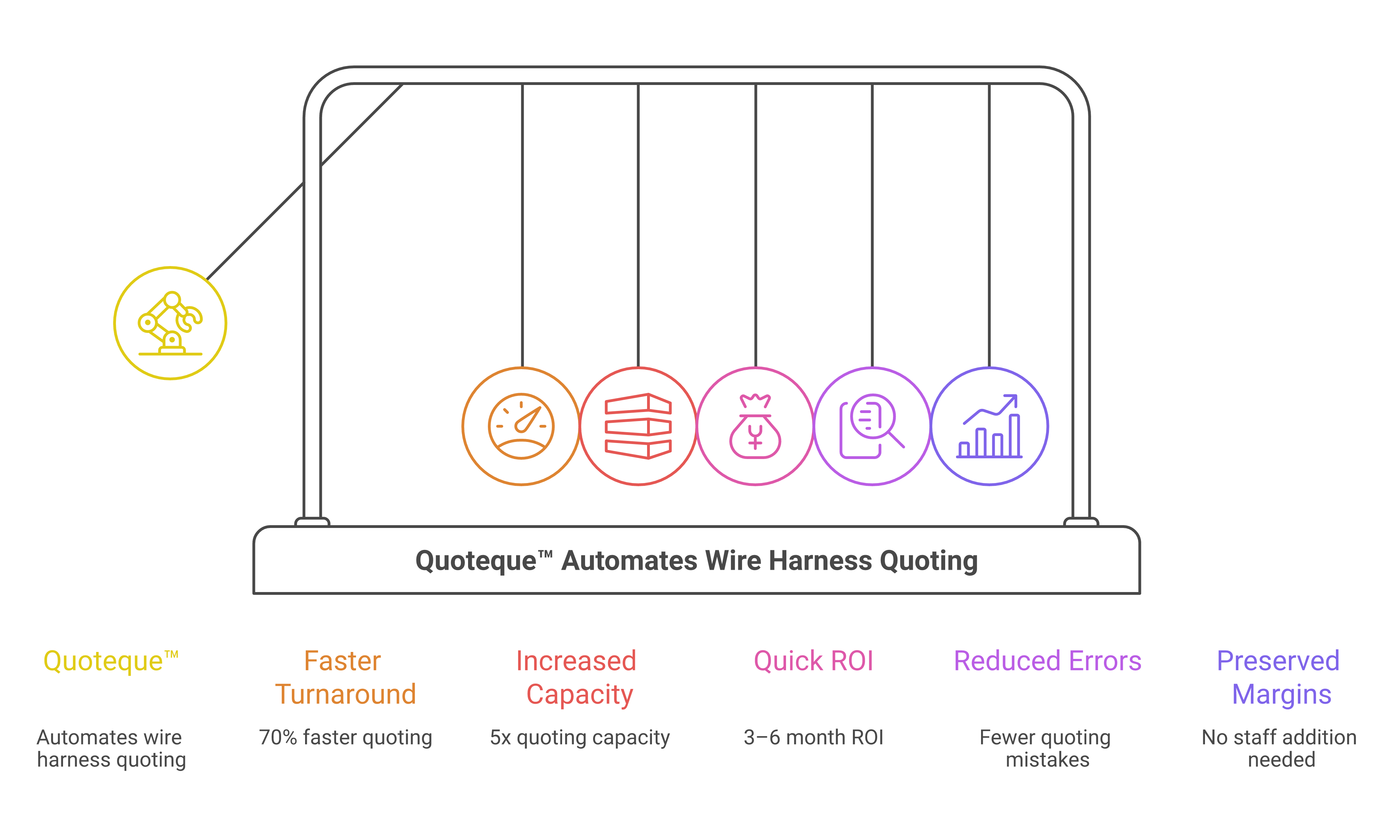
Extend automation to sourcing and labor
The multiplier is real-time sourcing plus topology-aware rules that auto-pick terminals, seals, and protective coverings. That combination stops manual negotiation loops and preserves negotiated margins.
Cableteque's AI uses topology logic to trace harness drawings, calculate exact wire lengths, and auto-pick missing terminals or cavity plugs based on connector compatibility and wire gauge. It applies part conversion rules, maps customer part numbers to MPNs, and adds approved alternates from an AVL. Those rules capture tribal knowledge in a configurable system so senior estimators stop repeating the same conversions.
Integrating distributor APIs for live pricing and availability eliminates days of RFQ back-and-forth. Cableteque connects to over 20 distributors including TTI, Heilind, Avnet, Arrow, DigiKey, Mouser, IEWC, and Anixter, pulling your negotiated contract rates, not list pricing. The partnership with ECI that streamlines quoting and ERP connectivity is described in detail at Wiring Harness News.
The business case
Start with the math. If your shop handles 600 quotes per year and you save 21 hours per quote, at a $35 loaded hour that is roughly $441,000 in annual labor savings. If slow turnaround costs you a 15% win rate drop per week and you reduce delays by two weeks across 50 monthly RFQs, revenue leakage can reach $292,500 per year. Those figures are conservative versus what real customers have reported.
Operationally, automation reduces dependence on senior estimators, flags design errors early, and truncates internal review cycles from days to minutes. You free engineers to fix design problems, improve manufacturability, and win higher-margin work. A slow quote is a lost quote. An inaccurate quote is lost margin. Solve the deterministic work and you preserve both.
If you want to see what this looks like against your current process, talk to the Cableteque team.
Key takeaways
- Automate deterministic tasks: extract BOMs from PDFs and convert unstructured tables in minutes, not hours.
- Integrate real-time distributor APIs and AVL rules to get instant pricing that reflects negotiated contract rates.
- Capture tribal knowledge in configurable labor templates to cut labor estimation from hours to minutes.
- Measure throughput stage times and aim to reduce BOM extraction, sourcing, and finalization to under 30 minutes collectively.
- Track quote turnaround time, manual input reduction, engineer hours saved, first-pass error detection rate, and win rate weekly.
FAQ
How much can automation reduce quote turnaround time?
Customers using automated BOM extraction and real-time sourcing report 70% faster turnaround on average, with complex quotes seeing up to 96% time savings. KCM Cable reduced a single complex quote from 18 hours to 45 minutes. Resco Electronics went from 30-day backlogs to 2 to 3 day turnaround. The savings come from eliminating manual BOM recreation, cutting days of RFQ cycles, and auto-populating labor operation counts from historical templates.
Will automation require retraining senior estimators?
Yes, but the shift is from repetitive tasks to oversight and exception handling. Training typically focuses on validating conversion rules, configuring approved vendor lists, and reviewing edge cases. In practice, teams see a three to six month payback as senior staff spend time on manufacturability and margin protection rather than data entry.
Can the system use our negotiated contract prices and bonded stock?
Yes. Integration with distributor APIs supports contract pricing and bonded inventory. That prevents quotes from showing list prices and preserves negotiated margins. AVL filtering ensures only approved suppliers are suggested.
How does automation handle ambiguous OEM descriptions?
The platform applies standardized conversion rules and intelligent parsing. Where ambiguity remains, the system flags rows for quick human review, which reduces rework later and keeps the estimator in control of the final output.
What ROI can a shop expect and how fast?
Typical ROI payback runs three to six months based on labor savings and improved win rates. Real customers report up to 5x increase in quoting capacity without adding headcount and significant reduction in annual revenue leakage caused by slow responses.
References
"Cableteque Launches Quoteque: Revolutionizing Wire Harness Design, Sourcing, and Quoting." Wiring Harness News.
"Accelerating Wire Harness Design, Quoting, and Manufacturing with Digital Thread Integration." Wiring Harness News, April 2026.
"WHMA Wire Harness Industry Survey Data." Wire Harness Manufacturers Association.
1-1.png?width=190&height=34&name=logo-transparent%20(1)1-1.png)
.png)