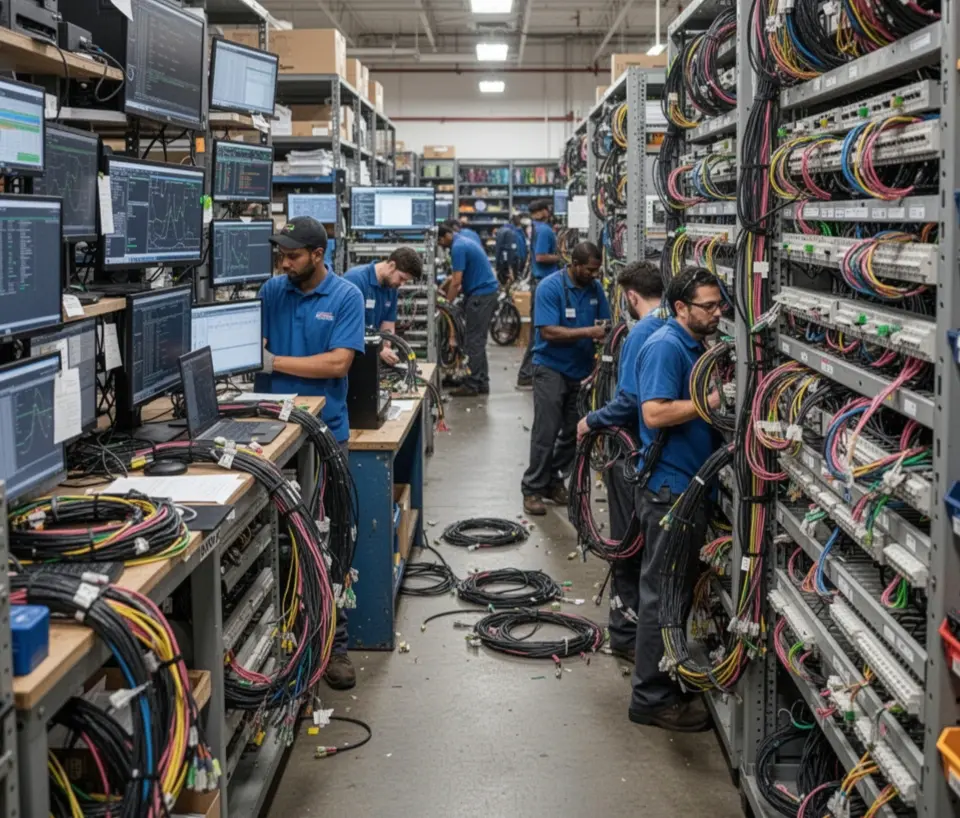
Manual BOM recreation from OEM PDFs swallows hours during peak season. Every PDF table that needs cleaning, every ambiguous description that must be interpreted differently. Missing terminals, vague tape notes, or ambiguous cable lengths generate clarification cycles. Those back-and-forths push an otherwise doable quote into a backlog that grows faster than you can hire your way out of.
Kory Ewell at KCM Cable was spending 18 hours on a single complex cable assembly quote because of this exact problem. After switching to Cableteque, that same quote takes 45 minutes. A 96% time saving on one quote alone.
Your best estimators disappear into parts lists
The PDF recreation step forces experienced staff to match parts, hunt alternates, and confirm packaging. This causes three immediate operational effects: the estimator workload shifts away from engineering judgment, sourcing cycles lengthen, and institutional knowledge becomes trapped in email chains.
- Estimators spend time matching vague descriptions to MPNs, which delays pricing decisions.
- Procurement questions multiply because distributor availability is not known at the quoting moment.
- Tribal rules about alternates and reel versus loose-piece parts are applied inconsistently, creating rework.
More than 50% of manufacturers depend heavily on engineer or tribal knowledge for quoting, which means the backlog risk is concentrated in one or two people. When they are unavailable, the queue stops moving entirely (WHMA).
Labor estimates become guesswork
Historical labor templates remain incomplete because time-consuming BOM recreation removed the chance to validate operation counts against actual parts. Estimators resort to rules of thumb for termination operations, splices, and breakout counts. Those rules of thumb vary by estimator, so quoted labor hours diverge from shop reality.
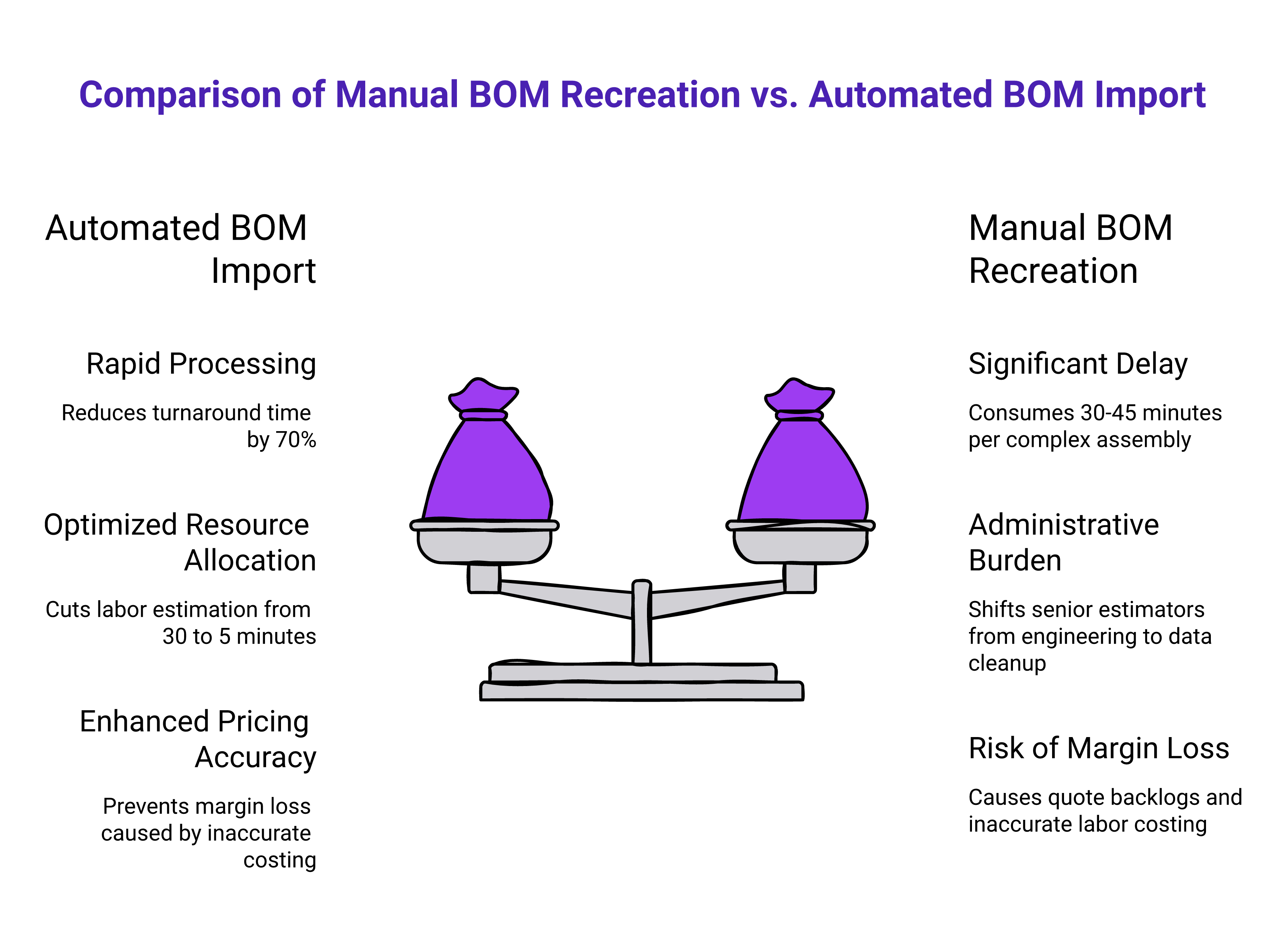
Because the estimator was tied up in parts matching, they cannot cross-check labor with production records on the spot. The absence of real-time component choices and topology-aware length calculations means labor becomes a guessing game. Cableteque customers report labor estimation moving from 30 minutes to roughly five minutes per quote when the BOM is imported and analyzed automatically.
Margin evaporates when quotes miss the mark
Inaccurate labor plus wrong parts equals wrong price. When a quote underestimates termination operations, the shop either eats the cost or raises a change order mid-build. When a quote overprices, the company loses the job. Industry evidence suggests a week of delay can cut win rates by 10 to 30%, and a slow quote is often treated like a no-show by OEMs.
Kelly Grato at Resco Electronics lived this reality. During busy periods, their quote queue stretched to 30 days. Customers could not wait that long and deals were lost before quotes were issued. After implementing Cableteque, turnaround dropped to 2 to 3 days even during peak season. Resco has already won new business directly because they could respond faster than competitors. Read the full Resco story.
The hiring wall
The process so far scales only by adding people because each manual step multiplies work. Backlogs push a shop to advertise for more estimators, only to discover that training a new estimator takes six to twelve months. Hiring increases fixed cost while not guaranteeing consistent quoting quality. You can buy capacity, but you cannot buy the years of judgment that come from on-the-job exposure.
This is where most shops get stuck. The WHMA survey shows 73.81% of manufacturers describe quoting as manual and time-intensive. When headcount is the only lever left, the company either accepts blown margins or stalls growth.
What automation actually changes
| Stage |
Before automation |
After automation |
| BOM creation |
30 to 45 minutes of manual transcription per assembly |
Under 2 minutes via AI-powered extraction |
| Component sourcing |
3 to 7 days to gather distributor quotes |
Minutes via real-time distributor APIs |
| Labor estimation |
Inconsistent estimator-based guesses |
Template-driven, history-backed estimates |
| Quote capacity |
Limited by estimator headcount |
Up to 5x without adding headcount |
Automation replaces manual extraction, part-matching, and labor guessing with deterministic processes. When a system imports the OEM PDF and maps descriptions to MPNs, the estimator reviews instead of retypes. When distributor APIs return contract pricing and availability in real time, sourcing is no longer a days-long task. These changes free senior staff to focus on design validation and negotiated exceptions, not table entry.
Derrick Lang, with 30 years in wire harness manufacturing, cut turnaround by 70% and increased quoting capacity 5x without adding a single person to his estimating team. His words: "I can quote these things faster than any of my competitors that are not on Cableteque." Read the full story.
Backlogs disappear because each RFQ now takes minutes instead of days. Win rates improve because accuracy and response time both rise. The shop that once lost opportunities to slow quoting now uses speed and accuracy as its competitive edge. See how Cableteque works.
Key takeaways
- Automate PDF-to-BOM extraction to remove the single biggest time sink and preserve estimator judgment for work that actually needs it.
- Capture component availability and contract pricing in real time to stop sourcing from delaying quotes by days.
- Use historical production data to convert labor templates from guesses into predictable operation counts.
- Replace hiring as the scaling strategy with automation that delivers up to 5x quoting capacity without adding headcount.
FAQ
How quickly can a shop see improvements after automating BOM extraction?
Early wins appear within days for simple assemblies and weeks for broader process adoption. Systems that import OEM PDFs can cut BOM recreation from 30 to 45 minutes to under two minutes on average, so the first set of RFQs you process will already be faster. Full rollout for labor templates and vendor integrations typically completes within one to eight weeks depending on AVL and contract pricing complexity.
Will automation force estimators out of a job?
No. Estimators shift from data entry to exception handling and commercial decision-making. Automation removes repetitive work and surfaces anomalies that require expert judgment. This raises the value of senior estimators because they spend time validating difficult alternates, setting margins for risky builds, and coaching newer staff on complex connector logic.
How do real-time distributor APIs affect quote accuracy?
They replace stale price lists and manual RFQs with instant availability and contract pricing, reducing procurement errors and late surcharges. That lowers build-time surprises and improves margin. If your shop uses negotiated rates or bonded stock, an API-based approach ensures the quote reflects those realities at the time of pricing.
What happens to tribal knowledge when quoting is automated?
Good automation codifies tribal rules into configurable templates and part conversion logic, so decisions like terminal packaging or approved alternates apply consistently. That reduces key-person risk and speeds onboarding because new estimators follow the same applied rules the seniors used to hold in their heads.
What is the typical ROI timeline for implementing a wire harness quoting automation platform?
Most shops see payback within three to six months from labor savings alone. A shop processing 600 quotes annually can save roughly $441,000 in labor costs based on 600 quotes multiplied by 21 hours saved per quote at a $35 loaded hourly rate. Add improved win rates from faster response times and the ROI accelerates further.
How does automation handle complex or non-standard assemblies?
Automation handles the routine 80% of work including standard connectors, wire gauges, and termination operations, so estimators can focus on the 20% that requires judgment. Manual override capabilities let you adjust labor, sourcing, or pricing for edge cases. This hybrid approach preserves flexibility while eliminating the bottleneck on standard work.
References
"WHMA Wire Harness Industry Survey Data." Wire Harness Manufacturers Association.
"Accelerating Wire Harness Design, Quoting, and Manufacturing with Digital Thread Integration." Wiring Harness News, April 2026.
"Cableteque Launches Quoteque: Revolutionizing Wire Harness Design, Sourcing, and Quoting." Wiring Harness News.