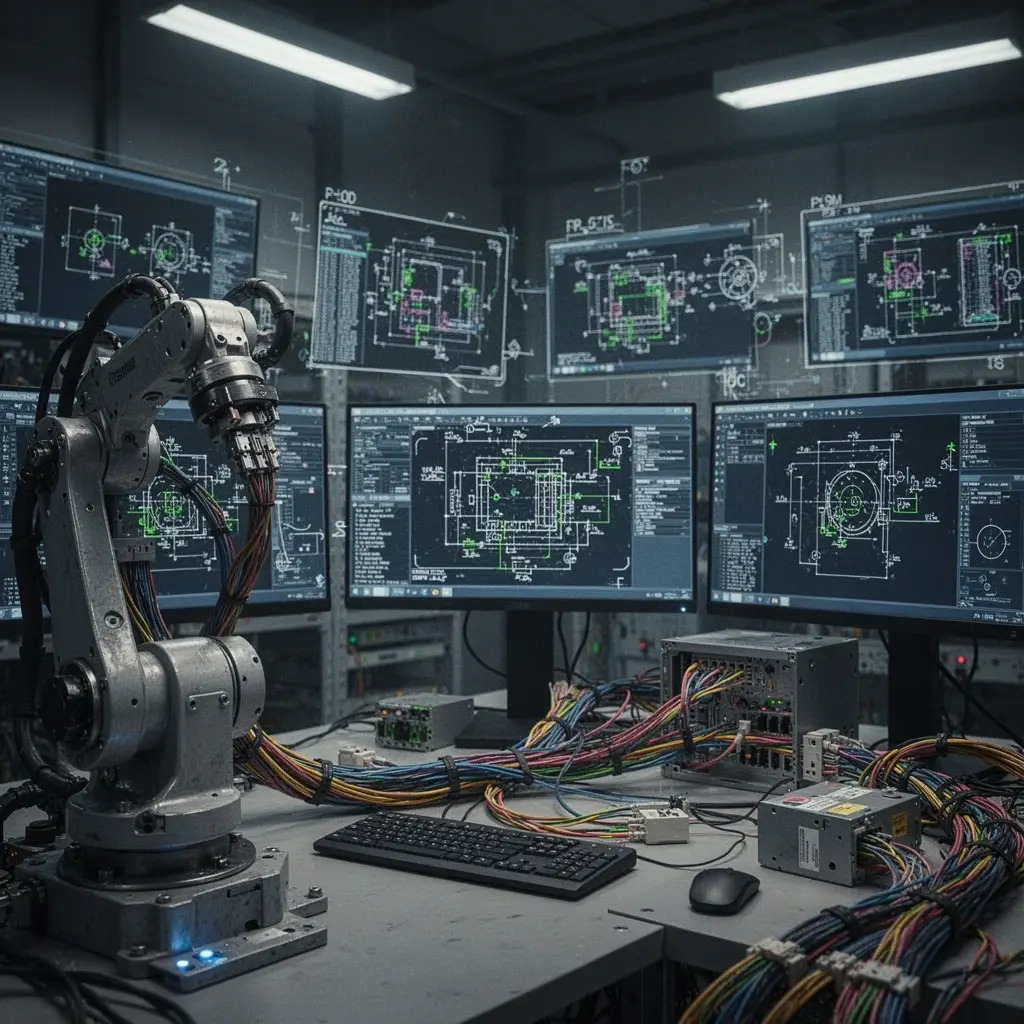
Automated BOM extraction reads a wire harness drawing package (BOM tables, connector tables, wire lists, notes and callouts) and turns it into a quote-ready bill of materials. In Cableteque, an estimator uploads the customer's drawing as received (PDF, scanned print, Excel, or a CAD export) and gets a quoting BOM in minutes, with likely-missing terminals, seals and cavity plugs flagged for review. KCM Cable cut one complex quote from 18 hours to 45 minutes.
For a short, step-by-step version, see How do I build a BOM from a customer's wire harness drawing faster?
If you've ever stared at a PDF drawing package at 4:50 on a Friday and tried to turn it into a clean BOM before the customer's deadline, you know where the time goes. Wire harness quoting lives or dies on what gets pulled out of those drawings, and the messy parts are always the ones that cost the most time: notes, callouts, revision blocks, alternates, and part numbers that don't match the customer's language.
Automated BOM extraction from PDF drawings is built to fix that bottleneck. It reads the drawing set, pulls out the usable parts data, normalizes it, and hands the estimator something they can source, price, and approve without rebuilding the job by hand. For contract manufacturers, that means fewer misses, fewer rework loops, and a faster path from RFQ to quote.
The old process is slow, manual, and easy to get wrong, which is exactly the gap Cableteque was built to close. A quote that used to take 7 to 10 days can come down to about 30 minutes when BOM extraction, part mapping, sourcing, and labor logic all move together instead of passing through separate manual steps.
What BOM Extraction from PDF Drawings Actually Means
BOM extraction from PDF drawings means turning a drawing package into structured quote data. The software separates tables, notes, connector callouts, wire instructions, alternates, and revision history, then converts all of it into a usable parts list for wire harness quoting.
That sounds simple until you open a real RFQ. A clean parts list is rare. What you usually get is a PDF with connector tables on one sheet, wire lengths on another, notes crammed into the margins, and a handful of customer part numbers that never match the supplier catalog. The WHMA survey on wire harness operations found that 73.81% of manufacturers still describe quoting as manual and time-intensive, and 57.14% named BOM completeness as one of their top challenges. Those numbers match what estimators run into every day.
Manual recreation is where the delay starts. Someone reads the drawing, retypes descriptions, checks cross-lists, guesses at shorthand, and chases down missing data. That builds key-person dependency, because one estimator's tribal knowledge becomes the only thing keeping the quote moving. In a wire harness assembly, one missed line item can change material cost, labor hours, and lead time all at once.
The work gets even less forgiving in aerospace, automotive, industrial, EV, and medical jobs, where standards like IPC/WHMA-A-620 and AS50881 shape what can be built, how it's inspected, and what has to be documented. A BOM extracted from PDF drawings has to hold up to that, or the quote is already shaky before sourcing even starts.
| What you see in the PDF |
What the extractor turns it into |
Why it matters for the quote |
| Connector tables and notes |
Structured part lines with quantities and references |
Removes manual retyping and missed items |
| Shorthand like "blk tape" |
Standard part name, e.g. black Tesa ¾" tape |
Improves sourcing accuracy and consistency |
| Customer part numbers |
Mapped MPNs and approved alternates |
Protects quote speed and buying confidence |
| Wire callouts and breakouts |
Wire lengths, terminations, and build logic |
Keeps labor and material estimates grounded |
How Automated BOM Extraction Works
It starts with an upload. An estimator drags one or several PDF drawings into the system, often alongside related files like BOM sheets, revision pages, or supporting notes. That one step removes the slowest part of quote prep: sorting documents before the actual extraction work can even begin.
Once the files are in, the software identifies tables, part descriptions, quantities, customer part numbers, and free-text notes. It doesn't just read text, it classifies what the text means. That distinction matters because a PDF drawing is full of mixed content, and a quote-ready BOM needs clean lines, not raw pages.
Next comes normalization. The system maps shorthand and shop-floor language to standard parts. It can convert something like "blk tape" into black Tesa ¾" tape, apply a rule like "loose piece terminal to reel," and map customer part numbers to MPNs without making the estimator rebuild every line by hand. Cableteque's guide to AI BOM creation from PDFs walks through how that part mapping becomes part of the quote itself, not a side task tacked on afterward.
Then rules take over where judgment matters. Approved alternates, part equivalencies, and source preferences can be set by customer, part, or product line, so the extractor follows the business rules your estimating team already uses instead of forcing everyone back into spreadsheets. A good extractor doesn't replace engineering judgment, it captures it and applies it faster.
From there, extraction ties into sourcing and manufacturing logic. The BOM isn't a frozen list, it moves directly into supplier pricing, availability checks, and the rest of the quote with less cleanup in between. In one customer case, Cableteque reports 96% time savings on a complex quote, with turnaround cut from 18 hours to 45 minutes.
Why Wire Harness BOMs Need More Than Basic OCR
Basic OCR reads characters. Wire harness quoting needs more than that. It needs connector compatibility, wire gauge logic, termination operations, cavity plugs, seals, protective covering requirements, and a way to read what a drawing implies when it doesn't spell everything out.
That's where wire-harness-specific software earns its keep. A harness topology tool can trace the drawing and calculate exact wire lengths straight from the PDF, which matters when breakouts, routing, and bundle paths affect both material usage and labor. Cableteque also applies connector compatibility rules to autopick missing terminals, cavity plugs, and seals based on the from-to list, wire gauge, and build context, rather than leaving an estimator to track those down manually.
Generic OCR tools tend to stop at transcription. That's not enough for aerospace or automotive work, where quoting touches design rule checks, compliance, and revision discipline. An engineering takeoff and procurement piece from Aginera makes a similar point in a different industry: the system has to classify the document, route it to the right extraction model, and flag anything that needs review before procurement can trust it. Wire harness quoting needs that same discipline, just tuned to harness-specific data.
The WHMA survey backs this up from the manufacturing side: only 9.52% of respondents described their quoting process as highly automated and scalable, and 83% said customer design errors affect production. That's why a real EWH quoting platform has to understand the work itself, not just parse the file type.
Cableteque's parts library holds more than 10 million parts, 2 million of them with full datasheet-level detail: what each part is, all of its attributes, what it works with, and the accessories and tooling that go with it. Live pricing and availability come separately, from your distributor API connections, inventory from your ERP, the Excel price lists you upload, and AI-processed supplier RFQs. That keeps the extracted BOM closer to a buildable quote and further from just a cleaned-up document.
From Extracted Data to a Quote-Ready Sourcing and Labor Plan
A quote-ready BOM has standardized part names, quantities, customer references, alternates, and source choices already attached. It's the version of the job sourcing can touch, labor can estimate against, and management can approve without three rounds of cleanup.
That's where quote turnaround time actually starts to change. BOM extraction from a PDF can drop from 30 to 45 minutes down to about 2 minutes. Material sourcing can move from 3 to 7 days down to minutes once real-time supplier data is already connected, pulling pricing straight from distributors like TTI, Heilind, Avnet, Arrow, DigiKey, Mouser, IEWC, and Anixter, using your negotiated rates rather than generic catalog pricing. Labor estimation can go from 30 minutes to 2 hours down to around 5 minutes, with the system auto-populating 50 to 70% of operation counts from the BOM and the estimator reviewing and adjusting the rest. Quote finalization itself can drop from 15 to 30 minutes down to about 5. Put together, that's how a process that used to take 7 to 10 days can land closer to 30 minutes.
The link between extraction and sourcing is what separates this from a plain document reader. When a customer part number is already mapped to the real part, the estimator doesn't have to guess. When an alternates rule is already stored, the buyer doesn't have to reopen the drawing for clarification. When the topology tool has already calculated lengths, the labor template starts from something real instead of a rough count.
What Improves When PDF BOM Extraction Is Automated
Turnaround gets shorter first. Manual BOM recreation can drop by up to 96%, which changes the pace of the whole quoting department. A job that used to sit in parsing and rekeying can move straight into review while the customer is still waiting on the first response.
Consistency improves next. Automated extraction cuts down on the small errors that compound into costly ones: cross-list mistakes, wrong part numbers, missed notes. Catching those on the first pass, instead of after a customer flags them, keeps senior engineers from spending their day cleaning up the same package twice.
Capacity changes after that. With only about 1 in 10 manufacturers describing their quoting as highly automated per WHMA's survey, most shops are still losing time to bottlenecks that feel normal simply because they're familiar. Automating extraction lets a team answer more RFQs without adding headcount, and it protects margin by cutting down on quotes that go out late or underpriced. Cost is still the real barrier for a lot of shops. 64.29% of WHMA survey respondents cited cost or budget constraints as the main reason they haven't adopted new quoting tools, which is exactly why the time and rework savings need to pencil out clearly before you buy.
If you're evaluating electrical wire harness quoting solutions, this is the real test: can the software read PDF drawings, extract the BOM, map the tribal knowledge that used to live in one person's head, connect to suppliers, estimate labor, and produce a quote fast enough to matter? If it can't do all of that together, it's just one more system in the room.
Where Cableteque Fits
Cableteque automatically extracts BOMs from OEM PDFs, applies part conversion rules, maps customer part numbers to MPNs, and flags gaps before they turn into sourcing problems. It also handles multi-assembly quotes and drag-and-drop file intake, which is where a lot of manual processes slow down on more complex jobs.
It was built for wire harness contract manufacturers specifically, not document automation in general, which is the difference that matters here. Generic extraction tools can read text. Cableteque also understands topology, connector compatibility, bundle logic, and labor templates tied to how harnesses actually get built, across automotive, aerospace, industrial, EV, medical, and machinery work.
If your team is still rebuilding BOMs line by line from PDF drawings, the cost is already visible: delayed RFQs, overloaded estimators, and quotes that land after the customer has moved on. See how Cableteque turns PDF drawings into a quote-ready BOM in minutes.
FAQ
What is automated BOM extraction in wire harness quoting?
It's the process of reading OEM PDF drawings and turning the content into a structured BOM an estimator can use directly. The software pulls out tables, notes, quantities, customer part numbers, and callouts, then normalizes them into usable line items, including connector data, wire gauges, alternates, and termination details. The real value isn't just speed, it's reducing rework before it ever reaches sourcing or labor estimation.
Why is PDF extraction harder for wire harness assemblies than for general parts?
A: Wire harness drawings mix tables, notes, routing data, and revision details in one package. The software has to understand connector compatibility, wire lengths, cavity plugs, seals, and terminology that shifts from customer to customer. Basic OCR can read text, but it can't tell whether a line is a part, a note, or a sourcing rule. That's why harness-specific logic matters.
Does the software replace human review of the BOM?
No, and it shouldn't. A good system flags ambiguous fields, duplicates, and missing information so an estimator can make a fast call. Human review still matters when a drawing is incomplete, a customer uses unusual naming, or a part needs an approved alternate. The difference is the estimator is checking exceptions instead of typing every line by hand.
How much time can automated BOM extraction actually save?
Cableteque reports BOM extraction dropping from 30 to 45 minutes down to about 2 minutes, with sourcing moving from days to minutes. Published customer results include 96% time savings on a complex quote and up to a 70% reduction in overall turnaround. The exact gain depends on drawing quality and how mature your process already is, but it's usually enough to change how many RFQs a team can realistically quote in a week.
Can extracted BOM data include alternates and customer part numbers?
Yes, and it should. A solid EWH quoting platform stores customer part numbers, maps them to MPNs, and keeps approved alternates tied to the right source rules. That cuts down on confusion when the drawing language doesn't match the supplier catalog, and it speeds up buying because the quote already carries the preferred part logic.
What should operations managers look for in electrical wire harness quoting solutions?
Look for a system built around the actual quote workflow, not just file parsing: it should handle PDF drawings, standardize the BOM, connect to live supplier data, estimate labor, and support compliance checks like IPC/WHMA-A-620. It should also fit into your existing process without forcing a full system replacement. If it doesn't reduce rework and improve quote turnaround time, it isn't solving the real problem.
1-1.png?width=190&height=34&name=logo-transparent%20(1)1-1.png)