A wire harness quote should not take a week to start, let alone finish. For most contract manufacturers, the real answer is hours, and for a disciplined quoting process, minutes are realistic when the BOM, labor, and sourcing steps run in parallel instead of waiting on one estimator to do everything by hand.
That matters because the old sequence is slow for reasons that do not change from job to job. Someone pulls a BOM from an OEM PDF, someone else cleans the part list, another person waits for distributor replies, and then a senior estimator checks the math. Industry data keeps saying the same thing in different ways. A recent WHMA survey found that 73.81% of manufacturers still describe quoting as manual and time-intensive, while only 9.52% say their process is highly automated. In the field, that shows up as lost RFQs, rushed pricing, and margin that disappears before the first build sheet is printed.
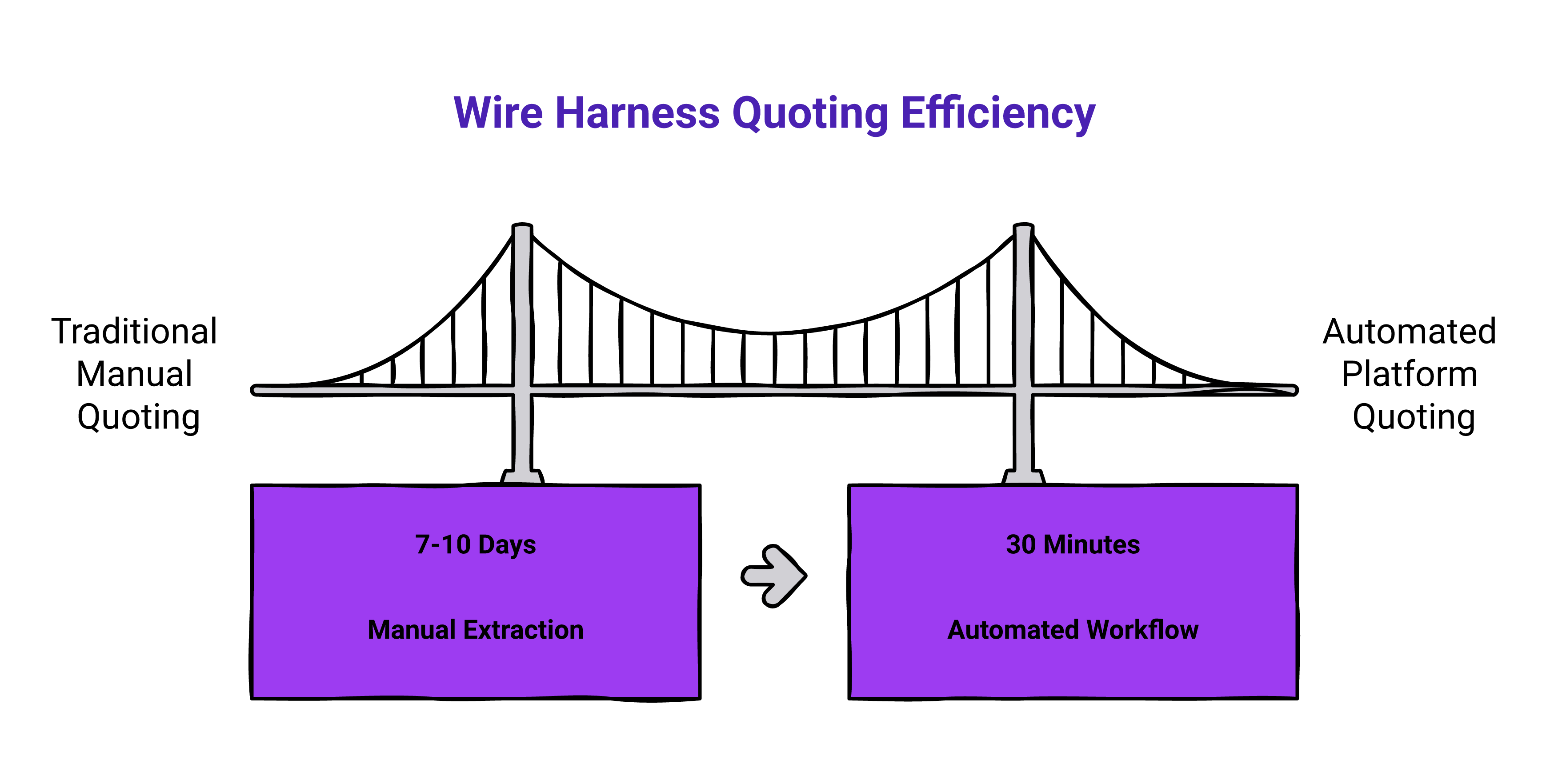
Cableteque was built for that gap. Its platform turns wire harness quoting from a 7-10 day chore into a 30-minute flow by extracting BOMs, checking part data, sourcing components in real time, estimating labor, and finalizing the quote in one place. That is the standard now if you want to stay responsive in the electrical wire harness industry.
Table of Contents
- How long quoting really takes
- Where the time goes
- What faster quoting changes
- A practical turnaround target
- Key Takeaways
- FAQ
- About Cableteque
How Long Wire Harness Quoting Really Takes
Seven to ten days is still common, but it is not a law of nature. It is the sum of handoffs, waiting, and rework. When you break the process into pieces, the delay becomes easy to see, and easier to fix.
A simple BOM extraction can take 30 to 45 minutes. A complex multi-assembly package can take a full day before the estimator even gets to pricing. Material sourcing then becomes the longest pause, often consuming 3 to 7 calendar days while distributors respond, alternates are checked, and missing details are clarified. Hooha Wire and Cable's guide on estimating wire harness assembly time reflects the same labor reality, because labor is only one part of the work, and it rarely sits alone.
The real issue is not the total number of minutes spent at a desk. It is the waiting between those minutes. A shop can move fast on extraction and still lose three days on sourcing. I have seen strong estimators spend 20 to 30 minutes per component on data entry for quotes that may never convert. That is how a quote pipeline gets clogged.
Where the Days Disappear
Material sourcing is the biggest bottleneck, and it is also the least forgiving one. If the distributor quote comes back late, the entire RFQ stalls. If a part number is wrong, the estimator starts over. If a connector table is incomplete, the labor template becomes guesswork.
There is a reason the industry keeps feeling this pain. In the WHMA survey of 42 contract manufacturers, 57.14% named BOM or design completeness as a top challenge, and 47.62% pointed to sourcing and materials difficulty. That lines up with what I have seen in estimating departments for years. The work is not hard because wire harnesses are mysterious. It is hard because every job contains part data, termination detail, wire length logic, and customer-specific exceptions that do not fit a generic ERP flow.
The cost shows up in lost response speed and in internal overhead. One week of delay can cut win rates by 10% to 30% when the customer is comparing multiple quotes, especially on build-to-print work where price and speed both matter. Cableteque's article on wire harness quoting lays out the same sequence from BOM extraction to quote finalization, and that sequence is where the waste lives.
A Better Turnaround Standard
Minutes to hours is the right target for most harness jobs. Days should be reserved for true edge cases, not for routine BOM handling, labor lookup, and distributor checks.
Cableteque's own implementation data shows what that standard looks like. BOM extraction can drop from 30 to 45 minutes to 2 minutes. Material sourcing can fall from 3 to 7 days to 2 minutes through real-time APIs. Labor estimation can move from 30 minutes to 2 hours down to about 5 minutes. Quote finalization can fall to another 5 minutes. That is why the platform can reduce turnaround time by up to 70% and, on complex quotes, by as much as 96%.
The broader business case is plain. Cableteque reports a 5x increase in quoting capacity without new hires. That matters more than most sales teams admit. If one estimator can process five times as many RFQs, the shop can answer more opportunities, protect senior engineering time, and avoid turning away work because the queue is full.
| Stage |
Manual time |
With Cableteque |
What changes |
| BOM extraction |
30 to 45 minutes, or longer for complex packages |
2 minutes |
PDF data moves into a usable BOM fast |
| Material sourcing |
3 to 7 calendar days |
2 minutes |
Distributor response delays drop out of the process |
| Labor estimation |
30 minutes to 2 hours |
5 minutes |
Templates carry estimator knowledge forward |
| Quote finalization |
15 to 30 minutes |
5 minutes |
Review and approval move faster |
What Faster Quoting Changes In The Shop
Speed changes the quote, but it also changes the team. When quoting is manual, senior engineers get pulled into repetitive data entry, corrections, and sourcing follow-ups. That is expensive labor used on low-value work. When automation handles the first pass, those same people can spend time on difficult builds, exceptions, and customer-facing problem solving.
There is also a real error reduction benefit. Manual BOM transcription creates bad part numbers, missing alternates, and wrong descriptions. Cableteque's workflow flags missing information early, maps customer part numbers to MPNs, and applies part conversion rules such as loose piece terminal to reel. That is not a convenience feature. It is how a shop avoids quoting the wrong component, then discovering the mistake after the customer has already issued a purchase order.
The WHMA survey gives this some extra weight. 83% of manufacturers said customer design errors affect production at least sometimes, and 64% said they would join WHMA-backed evaluation programs for new tools. That tells me the market knows the problem is real. It also tells me the market is ready for tools that fit how harness work actually gets done.
How Cableteque reduces a 10-day quote cycle to 30 minutes explains the same flow in more operational detail, including BOM extraction, sourcing, labor estimation, and quote finalization. The point is simple. If your quoting process still depends on one person sitting on a queue of PDFs, you are leaving capacity on the table.
Key Takeaways
- Aim for quote turnaround in hours, and push routine jobs toward minutes.
- Treat sourcing as a workflow problem, not just a purchasing task.
- Use automation to cut BOM transcription errors before they reach pricing.
- Protect senior estimator time for exceptions, not repetitive entry.
- Measure quoting speed as a revenue issue, because slow responses lose RFQs.
FAQ
Q: How long should a wire harness quote take?
A: For routine work, the target should be hours, not days. A simple package can move quickly if the BOM is complete and sourcing is automated. Complex multi-assembly jobs may need more review, but they should still move far faster than a week-long manual cycle. The key is removing waiting time between steps.
Q: Why do wire harness quotes still take 7-10 days?
A: Most of that time is spent on manual BOM extraction, sourcing delays, and internal review loops. The estimator is often waiting on responses instead of actively moving the quote forward. When one step cannot start until the previous one ends, the timeline stretches fast. That is why the process feels slower than the actual hands-on work.
Q: What part of quoting takes the longest?
A: Material sourcing usually takes the longest, often 3 to 7 days. Distributor responses, alternate part checks, and missing data add delay. In practice, the sourcing step becomes the bottleneck even when extraction and labor estimation are handled well. This is where real-time pricing and supplier data make the biggest difference.
Q: Can automation really cut quoting time that much?
A: Yes, if it handles the full chain instead of only one piece. Cableteque reports BOM extraction dropping to 2 minutes, sourcing to 2 minutes, and labor estimation to about 5 minutes. Those numbers matter because they remove the largest manual waits. The result is a quote cycle measured in minutes to hours.
Q: What is the business cost of slow quoting?
A: Slow quoting lowers win rates, creates margin pressure, and keeps senior people busy on low-value work. A late quote often means the RFQ is already gone when it finally lands. In a competitive market, speed is part of pricing power. The faster response usually gets reviewed first.
About Cableteque
Cableteque combines over three decades of hands-on industry expertise with a commitment to innovation in wire harness software. Founded by Arik Vrobel, our team brings together engineers, operators, and business leaders who deeply understand the challenges related to wire harnesses.
We focus on solving the toughest problems across the entire design-through-manufacturing lifecycle, helping teams work smarter, faster, and with greater precision.
Our company thrives on innovation, inclusivity, and collaboration. We value individuality, sustainability, and making a positive impact, building trust and shared success every step of the way. We are the only company creating software designed by wire harness people, for wire harness people. Our goal is to simplify communication between OEMs and contract manufacturers, improve operations, and help businesses grow.
Cableteque isn't just a tool; it's an evolving platform built to support engineers, supply chain specialists, sales teams, and manufacturing professionals in doing their best work.
If a quote still takes a week in your shop, what would it mean to get that same package out in 30 minutes?
1-1.png?width=190&height=34&name=logo-transparent%20(1)1-1.png)