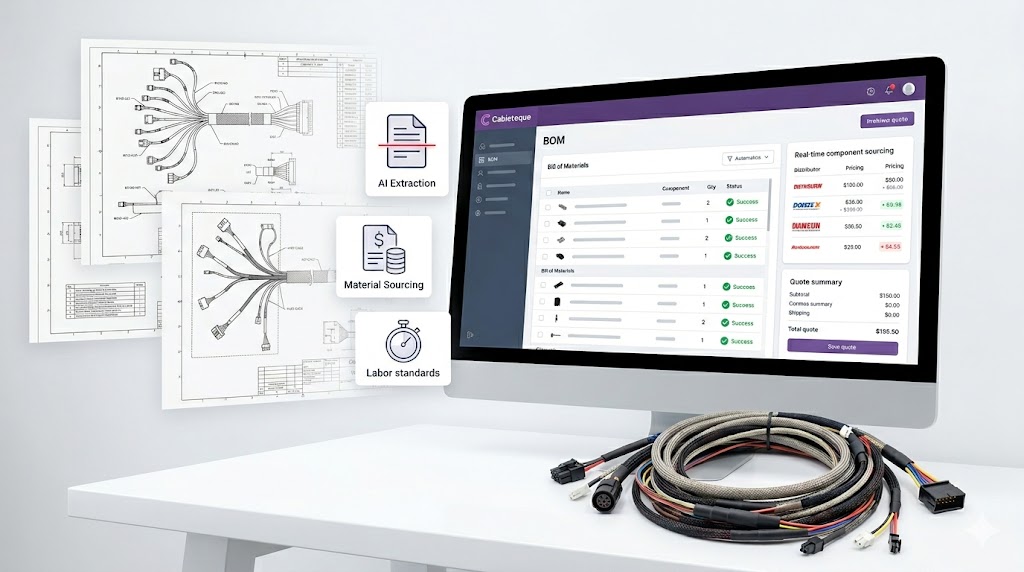
Wire harness quoting is one of the most technically demanding quoting processes in contract manufacturing. A single RFQ can involve dozens of custom assemblies, hundreds of components, specialized labor operations, and supplier coordination across multiple distributors. All of it time sensitive. All of it consequential if it goes wrong.
Most manufacturers are doing this with some combination of spreadsheets, email, and institutional knowledge held by one or two experienced people. It works, until it doesn't.
This page is a reference for anyone who wants to understand how wire harness quoting actually works: what the process involves, where shops typically struggle, what the numbers look like across the industry, what tools exist and what each one is built for, and how to tell whether your current process is holding you back.
If you already know you have a problem and want to understand what fixing it looks like, the ebook How to Cut Quote Turnaround Time to 1 to 3 Days goes deeper on that specific question.
What makes wire harness quoting different
Wire harness quoting is not like quoting sheet metal, machined parts, or PCB assemblies. It has a specific set of characteristics that make it harder, slower, and more error-prone when you try to handle it with general-purpose tools.
Every quote is custom.
Wire harnesses are built to a customer's specific design. There are no off-the-shelf configurations. Every RFQ requires reading a unique drawing and building a quote from scratch.
The drawings are PDFs.
Around 90% of customer RFQs arrive as PDF drawings: schematics, wire lists, connector tables, routing diagrams. Most quoting tools in adjacent industries are built around structured CAD data. Wire harness quoting starts with an unstructured document that a human has to read and interpret. This is one of the core reasons generic quoting tools fall short for wire harness manufacturers, they were never designed to work with the documents your customers actually send.
Wire is not a discrete component.
Wire and cable are sold by length: foot, meter, spool, reel. Generic electronics quoting tools are built around discrete parts with fixed unit pricing. They cannot handle wire correctly without manual unit conversion, which is tedious, slow, and error prone.
Labor is complex and operation specific.
Building a wire harness involves dozens of distinct operations: cutting, stripping, crimping, inserting, routing, terminating, overmolding, and more. Each operation has its own time standard. Labor estimation requires counting every operation from the drawing and applying the right time to each one. This is not the same as PCBA labor estimation, and tools built for circuit boards cannot do it properly.
Missing components are the norm.
Customer drawings rarely show everything that goes into a harness. Cavity plugs, backshells, heat shrink, labels, and cable ties almost never appear on the drawing, but they are real costs. Knowing what to add requires experience. Only estimators who have built harnesses know what is typically missing from a given connector family or specification.
The supplier landscape is specialized.
Wire harness components are sourced from a specific set of distributors: companies like TTI, Heilind, IEWC, Anixter, and others who specialize in wire, connector, and harness components. Pricing is negotiated, not catalog. A quote built on generic market pricing will not reflect your actual landed cost.
These characteristics mean that almost every general purpose quoting tool, whether it is a search aggregator, a PCBA quoting platform, or a standard ERP module, requires significant workarounds to use for wire harness quoting. Some manufacturers spend more time fighting the tool than they would just doing it manually. If that sounds familiar, you are not alone.
The five stages of a wire harness quote
A wire harness quote moves through five distinct stages, each with its own time requirement and failure mode.
Stage 1: BOM extraction
The quoter reads the customer's PDF drawing and transcribes every part number, quantity, length, and specification into a spreadsheet. For a straightforward assembly this takes 30 to 45 minutes. For a large package with multiple assemblies, it can consume most of a working day.
This step is entirely manual in most shops. It is also where data entry errors enter the process. A transposed part number or an incorrect length can create pricing errors that surface later in production, when they are much more expensive to fix. It is one of the most common and costly quoting mistakes wire harness manufacturers make, not because estimators are careless, but because manual transcription at volume is inherently error-prone.
Stage 2: BOM completion
Customer drawings do not show everything needed to build the harness. The estimator has to identify every component not listed on the drawing: cavity plugs, backshells, heat shrink, ties, labels, seals, and add them to the BOM before pricing can begin.
This step requires genuine expertise. There is no shortcut for someone who does not know the product well. A junior estimator can take hours researching what should go in here. An experienced one knows it from memory. This is one of the main reasons training new estimators takes six to twelve months before they can work independently, and it is exactly the kind of tribal knowledge that puts wire harness businesses at risk when a senior person leaves.
Cableteque's free tooling search tool can help speed this up, you can look up tooling requirements by part number without needing an account, which saves time when you are trying to identify what a connector family needs before the quote goes out.
Stage 3: Material sourcing
Once the BOM is complete, every component needs a price. The traditional approach is to email RFQs to one to five distributors per component, then wait for responses. Distributors typically take one to three days to respond, sometimes longer. The quoter then compares pricing across suppliers, checks availability and lead times, follows up on non responses, and updates their spreadsheet with the best offer for each line item.
This waiting period is where most of the elapsed time in a wire harness quote goes. The work itself is not complicated, but it cannot move forward until the distributor responses come back. Material sourcing alone typically accounts for three to seven calendar days of a quote cycle. That single bottleneck is why so many shops are losing winnable deals before their quote even goes out.
Stage 4: Labor estimation
The estimator counts operations from the drawing: every cut, strip, crimp, insert, and route, and applies the shop's time standards to calculate total assembly hours. This takes 30 minutes to two hours depending on assembly complexity.
Labor estimation is where institutional knowledge is most concentrated. Most shops do not have documented time standards that a newer estimator can follow. The numbers exist in the senior estimator's head, built from years of experience on the shop floor. When that person leaves, the accuracy of labor estimates tends to degrade until someone else builds up the same experience base. This is one of the most underestimated operational risks in wire harness manufacturing, and it is a risk that gets harder to manage the longer it goes unaddressed.
Stage 5: Quote finalization
The estimator aggregates material and labor costs, adds excess costs like tooling, testing, and tariffs, applies margin, formats the quote to the customer's preferred format, and sends it. This typically takes 15 to 30 minutes.
It is the shortest stage, but it arrives after a process that has already consumed days or weeks.
Total elapsed time across all five stages in most shops: one to three weeks. For a detailed look at what each stage looks like before and after automation, the wire harness quoting automation guide walks through it step by step.
Where shops typically struggle
Every stage of the quoting process has a characteristic failure mode. Understanding which ones apply to your operation is the starting point for fixing them.
Bottleneck at BOM extraction.
When your estimators are spending the first hour of every quote manually transcribing data from a PDF, they are doing work that does not require their expertise. This is a capacity problem that shows up as a speed problem. AI powered BOM extraction is the most direct fix for this specific bottleneck.
Bottleneck at material sourcing.
When your turnaround time is measured in weeks, material sourcing is almost always the reason. Three to seven days of waiting on distributor email responses is baked into the process, and there is no way to shortcut it without changing how you source.
Dependency on one or two people.
Most wire harness quoting operations run through a very small number of experienced estimators. When those people are busy, quotes queue up. When they are out, the pipeline stops. When they leave, the operation is in crisis. This is the most common structural problem in wire harness quoting, and it is one of the hardest to solve without changing the process itself. The existential risk that quoting dependency creates is worth reading if this describes your shop.
Labor estimation variability.
When labor estimates live in someone's head rather than documented standards, two estimators quoting the same assembly will get different numbers. That variability creates inconsistent margins and makes it harder to understand whether a job was profitable after the fact.
Underdocumented missing components.
If BOM completion relies entirely on the estimator's memory of what each connector family needs, every quote is only as good as that estimator's knowledge on that day. Errors here are particularly costly because they surface in production rather than in the quote. Tribal knowledge in wire harness quoting covers this problem in depth.
Using the wrong tool.
Many shops have tried general purpose quoting tools and found them slower than Excel for wire harness work. The unit of measure problems with wire, the lack of PDF extraction capability, the absence of harness specific labor logic: these are not configuration problems. They are fundamental design issues that cannot be fixed with workarounds. Why wire harness quoting requires purpose built intelligence explains exactly why this happens and what to look for instead.
What the numbers look like across the industry
In a survey of 42 wire harness manufacturers conducted through the WHMA, the picture that emerged was consistent with what most people in the industry already know from experience, but the numbers put a finer point on it.
73% of respondents described their quoting process as manual and time intensive. 57% said it is dependent on engineer or tribal knowledge. Only 10% described it as highly automated and scalable.
When asked which areas would benefit most from innovation, the top answers were: validation of customer designs before manufacturing (52%), quoting accuracy and speed (40%), assembly work instructions (40%), and labor and cycle time estimation (38%). These are not separate problems. They are all symptoms of a quoting process that requires more human judgment and manual effort than it should.
On the tools side, 48% of respondents said they use in house Excel or Word based methods for design and documentation. 43% use AutoCAD or AutoCAD Electrical. Only 14% reported using any automated tools for sourcing and quoting. That means the vast majority of wire harness manufacturers are still running their quoting operation almost entirely on spreadsheets and email.
When asked about barriers to adopting new technology, the top answers were cost or budget constraints (64%), compatibility with existing systems (57%), and lack of internal resources (52%). These are real barriers, but they are worth weighing against the cost of the status quo. A shop that cannot get quotes out in under a week is leaving revenue on the table every month. Making the Decision to Transform Quoting is a practical guide for working through exactly that calculation.
The full research is available in The State of Wire Harness Operations, which covers digital maturity, tooling, quoting challenges, and where manufacturers see the most opportunity for improvement.
On turnaround time, the manufacturers operating at the leading edge of the industry are turning around standard packages in a matter of hours. Complex multi assembly packages in one to two days. Most shops sit at seven to fourteen days. Many hit three weeks or more during peak periods.
That gap has real consequences. Customers who send RFQs to multiple shops make decisions based on who responds first. A shop still waiting on distributor emails three days after an RFQ arrived is not in the conversation when another shop sent an accurate quote the same afternoon.
What tools exist, and what each one is built for
Understanding the tool landscape matters because using the wrong tool is genuinely worse than using Excel. Several categories are worth understanding.
Search aggregators (Octopart, Trustedparts, Findchips).
These are part search engines. They aggregate inventory data across hundreds of distributors and let you search for component availability and pricing. They are useful for engineers doing design research. They are not quoting tools. They use cached data that can be days or weeks out of date, they show list pricing rather than your negotiated rates, they cannot handle wire unit conversions, and they have no concept of BOM extraction, labor estimation, or quote finalization. Using them as a quoting tool means doing all of that manually anyway.
PCBA quoting platforms (CalcuQuote, Luminovo, Breadboard).
These tools were built for electronics manufacturing services quoting, primarily PCB assemblies and discrete components. They work well for the problem they were designed for. For wire harness quoting, they run into the same fundamental issues: no PDF extraction capability, wrong unit of measure handling for wire, no harness specific labor logic, and no concept of harness topology. Derrick Lang, a wire harness professional with 30 years of experience, tested these tools directly: "I would find I could quote it my old manual way in fifteen minutes, but if I use a PCBA tool, it took me forty five minutes. None of those tools really worked. At the end of the day, I found myself always gravitating back towards Excel." The full comparison between purpose built and general quoting tools is worth reading before you evaluate any platform.
Standard ERP quoting modules.
SAP, Oracle, and similar platforms have quoting functionality built for general manufacturing. They can store pricing, generate quote documents, and track opportunities. They cannot read PDF drawings, handle wire correctly, or estimate harness labor. They are workflow tools, not quoting intelligence tools. If you are currently trying to make an ERP module work for wire harness quoting, this comparison covers the gap in detail.
Purpose built wire harness quoting platforms.
This is a small category. A purpose built tool for wire harness quoting handles PDF extraction, wire unit conversions, harness specific labor estimation, real time distributor pricing at negotiated rates, and quote finalization in one workflow. It is designed around how harnesses are actually built and quoted, not adapted from an adjacent industry.
The decision between these categories is not really about features. It is about whether the tool understands the problem. A tool that does not understand wire as a continuous material, that cannot read a PDF drawing, and that has no harness labor logic will require more manual work than doing it without the tool.
How to tell whether your current process is holding you back
A few honest questions worth working through.
How long does a typical quote take from the moment the RFQ arrives to the moment the quote goes out? If the answer is measured in weeks rather than hours, you are slower than the manufacturers winning business on speed right now.
How many people in your shop can run a complete quote independently? If it is one or two, you have a fragile operation that one resignation can break.
What happens to the quote queue when your lead estimator is out for a week? If the answer is "it stops," that is a business continuity risk worth taking seriously.
Are your estimators working late or on weekends during busy periods? That is a sign the process is at capacity and will not scale without something changing. If that is where you are, how to win more contracts without working overtime is worth a read.
Have you lost an experienced estimator in the last two years, or are you worried about losing one? If so, the question of what happens to their knowledge when they leave is worth answering now rather than after the fact.
Do customers ever tell you your response time is too slow? That feedback is worth taking at face value. How to speed up your wire harness quoting process covers the practical steps for getting there.
If three or more of those land, the quoting process is likely your biggest operational constraint right now. Not hiring, not production capacity, not sales. Quoting.
What good looks like
The manufacturers operating at the leading edge of wire harness quoting share a few characteristics.
Their turnaround is measured in hours, not weeks. Standard packages go out the same day an RFQ arrives. Complex multi assembly packages take one to two days. They are never waiting on distributor emails.
Their process does not depend on one person. Multiple team members can run a complete quote. Labor standards are documented and consistent. If the senior estimator is out, the queue does not stop.
Their pricing reflects their actual costs. They are sourcing at negotiated rates, checking real time availability, and not settling for the first price that comes back. How to increase your quote win rates covers how accurate pricing directly connects to win rate.
Their estimators spend their time on judgment, not data entry. BOM extraction, unit conversion, and supplier follow up are handled by the system. The estimator focuses on the things that actually require experience: complex assemblies, unusual specifications, customer specific requirements.
Their institutional knowledge is in the system, not just in people's heads. When someone retires or moves on, the operation continues at the same standard.
These are not unreachable outcomes. Kelly Grato at Resco Electronics described what changed after implementing Cableteque: "Before Cableteque, a normal quote took at least five days, and when things got busy, the queue could mean waiting a month just for a quote. Now we have cut that time in half, and the backlog is gone, even during our busiest months. We have already won new business because we could respond faster."
Kory Ewell at KCM Cable saw a 96% reduction in time on complex quotes, from 18 hours down to 45 minutes: "From using it for a month, I feel more confident in the pricing because I can see the exact number. Customers have told us our pricing is more competitive."
Derrick Lang at Carr Manufacturing went from a week and a half turnaround down to two to three days and now handles five times the quote volume with the same team: "I can quote these things faster than any of my competitors that are not on Cableteque. I kinda feel bad for those guys. You better get on this software and catch up because I am gonna start taking your business."
These are not bigger shops or better funded shops. They are shops that recognized quoting as a competitive differentiator and treated it accordingly. If you want to understand the full decision process for making that change, Making the Decision to Transform Quoting walks through exactly that.
1-1.png?width=190&height=34&name=logo-transparent%20(1)1-1.png)