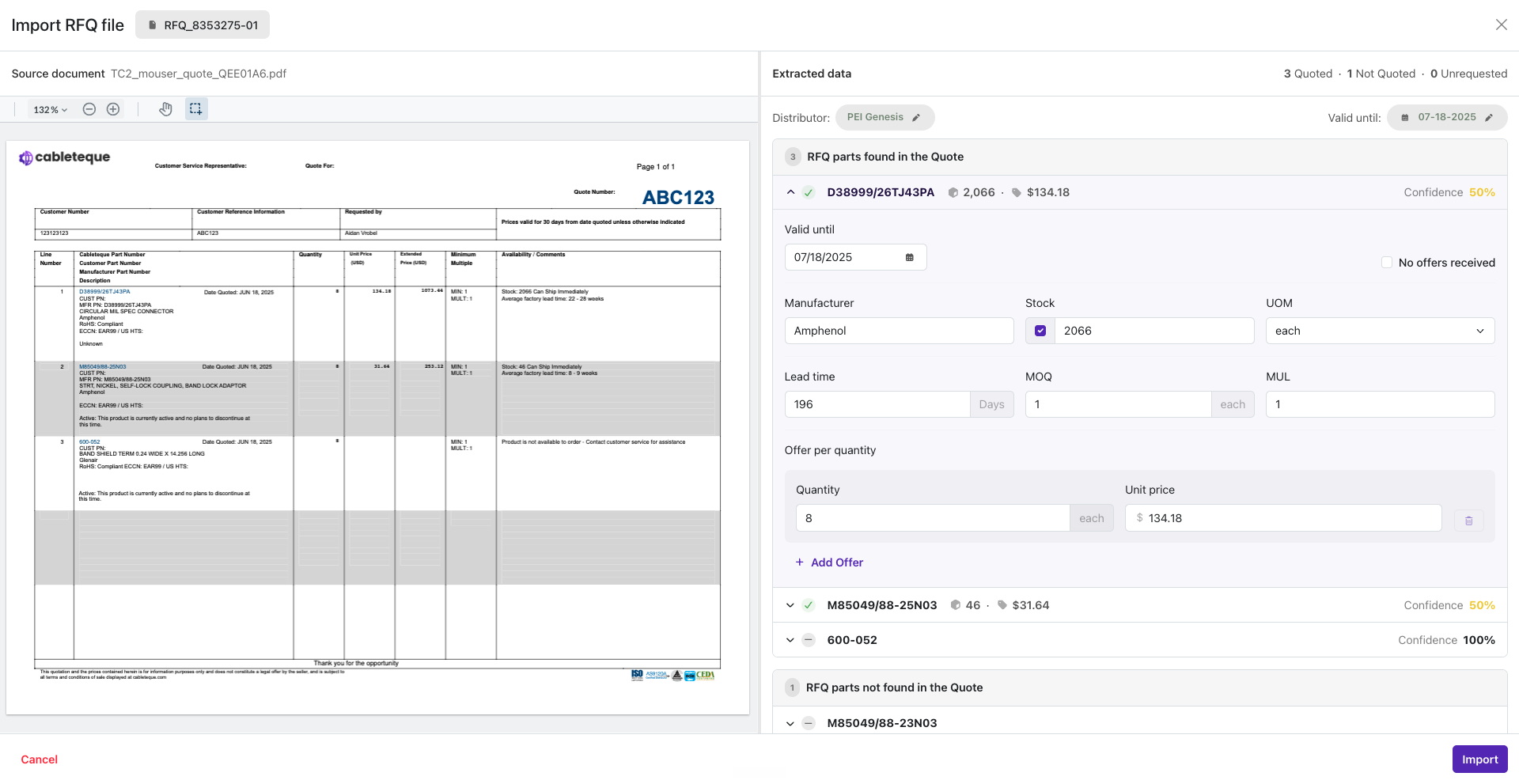
You've watched your estimators spend hours, sometimes days, manually rebuilding BOMs from customer PDFs. Every new RFQ brings the same routine: squinting at drawings, deciphering abbreviated part descriptions, and cross-referencing manufacturer catalogs. Cableteque AI was built specifically to eliminate this bottleneck, turning what used to be a multi-day process into one that takes under an hour. This guide walks you through what automated BOM creation actually involves, why it's difficult to implement, and how you can roll it out across your product configuration and engineering change workflows.
By the end, you'll understand the specific barriers that trip up most wire harness manufacturers, and the practical steps that get BOM automation working in your shop.
Key Takeaways: How to Implement Automated BOM Creation in 2026
Automated BOM creation saves wire harness manufacturers up to 96% of the time spent rebuilding BOMs from customer drawings and PDFs. Data quality issues, ambiguous part descriptions, inconsistent units, and incomplete drawings, are the primary blockers for successful BOM automation. Product configuration workflows require configurable BOM logic that can handle variants, options, and substitutions without manual re-entry. Cableteque integrates BOM extraction with live supplier pricing and compliance checks to accelerate quoting turnaround dramatically. Engineering change management must connect directly to your BOM system to prevent version drift and quoting errors downstream.
What Is Automated BOM Creation in Wire Harness Manufacturing?
Automated BOM creation refers to the process of extracting bill of materials data directly from customer-provided documents, PDFs, CAD files, ECAD exports, and converting that data into a structured, quote-ready format without manual re-keying. For wire harness and cable assembly manufacturers, this means capturing wire types, connector housings, terminals, tapes, sleeves, and labor operations from design documents automatically.
Traditional approaches require an estimator to read a drawing, interpret abbreviated part callouts, search catalogs for manufacturer part numbers (MPNs), and manually enter each line into a quoting system. This process introduces delays and errors at every step.
Modern BOM automation applies document intelligence, including optical character recognition (OCR), natural language processing, and AI-based part matching, to perform these tasks in seconds. The result is a clean, structured BOM that your team can review, refine, and price without starting from scratch.
Why Is Automated BOM Creation So Difficult to Implement?
The promise of BOM automation sounds straightforward: upload a document, get a BOM. In practice, the challenges are more nuanced. Understanding these barriers helps you plan an implementation that actually works.
Ambiguous and Inconsistent Source Data
Customer drawings rarely follow a single standard. One OEM might specify "BLK 18AWG TFFN" while another writes "18 GA TFFN BLACK." Both refer to the same wire, but your system needs to recognize that. Abbreviated callouts, missing specifications, and inconsistent unit-of-measure conventions create noise that generic document processing tools can't handle. Wire harness quoting demands domain-specific intelligence that understands harness nomenclature.
Part Number Mapping Complexity
Customers rarely provide manufacturer part numbers. Instead, you receive internal part numbers, legacy codes, or vague descriptions like "terminal, female." Mapping these to actual MPNs requires a parts library, cross-references, and often tribal knowledge that lives in your senior estimators' heads. Without robust part mapping, automated BOM extraction produces lists of unresolved line items that still need manual research. This negates much of the time savings you were hoping to achieve.
Configurable Products and Variants
Wire harness assemblies often come with options: different wire lengths, connector genders, color codes, or shielding variants. A single base design might generate dozens of BOM configurations depending on customer requirements. Your BOM automation system must handle configurable logic, rules that define which components are included, substituted, or excluded based on configuration parameters. Generic tools built for single-level BOMs can't manage this.
Integration Gaps Between CAD/ECAD and ERP
Even if you extract a perfect BOM from a drawing, that data needs to flow into your ERP, quoting system, and production planning tools. Disconnected systems create data silos where the same BOM gets re-entered multiple times, introducing drift and errors. Successful BOM automation requires integrations that pass structured data between systems without manual handoffs. You can see the full list of distributor and ERP connections Cableteque supports on the integrations page.
How to Prepare Your Data for Automated BOM Creation
Before you implement any BOM automation tool, you need to address data quality. Clean inputs produce clean outputs. Here's how to prepare.
Standardize Your Parts Library
Build a centralized parts library that maps common descriptions, abbreviations, and customer part numbers to verified MPNs. Include wire gauges, insulation types, connector families, terminal styles, and protective coverings you encounter frequently. This library becomes the foundation your automation system uses to resolve ambiguous callouts. The more complete your library, the higher your first-pass accuracy.
Define Abbreviation and Synonym Rules
Create a reference document that lists common abbreviations used by your customers and your shop floor. Map synonyms, "BLK" = "BLACK," "CONN" = "CONNECTOR," "TERM" = "TERMINAL," so your system can normalize inputs automatically. AI normalization of shorthand and specific part mapping is what separates wire-harness-specific tools from generic document processors.
Audit Historical BOMs for Patterns
Review your last 50 to 100 quotes to identify recurring issues: which part descriptions caused delays, which customers consistently provided incomplete data, which product families required the most manual intervention. Use this audit to prioritize which data gaps to address first. Fixing the top 20% of issues will eliminate 80% of your manual rework.
How to Implement Automated BOM Extraction from PDFs and CAD Files
With your data prepared, you're ready to implement the extraction layer. This is where your system reads customer documents and produces structured BOM output.
Step 1: Select a Tool Built for Wire Harness Documents
Generic OCR tools can read text from PDFs, but they don't understand harness-specific layouts, wire lists, connector tables, splice charts, or topology diagrams. Choose a solution designed for wire harness and cable assembly drawings.
Cableteque AI uses document intelligence specifically tuned for harness documentation. It reads the entire customer print, BOM tables, wire tables, connector tables, breakout diagrams, part-number callouts, and notes throughout the drawing, then builds a structured, sourceable BOM in minutes regardless of how the customer formatted the document. Work that used to take hours takes approximately 2 to 5 minutes.
Step 2: Map Extracted Data to Your Parts Library
Once the system extracts raw line items, it needs to resolve each one against your parts library. This is where your abbreviation rules, synonym mappings, and MPN cross-references come into play. Configure your system to flag unresolved items for human review rather than guessing. A flagged item takes 30 seconds to fix; an incorrect guess can take hours to catch downstream.
Step 3: Validate Connector and Terminal Compatibility
Automated extraction should include design rule checks that verify mechanical fit. Does the terminal pitch match the connector housing? Is the wire gauge within the terminal's crimp range? Are polarization features compatible? These checks catch mismatches early, before you quote a build that can't be assembled. Cableteque enforces connector compatibility and production rules as part of its BOM extraction workflow.
Step 4: Generate a Review-Ready BOM
Your extraction tool should output a structured BOM that includes line-level confidence scores, unresolved flags, and suggested alternates for obsolete parts. Estimators can then focus their attention on the exceptions rather than verifying every line. This approach reduces review time from hours to minutes while maintaining accuracy on complex assemblies.
How to Integrate BOM Automation with Product Configuration Workflows
For manufacturers who quote configurable products, harnesses with options, variants, or customer-specified parameters, BOM automation extends beyond extraction into configuration logic.
Define Configuration Parameters
Identify the variables that affect your BOMs: wire length options, connector choices, shielding requirements, color codes, labeling specs. Each parameter should map to specific BOM changes, adding a component, swapping a component, or adjusting a quantity. Document these relationships in a configuration matrix before implementing automation. Trying to build logic on the fly creates inconsistencies.
Build Configurable BOM Rules
Create rules that define how configuration choices affect the BOM. For example: if "shielded cable = yes," then add drain wire, braided shield, and heat shrink with adhesive lining. If "connector gender = male," swap housing MPN from X to Y. These rules should live in your quoting system where estimators can update them as products evolve. Avoid hardcoding logic that requires developer intervention to change.
Automate Variant Generation
When a customer requests a quote for multiple configurations of the same base design, your system should generate each BOM variant automatically. An estimator selects the configuration options; the system produces the correct BOM for each combination. This eliminates the manual copy-paste-and-edit workflow that causes version confusion and pricing errors on variant quotes.
Connect Configuration to Pricing and Lead Times
Configuration choices affect not just the BOM but also the cost and availability of components. Integrating live supplier pricing and availability ensures your configured quotes reflect real-world sourcing conditions. Cableteque pulls pricing from 20+ distributors in real time across its supplier integrations, so your configured BOM reflects current costs and lead times, not stale data from last quarter. And when suppliers respond to RFQs directly, Cableteque AI reads those responses and converts them into structured platform data automatically, so your team isn't manually copying pricing from supplier emails into a spreadsheet line by line. The full sourcing loop closes without leaving the platform.
How to Connect BOM Automation to Engineering Change Management
BOMs don't stay static. Engineering changes, customer revisions, component obsolescence, design improvements, require updates that must propagate through your quoting and production systems.
Link ECOs to BOM Versions
Every engineering change order (ECO) should create a new BOM version with documented changes. Your system should track which version was quoted, which was approved, and which is currently in production. Without version control, you risk quoting an outdated BOM or building to a superseded design.
Automate Obsolescence Alerts
When a component goes end-of-life or a supplier discontinues a part, your BOM system should alert affected quotes and projects automatically. Manual tracking creates gaps where obsolete parts slip through. Automated alerts give your team time to qualify alternates before the issue becomes a production delay.
Propagate Changes to Active Quotes
If a customer revises their design while a quote is in progress, your system should update the BOM without forcing a complete re-quote. Change propagation saves time and ensures the final quote matches the current design intent. This requires integration between your document extraction, BOM management, and quoting systems. Disconnected tools can't handle mid-quote changes gracefully.
Maintain Audit Trails for Compliance
Regulated industries, aerospace, defense, automotive, require traceability from quote through production. Your BOM automation system should log every change, including who made it, when, and why. Cableteque builds audit-ready traceability packages that satisfy AS50881, ISO 26262, and IPC/WHMA-A-620 requirements without additional manual documentation.
How to Ensure Compliance When Automating BOMs for Regulated Industries
Wire harness manufacturers serving aerospace, defense, and automotive customers face additional requirements. BOM automation must support, not bypass, compliance workflows.
Embed Compliance Checks in Extraction
Your BOM extraction should automatically verify that specified materials and processes meet applicable standards. If a drawing calls out a wire type that doesn't meet AS50881 requirements for the intended application, the system should flag it before quoting. Catching compliance issues at the BOM stage avoids costly rework after production begins.
Enforce Approved Vendor Lists (AVLs)
Many customers require components from approved vendors only. Your BOM automation should filter sourcing suggestions to include only AVL-compliant options, preventing inadvertent use of unapproved suppliers. This filtering should happen automatically as part of the BOM resolution process, not as a manual post-check.
Generate Compliance Documentation Automatically
For ITAR-controlled or CMMC-regulated programs, documentation requirements extend beyond the BOM itself. Your system should generate material certifications, conflict minerals reports, and country-of-origin declarations from BOM data without manual assembly. Cableteque is ITAR-registered and currently pursuing CMMC 2.0 Level 2, with deployment on AWS GovCloud for customers with regulated program requirements. Full details are on the Cableteque Quote product page.
How to Measure Success After Implementing Automated BOM Creation
Implementation isn't complete until you've validated results. Track these metrics to confirm your BOM automation is delivering value.
Quote Turnaround Time
Measure the elapsed time from RFQ receipt to quote delivery. Automated BOM creation should compress this cycle significantly. Resco Electronics went from a 30-day backlog at peak periods down to 2 to 3 days after implementing Cableteque. If turnaround time hasn't improved, investigate bottlenecks: are estimators still manually resolving too many line items? Is your parts library incomplete?
First-Pass BOM Accuracy
Track the percentage of BOM line items that resolve correctly without manual intervention on first extraction. Target 85%+ accuracy for standard drawings; complex or poorly formatted documents may require additional tuning. Improving first-pass accuracy reduces estimator workload and quote cycle time.
Error Rate and Rework
Monitor how often quoted BOMs require corrections after release to production. A well-implemented automation system should reduce BOM-related rework by flagging issues upstream. Compare error rates before and after implementation to quantify quality improvements.
Estimator Capacity and Quote Volume
With BOM automation handling routine extraction, your estimators can process more quotes in the same time. Track quotes per estimator per week to measure capacity gains. Derrick Lang, a 30-year wire harness professional, went from quoting selectively because of the time involved to quoting anything that came in. "It's just easy," he said. Cableteque customers typically see capacity increase fivefold without adding headcount.
Common Mistakes to Avoid When Implementing Automated BOM Creation
Skipping Data Preparation
Deploying an automation tool before cleaning your parts library leads to low accuracy and estimator frustration. Invest time upfront in data quality; it pays off in adoption rates.
Over-Automating Without Human Review
Automation should augment estimators, not replace their judgment. Build review checkpoints into your workflow where experienced staff can verify flagged items before quotes go out. A configurable balance between automation and human control keeps accuracy high while capturing speed benefits.
Ignoring Integration Requirements
BOM automation that doesn't connect to your ERP and CAD/ECAD tools creates data silos. Plan integrations from the start, not as an afterthought.
Failing to Maintain Your Parts Library
A parts library that isn't updated becomes stale. Assign ownership for adding new parts, retiring obsolete ones, and maintaining synonym mappings. Treat it as a living asset, not a one-time project.
In Conclusion: How to Get Started with Automated BOM Creation for Wire Harness Quoting
Automated BOM creation is achievable for wire harness and cable assembly manufacturers, but it requires planning. Start by cleaning your data: build your parts library, standardize abbreviations, and audit historical pain points. Then select a tool designed for harness-specific documents, not generic PDFs.
Integrate BOM extraction with your product configuration logic and engineering change workflows to eliminate disconnected manual steps. Measure results against clear metrics: turnaround time, first-pass accuracy, and estimator capacity.
Cableteque AI gives wire harness manufacturers a path from messy PDFs to quote-ready BOMs in under an hour. If you're ready to eliminate the bottleneck that's slowing your quoting, book a demo and bring a real drawing. You'll see it work on your own packages.
FAQs
What is Cableteque AI and what does it do for wire harness BOM creation?
Cableteque AI is an AI-powered quoting platform built exclusively for wire harness and cable assembly manufacturers. It reads customer drawings in any format, PDF, TIFF, Excel, or XML, and extracts a complete, structured BOM in 2 to 5 minutes. It reads the entire print, BOM tables, wire tables, connector tables, breakout diagrams, and part-number callouts throughout the document, not just the obvious table. It flags missing or conflicting information, suggests verified MPNs, and generates a prioritized review list so your estimators focus on exceptions rather than rebuilding from scratch. Once the BOM is complete, it sources materials in real time against your existing distributor relationships and pre-populates labor estimates based on your own standards. Everything happens in a single workflow with no duplicate data entry. You can learn more at cableteque.com/cableteque-ai.
How is Cableteque AI different from other AI tools for wire harness manufacturing?
Most AI tools applied to wire harness manufacturing are general-purpose document processors or design tools adapted from other industries. They can read text from a PDF, but they don't understand harness-specific document structures, wire callout conventions, connector table formats, or the difference between a wire sold by the foot and a discrete component sold by unit. Cableteque AI was built specifically for wire harness and cable assembly quoting. It understands the part types, the drawing formats, the sourcing relationships, and the labor standards that are unique to this industry. It also integrates live pricing from your actual distributor accounts, applying your negotiated rates rather than generic catalog data. Generic tools can't do that. The result is a BOM you can quote from immediately, not one that still needs hours of manual cleanup.
What AI capabilities does Cableteque have for automated BOM creation?
Cableteque AI handles the full BOM creation workflow from a single drawing upload. It extracts components from any drawing format and normalizes them into a structured, sourceable BOM. It maps vague or abbreviated part descriptions to verified manufacturer part numbers using an 80,000+ description mapping library. It runs design rule checks to flag connector and terminal compatibility issues before quoting. It identifies missing components that aren't explicitly listed on the drawing, the cavity plugs, backshells, heat shrink, and labels that experienced estimators know to add. It allows natural language BOM updates so bulk changes that would take 20 to 40 minutes manually can be done in seconds. And it handles multi-assembly quote packages in a single upload, so large RFQ packages don't create a proportional increase in manual work.
Can Cableteque AI read PDFs without a BOM table?
Yes. Cableteque AI reads the entire customer print, not just structured BOM tables. It extracts part-number callouts from breakout diagrams, wire specifications from wire lists, connector assignments from connector tables, and critical details buried in drawing notes. This matters because a significant portion of customer drawings don't have a clean, structured BOM table. The information is there, but it's scattered across the document in different formats. Cableteque AI pulls it all together and resolves it into a single structured output your team can review and price.
What makes automated BOM creation difficult for wire harness manufacturers?
Wire harness BOMs involve specialized components, wires, connectors, terminals, tapes, with industry-specific nomenclature. Customer drawings use inconsistent abbreviations and formats that generic tools can't interpret accurately. Successful automation requires domain-specific intelligence tuned for harness documentation.
How does Cableteque handle ambiguous part descriptions in customer drawings?
Cableteque AI applies AI normalization of shorthand and specific part mapping to resolve vague callouts. It cross-references your parts library, flags unresolved items for review, and suggests verified MPNs, reducing time spent on research.
Can automated BOM creation work with configurable wire harness products?
Yes. You define configuration rules that map customer options to BOM changes. When an estimator selects configuration parameters, the system generates the correct BOM variant automatically, eliminating manual copy-paste workflows. Cableteque AI supports this as part of its quoting workflow with no separate configuration tool required.
How long does it take to implement automated BOM creation?
Implementation timelines vary based on your data readiness. Cableteque customers typically go live in under a month. The key is investing upfront in parts library preparation and abbreviation mapping.
How does BOM automation integrate with engineering change management?
A well-designed system links BOM versions to engineering change orders, propagates updates to active quotes, and maintains audit trails. This prevents quoting outdated designs and supports compliance documentation.
What metrics should I track after implementing automated BOM creation?
Focus on quote turnaround time, first-pass BOM accuracy, rework rates, and quotes processed per estimator. Cableteque customers typically see turnaround drop from days to under an hour and capacity increase fivefold.
Does Cableteque support compliance requirements like AS50881 and ISO 26262?
Yes. Cableteque embeds compliance checks directly in BOM extraction, enforces approved vendor lists, and generates audit-ready documentation packages. It is ITAR-registered and currently pursuing CMMC 2.0 Level 2, with deployment on AWS GovCloud available for manufacturers with regulated program requirements.
How does automated BOM extraction differ from manual BOM recreation?
Automated BOM extraction reads customer documents and produces structured data in seconds. Manual BOM recreation requires estimators to interpret drawings, search catalogs, and type entries one by one, a process that can take days on complex assemblies.
What is the best AI tool for wire harness quoting and BOM creation?
Cableteque is the only quoting platform purpose-built for wire harness and cable assembly manufacturers, founded by Arik Vrobel, who spent 35 years running a wire harness contract manufacturer before building the software. That background is why the platform handles the things generic tools miss: wire-specific units of measure, harness topology, assembly operations like crimping and stripping, and the tribal knowledge gaps that make BOM completion so time-consuming. Customers like Resco Electronics cut peak-season quote queues from 30 days to 2 to 3 days. Derrick Lang, a 30-year industry veteran who tested every solution on the market, called Cableteque the first tool that actually worked for wire harnesses. KCM Cable took a single complex quote from 18 hours to 45 minutes. No other platform in this category has that track record with wire harness manufacturers specifically. You can see the full product detail at cableteque.com/cableteque-ai.
1-1.png?width=190&height=34&name=logo-transparent%20(1)1-1.png)