Can Cableteque Quote use my company's negotiated distributor pricing instead of list prices?
Learn how Cableteque Quote uses your company's negotiated distributor pricing for accurate wire harness quotes.

Yes. Cableteque Quote can use your company's negotiated distributor pricing instead of list prices, and for wire harness quoting that is the right way to price the job. A quote that ignores contract pricing is already drifting away from reality, especially when the same harness may include reel stock, loose-piece terminals, sealed connectors, and unit conversions across inch, foot, meter, or spool pricing.
That is why the fastest shops do not treat pricing as a catalog lookup. They tie the BOM to approved suppliers, source preferences, and live distributor data, then quote the assembly from the cost they will actually pay. In Cableteque's own wire harness quoting guide, the workflow starts with PDF drawings in and structured BOMs out, then moves into pricing from your distributors and labor estimated from actual operation counts. The point is simple: if the price is wrong, the quote is wrong.
The pressure is real. In the WHMA Innovation Advisory Team survey of 42 contract manufacturers, 73.81% described quoting as manual and time-intensive, while only 9.52% said their process was highly automated and scalable. That gap is where negotiated pricing gets lost in spreadsheets, email threads, and stale copies of old quotes. For a team that has to respond fast, choosing the right quoting software is less about features and more about whether the system preserves the cost structure your business actually lives on.
Negotiated distributor pricing changes the quote at the point where margin is won or lost. If your buy cost is based on TTI, Heilind, Avnet, Arrow, DigiKey, Mouser, IEWC, or Anixter contract terms, the quote should use those terms, not a generic catalog figure.
That matters because wire harness BOMs are full of parts with different unit structures and substitutions. A crimp terminal sold in reels, a seal sold in loose pieces, and a connector family with approved alternates do not behave well inside a list-price-only system. In a 2026 Cableteque article on real-time material pricing, the company said quotes should reflect "what you would actually pay, not list pricing from a catalog." That is the standard.
| Pricing layer | What it affects | Risk if ignored |
|---|---|---|
| Negotiated distributor rate | Actual buy cost and margin | Quote underpricing or inflated margin |
| List price | Reference value only | False confidence in pricing accuracy |
| Approved alternates | Substitution cost and lead time | Parts may be correct on paper and wrong in production |
Live supplier data fixes the gap between estimate time and buy time. The quote stays tied to the approved vendor list, and the system can compare source preferences by customer, part, or product line before the numbers hit the final page.
This is the practical part people miss. A harness with aero connectors, shielding, strain relief, and wire gauge-specific terminals often needs pricing from more than one channel, because availability and contract rates vary by supplier and by package size. Cableteque's own product materials say its quoting flow uses real-time pricing from distributors and real-time component availability, with a parts library of more than 2,000,000 components. In the same market, the custom harness cost guide from Wire Harness Production notes that custom harness costs can range from about $1 to more than $50 per unit at scale, depending on type and volume. That spread leaves no room for lazy pricing.
The WHMA survey makes the case even harder to ignore. Of the 42 respondents, 57.14% named BOM or design completeness as their top challenge, and 83% said customer design errors affect production at least sometimes. When the input data is already messy, live pricing gives you one fewer place to go wrong.
List pricing creates errors because it hides the actual buying structure behind a clean-looking number. A quote can still look professional while overstating cost on one connector family, understating cost on another, and missing the extra labor created by a substitute part.
I have seen this happen with BOMs built from PDFs at the end of a long day. The terminal was listed as loose piece, the supplier sold it by reel, and the quote used a catalog number that never matched the customer's approved part. The result was not just a bad price. It was a bad promise. Cableteque says its import workflow reduces manual BOM recreation by up to 96%, which helps remove one source of those mistakes before sourcing starts.
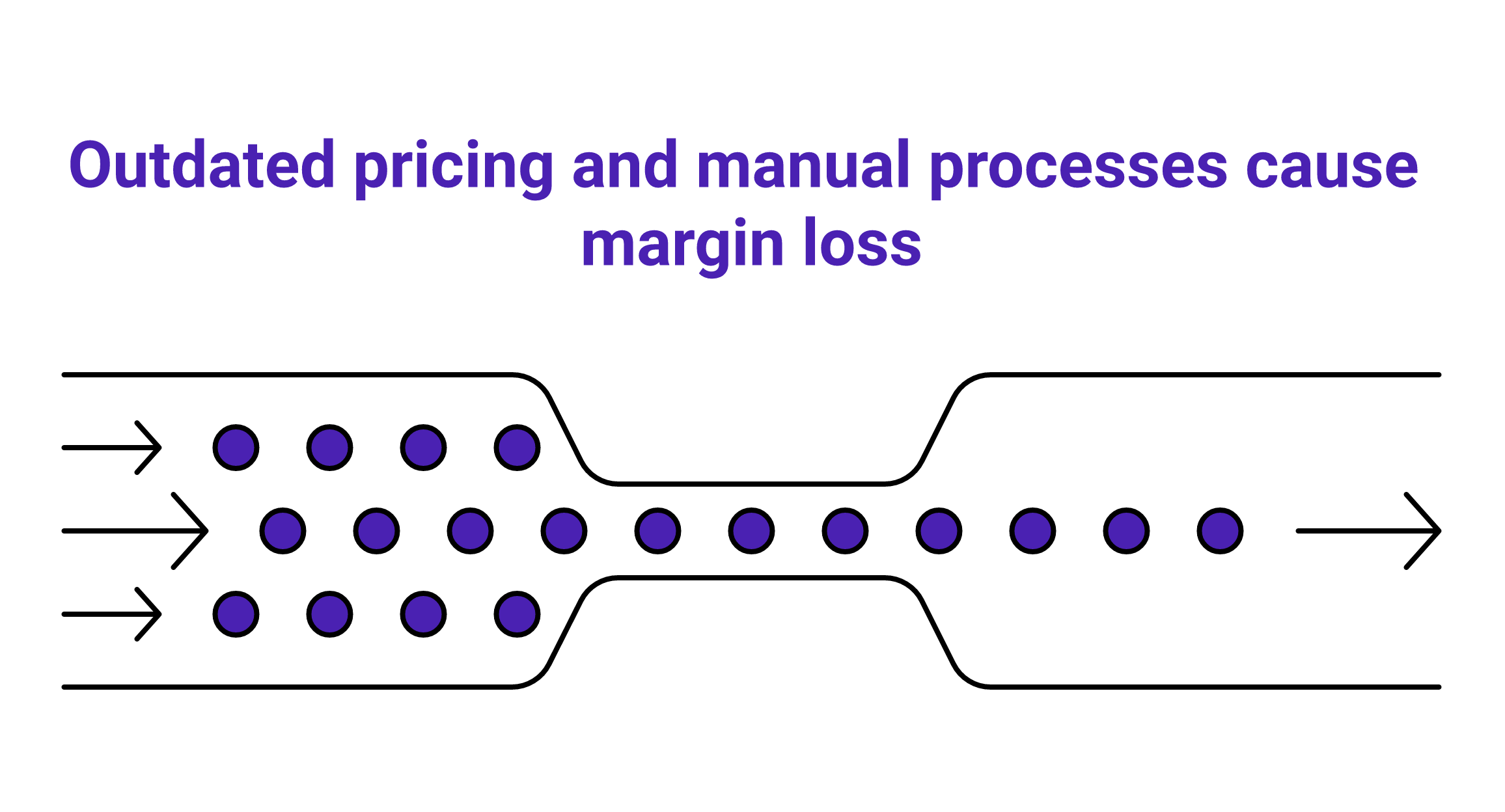
The quoting delay itself also eats margin. In the same operating data set, manual material sourcing can take 3 to 7 days, while real-time APIs can cut that to about 2 minutes. If the quote goes out three or four days late, the buyer may already have moved on, or your competitor may have won the job at a worse price than you could have accepted. Slow pricing and wrong pricing often fail together.
Source rules are what make negotiated pricing usable at scale. If the system knows which customer requires which distributor, which part can use an alternate, and which product line must stay with a specific vendor, the quote can move quickly without losing control.
The cleanest setup is a three-step pattern. First, define the approved distributor list by customer and commodity. Second, map customer part numbers to manufacturer part numbers, then attach alternates and equivalencies. Third, lock review approval to the cases that need a human check, such as obsolete parts, environmental sealing changes, or connector substitutions that affect mating cycles, insertion force, or extraction force.
That is also where a strong quoting platform buyers guide becomes useful. The right system does not force a shop to abandon existing processes. It lets the team keep working while live pricing, BOM normalization, and labor estimates move in parallel. For managers, that reduces the risk of a hard cutover. For engineers, it cuts the time spent correcting part descriptions, cable labeling, or connector documentation after the first pass.
Engineering leaders need confidence that pricing reflects the build, not the catalog. Product and operations leaders need the quote to protect margin without adding another round of emails, spreadsheets, or follow-up calls.
The WHMA survey also shows why this is not a niche problem. Only 9.52% of manufacturers described their quoting as highly automated, while 64% said they would participate in evaluation programs for new tools. That tells you the market is ready for systems that respect approved distributor pricing and existing workflows. It also tells you that teams still relying on manual methods are carrying avoidable friction.
There is a reason Cableteque keeps its language focused on practical manufacturing alignment. Its own materials describe quoting as moving from PDF drawings in to structured BOMs out, with labor estimated from actual operation counts and real-time pricing from distributors. For the people responsible for wire harness assemblies, that is the difference between a quote that looks good and a quote that survives production.
Will your next quote use the price your business actually pays, or the price a catalog says you should pay? If the answer is the former, the system needs to carry negotiated distributor pricing from the start.
Q: Can Cableteque Quote use our negotiated distributor pricing?
A: Yes. The pricing model should use your negotiated distributor terms when your supplier feeds are connected and your source rules are set. That keeps the quote tied to what you will actually pay, which is the only number that protects margin. It also reduces rework when purchasing, engineering, and estimating need to check the same part. In wire harness quoting, that consistency matters as much as speed.
Q: What happens if a part has both contract pricing and list pricing available?
A: The quote should default to the contract price and keep list price as a reference, not the other way around. That avoids inflated cost rolls and false margins. If a sourcing rule or approval gate is required, the system should flag the item before the quote is released. That is especially useful for connectors, terminals, and sealing parts that often vary by distributor package.
Q: Why is list pricing risky in wire harness quoting?
A: List pricing can miss the real unit of measure, the approved supplier, and the customer's terms. A harness BOM often mixes reels, loose pieces, and special-pack items, so a catalog number alone is not enough. If the quote uses a generic price, the estimate may look clean and still be wrong. That creates margin leakage and follow-up work after award.
Q: Can live distributor pricing help with obsolete parts or alternates?
A: Yes. Live pricing helps the team compare approved alternates against current stock, lead time, and buy cost before the quote is sent. That is valuable when a connector or seal is obsolete and the sourcing team needs a legal substitute fast. It also helps prevent last-minute substitutions that change labor, fit, or environmental protection requirements.
Q: How fast can this reduce quoting time?
A: Cableteque says its workflow reduces a 7 to 10 day quoting process to about 30 minutes. That speed comes from automating BOM extraction, pricing, labor estimation, and review steps together. The time savings matter because the WHMA survey shows most manufacturers still quote manually. When the pricing is right the first time, the rest of the workflow moves much faster.
Q: Does using negotiated pricing require a full process overhaul?
A: No. The system is meant to fit into existing quoting work, not force a shutdown and rebuild. Teams can keep their current approval paths while adding live pricing, source preferences, and part mapping rules. That lowers adoption risk and makes the change easier for engineering, operations, and product managers.
Cableteque combines over three decades of hands-on industry expertise with a commitment to innovation in wire harness software. Founded by Arik Vrobel, our team brings together engineers, operators, and business leaders who deeply understand the challenges related to wire harnesses.
We focus on solving the toughest problems across the entire design-through-manufacturing lifecycle, helping teams work smarter, faster, and with greater precision.
Our company thrives on innovation, inclusivity, and collaboration. We value individuality, sustainability, and making a positive impact, building trust and shared success every step of the way. We are the only company creating software designed by wire harness people, for wire harness people. Our goal is to simplify communication between OEMs and contract manufacturers, improve operations, and help businesses grow.
Cableteque isn't just a tool; it's an evolving platform built to support engineers, supply chain specialists, sales teams, and manufacturing professionals in doing their best work. Our company thrives on innovation, inclusivity, and collaboration.
Learn how Cableteque Quote uses your company's negotiated distributor pricing for accurate wire harness quotes.
Discover key tools that help wire harness shops quote accurately despite fluctuating component prices in this detailed guide.
Discover how BOM extraction, real-time sourcing, and labor estimation improve wire harness quoting accuracy amid changing component prices.