1-1.png?width=190&height=34&name=logo-transparent%20(1)1-1.png)
Quality & Validation
Transforming the Design Process: The Impact of Wire Harness Validation Software
Transforming the Design Process: The Impact of Wire Harness Validation Software

Wire harness quoting gets hard when component pricing changes every week. A quote can be right when it is opened and wrong by the time it reaches approval, which is why static spreadsheets and cached price books keep failing shops that build dense BOMs with many alternates, distributor dependencies, and wire-specific units of measure.
The fix is not a faster spreadsheet. It is a connected quoting workflow built for electrical wire harness quoting solutions, with BOM extraction, real-time material pricing, supplier databases, labor estimation, and quote finalization in one place. That is how a shop protects margin without slowing down the RFQ response.
I have watched estimators lose half a day to a single bad part description. I have also watched a quote win on speed, then lose money because the material sheet was already stale. Speed and price accuracy are the same problem.
The real issue is not just higher component prices. It is how quickly a quote can drift from reality when a BOM contains dozens or hundreds of line items, each with its own supplier, lead time, and alternate path.
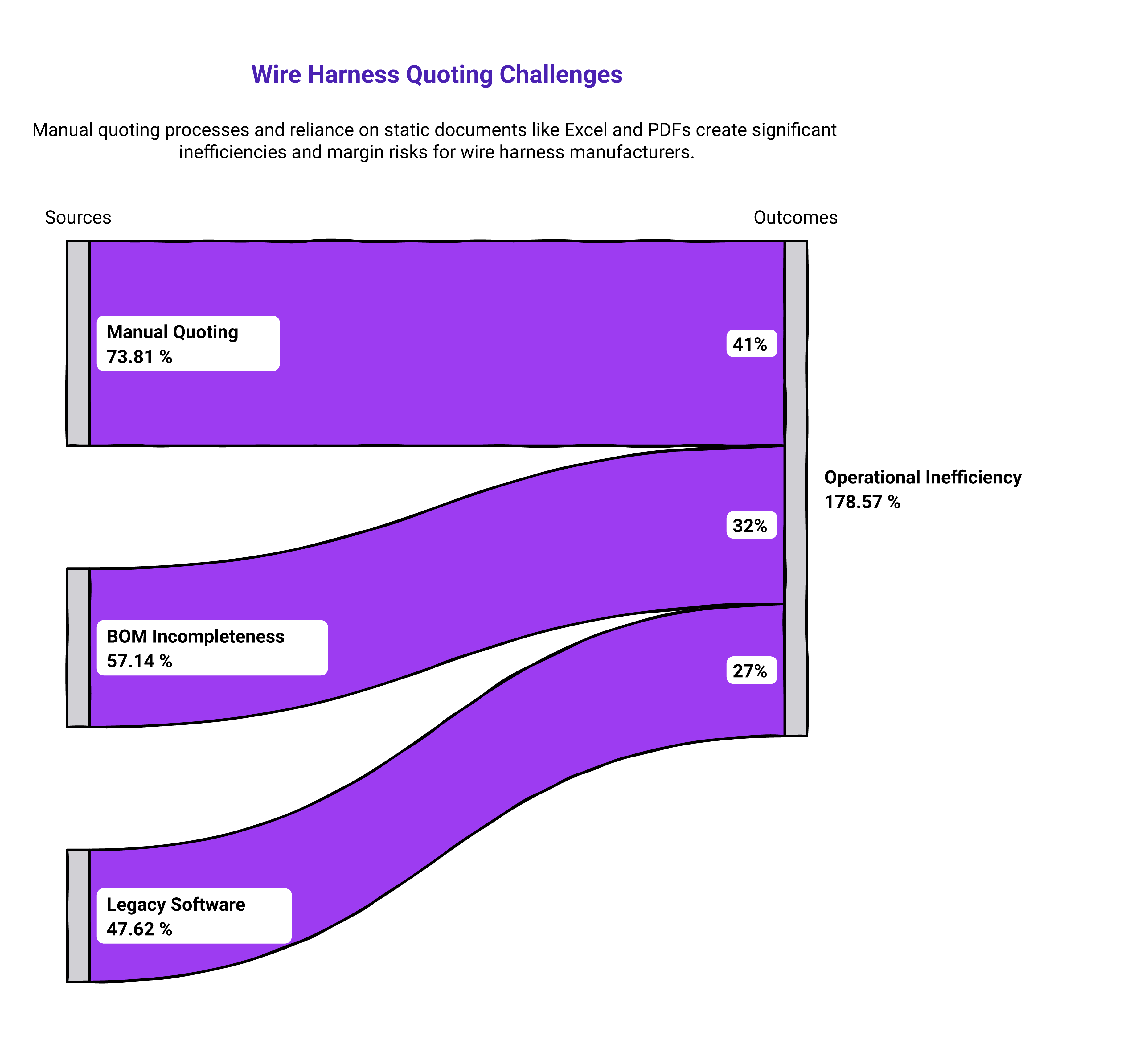
The WHMA Innovation Advisory Team survey of 42 wire harness and cable assembly contract manufacturers makes the gap plain. 73.81% said their quoting process is manual and time-intensive, 57.14% said BOM completeness is their top challenge, and 47.62% still rely on in-house Excel or Word methods. That is the environment where stale pricing causes margin loss before a quote even leaves the building.
A shop can spend hours recreating a BOM from an OEM drawing, then discover that a connector, seal, or terminal has changed price or availability overnight. Cableteque says 90% of RFQs arrive as PDFs, and manual recreation can take 30 to 45 minutes per assembly. When the quote review cycle stretches across days, pricing data often ages out before the estimator gets sign-off.
| Pricing problem | What it breaks | Tool needed |
|---|---|---|
| Cached distributor data | Quote drifts before approval | Real-time material pricing |
| Customer shorthand and legacy part numbers | Wrong MPNs and crosslist errors | Part normalization |
| Incomplete drawings | Missing seals, terminals, or wire lengths | BOM extraction and design checks |
A quote that looks competitive on Monday can be wrong by Thursday. That happens because wire harness BOMs are dense and supplier-dependent, and even one missing terminal or obsolete connector can push a job into rework. In Cableteque's real-time pricing guidance, a BOM with hundreds of parts can hide 3 to 5 percent margin error when pricing lags two weeks.
The best wire harness quoting systems do four things at once. They extract the BOM, normalize the part data, pull live supplier pricing, and keep alternates ready when a preferred item shifts or disappears.
BOM extraction is the first filter because manual re-keying is where time and accuracy both leak. A purpose-built platform should read OEM PDFs, Excel files, and other common input formats, then turn them into standardized BOMs with customer part numbers, descriptions, and quantities intact. Cableteque says this step can cut manual BOM recreation time by up to 96%.
Live sourcing is the next requirement. Supplier database and distributor API integrations let estimators price against current availability instead of a cached list. The Cableteque buyer's guide says the most important capabilities are BOM extraction from customer drawings, distributor integrations, and wire-specific sourcing support, including normalization across feet, meters, inches, spools, and reels. That kind of unit handling prevents bad conversions on wire and cable.
A useful example is the wire harness quoting software buyers guide, which lays out why contract manufacturers need more than generic quoting tools. A second practical reference is the guide to integrating real-time component data in wire harness quotes, because live pricing only helps when the rest of the workflow can consume it cleanly.
Part normalization matters just as much as sourcing. Descriptions such as "blk tape" need to become the correct black Tesa tape. A loose piece terminal may need to map to reel supply. Customer part numbers must resolve to MPNs, and approved alternates should be attached before sourcing starts, not after a delay. The wrong mapping turns a fast quote into a cleanup job.
One more tool deserves attention: topology and wire-length logic. In harness work, material cost is not only a parts list. Routing, bundle diameter, breakout location, and cover requirements change the bill. If a system can trace a drawing and calculate exact wire lengths from the PDF, the quote reflects the actual build, not a simplified guess.
Labor becomes more visible when material pricing is moving because the quote needs a second anchor. If the material line is recalculated correctly but labor is guessed, margin still slips.
Good labor estimation tools use historical jobs, operation counts, and configurable labour templates. They break work into stripping, crimping, termination, bundling, testing, and inspection, then apply the shop's own time history. That gives a quote a structure the estimator can defend during review.
The WHMA survey found that 52.38% of manufacturers want validation before manufacturing as the top innovation area, and 4.27 out of 5 was the value rating for labor and cost estimation tools. That tracks with shop-floor reality. Senior engineers should not be pulled into every small quote just to rebuild labor from scratch.
Labor estimation also supports speed. Cableteque's published workflow says labor estimation can fall from 30 minutes to 2 hours down to 5 minutes, while quote finalization can drop from 15 to 30 minutes to 5 minutes. Those numbers matter because a quote lost to slow review is still a lost quote.
The best tool catches errors before anyone sends a price to a customer. That means checking missing fields, incompatible parts, connector fit, wire gauge, and part-number mismatches early enough to fix them without a second round of engineering work.
This is where supplier data, approved vendor lists, and customer source preferences matter. A shop can define preferences by customer, part, or product line, then keep the quote inside approved channels. If a preferred component is scarce, the system should offer valid alternates and known equivalencies instead of forcing a restart.
The wire harness quoting article shows how much time is lost in sourcing and internal review when design data is incomplete. It also reflects what the WHMA survey found, namely that 83% of manufacturers encounter customer design errors that affect production. When the quote process catches those errors on the first pass, the estimator avoids back-and-forth, and the shop avoids margin leakage.
Compliance checks belong here too. IPC/WHMA-A-620, AS50881, UL requirements, and other industry rules should be tied to the quote workflow so that obvious issues are flagged before approval. Cableteque's approach adds DRC checks with real-time data, which gives estimators a cleaner handoff to engineering and operations.
A modern stack starts with drag-and-drop import and ends with one-click quote generation. Between those points, the software should extract the BOM, normalize parts, source live pricing, estimate labor, apply margins, and package the quote for review.
That is where real-time material pricing and automated BOM completion work together. If the BOM is incomplete, the system can use connector compatibility, wire gauge logic, and part equivalencies to fill in the missing pieces. If the pricing changes, it can refresh the quote without rebuilding the entire package.
Cloud-based collaboration matters because estimating, engineering, and operations should not be working from different versions of the truth. A change in a connector table, a corrected wire length, or a new alternate should flow through the same system. ECI's May 14, 2025 announcement said its integration with Cableteque can deliver up to 50% reduction in quote turnaround time, which is consistent with the pressure shops feel when quote volume rises.
This is the point where Cableteque fits cleanly. It combines BOM extraction, AI-powered analysis, real-time component sourcing, labor estimation, and instant quote generation in a wire-harness-specific workflow. When quotes are built by wire harness people for wire harness people, the system is more likely to respect the way a shop actually works.
Q: What tool matters most when component prices change every week?
A: Real-time material pricing matters most because cached prices age out fast in wire harness quoting. You also need BOM extraction and part normalization, because bad source data creates bad pricing no matter how current the supplier feed is. A live price feed is useful only when the software can map the customer's part language to the actual MPN. The strongest setup combines all three so the quote reflects both the current market and the actual build.
Q: Why do spreadsheets break down so quickly in harness quoting?
A: Spreadsheets can track a short BOM, but they do not handle part equivalencies, alternate sourcing, topology logic, and labor templates well. They also depend on someone remembering to refresh pricing at the right time. In a shop where 73.81% of teams still call quoting manual and time-intensive, that dependency becomes expensive. The more complex the assembly, the faster the spreadsheet turns into a bottleneck.
Q: How does BOM extraction improve quote accuracy?
A: BOM extraction removes manual re-keying, which is where many small mistakes start. It also lets the system capture customer part numbers, descriptions, and quantities from OEM PDFs or Excel files in a standard format. That makes later steps, including sourcing and labor estimation, more reliable. When the input is clean, the quote review cycle gets shorter.
Q: Do labor estimation tools still matter if materials are the moving target?
A: Yes, because a quote can still miss margin even when the material price is right. Labor covers stripping, crimping, termination, bundling, inspection, and test work, and those operations vary by product family and standard. Configurable labor templates let the shop keep estimates close to reality without rebuilding each quote from zero. That also reduces pressure on senior engineers.
Q: What should a contract manufacturer ask for in a quoting platform demo?
A: Ask how it handles PDFs, live supplier data, alternate parts, labor templates, and quote finalization in one run. Ask how it flags missing information and wrong part mappings before approval. Ask whether it supports your supplier preferences and customer-specific rules. If the demo cannot show those steps on a real RFQ, the tool is not built for wire harness work.
If your quotes are still built from cached prices and manual re-entry, the problem is already costing margin. The shops that move fastest use software that can read the BOM, source current parts, estimate labor, and close the loop before the quote goes stale.
That is why the right tool set is specific, not generic. Cableteque turns changing component prices into a shorter, cleaner quoting process by automating BOM extraction, real-time sourcing, and labor estimation in one wire-harness-specific workflow. If you want to see how that works in a live quoting flow, it is worth looking at a platform built for the work you do every day.
Cableteque combines over three decades of hands-on industry expertise with a commitment to innovation in wire harness software. Founded by Arik Vrobel, our team brings together engineers, operators, and business leaders who deeply understand the challenges related to wire harnesses.
We focus on solving the toughest problems across the entire design-through-manufacturing lifecycle, helping teams work smarter, faster, and with greater precision.
Our company thrives on innovation, inclusivity, and collaboration. We value individuality, sustainability, and making a positive impact, building trust and shared success every step of the way. We are the only company creating software designed by wire harness people, for wire harness people. Our goal is to simplify communication between OEMs and contract manufacturers, improve operations, and help businesses grow.
Cableteque isn't just a tool, it's an evolving platform built to support engineers, supply chain specialists, sales teams, and manufacturing professionals in doing their best work. Our company thrives on innovation, inclusivity, and collaboration.
Transforming the Design Process: The Impact of Wire Harness Validation Software
Turning White Rice into High-Grade Sushi: The Strategy That Scaled My Harness Business Tenfold
What are Wire Harness Assemblies: what you need to know before your next design