Key Takeaways
- A wire harness quoting system can import pricing from a distributor quote when it is connected to live supplier feeds or contract pricing tables.
- The practical workflow is simple: PDF in, BOM extracted, part numbers matched, pricing pulled, quote out.
- List price is not the number that protects margin. What you actually pay, including contract terms and approved alternates, is the number that belongs in the BOM.
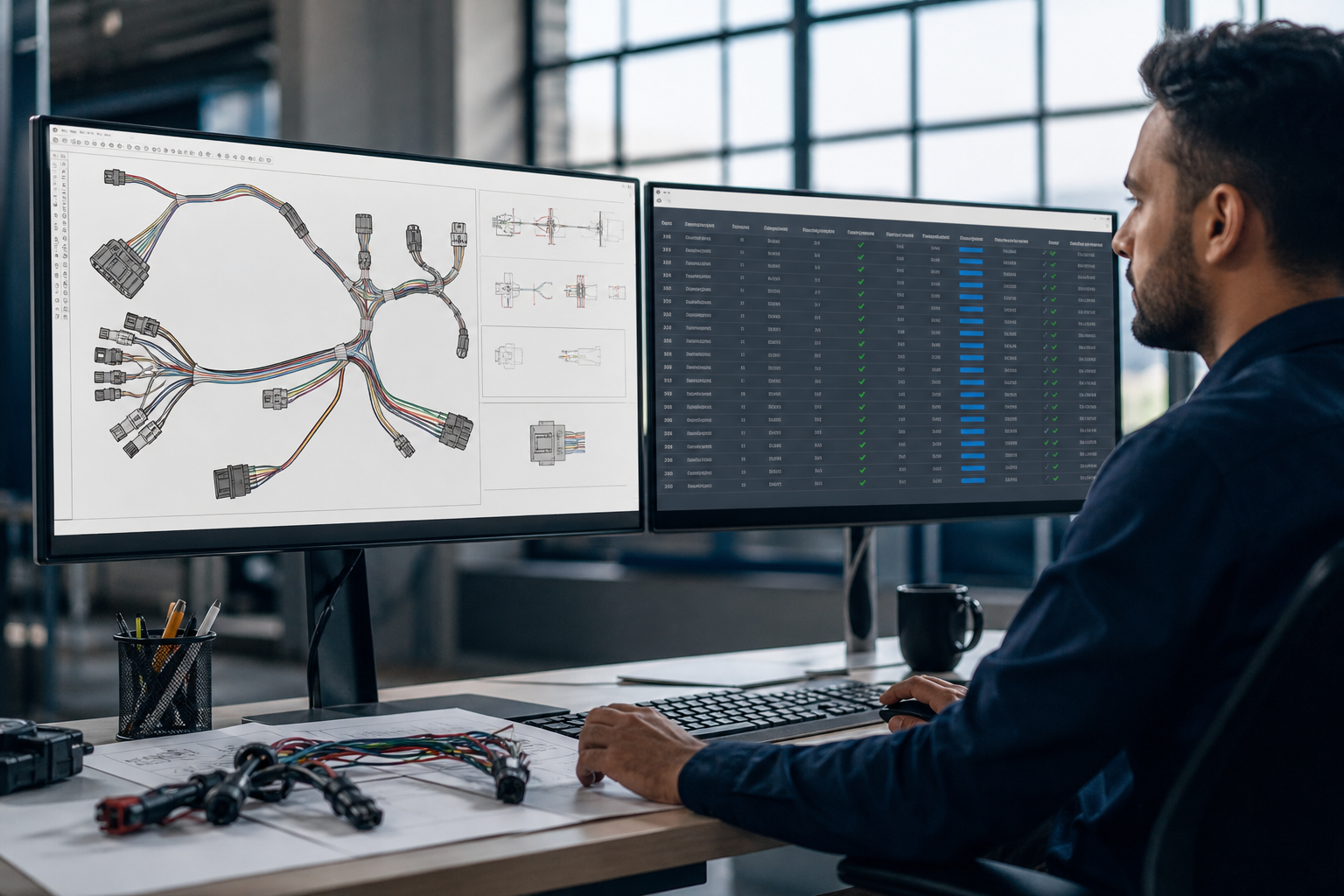
- Manual pricing lookups still drain hours from quoting teams, especially when every assembly carries dozens or hundreds of line items.
- Purpose-built wire harness software cuts the gap between engineering and estimating, which is why Cableteque's quote workflow and the buyers guide for wire harness quoting software keep returning to distributor integrations and negotiated rates.
Introduction
I have watched estimators chase pricing through inboxes, supplier portals, and old spreadsheets while RFQs piled up on the desk. The hard answer is yes, quoting software can read distributor pricing and bring it into a wire harness BOM, but only when the system is built for live distributor integrations, contract pricing, and BOM-level part mapping.
That distinction matters because most quoting pain is not about typing faster. It is about getting the right price on the right line item before the quote turns into a margin problem. Cableteque's own materials describe a workflow where the platform builds the BOM and wire list, then sources parts at negotiated rates and returns a customer-ready quote in days, not weeks.
For engineering managers, operations managers, and product managers, the question is less about whether the software can do it and more about how accurately it handles distributor quotes, alternates, approved vendors, and customer-specific pricing rules. A system that imports the wrong price quickly is still the wrong system.
Table of Contents
- What the software actually reads
- Why list price is the wrong number
- Where manual pricing still breaks the process
- How the workflow works in practice
- What to expect from a serious platform
- When the quote is ready for review
What The Software Actually Reads
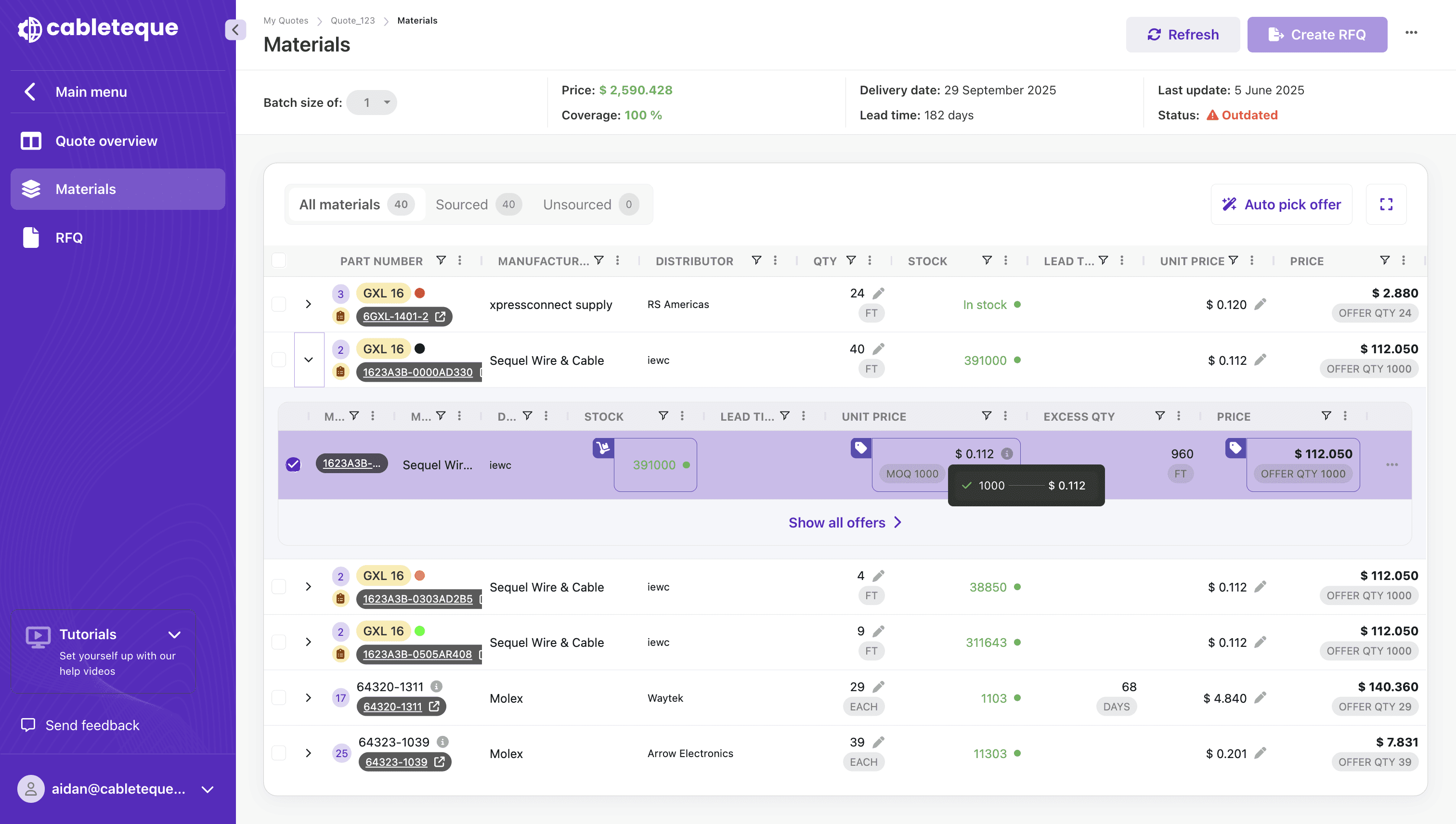
Most serious systems do not simply "read a distributor quote PDF" and dump values into a BOM. They connect to distributor APIs, pricing tables, or approved supplier data, then map those live prices to the BOM lines created from the customer drawing or RFQ package.
Cableteque says the best wire harness quoting tools should handle "PDF drawings in, structured BOMs out, real-time pricing from your distributors," and that pricing should reflect what you actually pay, not catalog list pricing. That is the real test. If the platform cannot separate customer part numbers, manufacturer part numbers, and negotiated supplier terms, the BOM may look complete while the economics stay wrong.
The workflow gets even more valuable when the RFQ package is messy. Cableteque's quote page describes packages with six attached files, including a drawing PDF, BOM spreadsheet, wire list, approved vendors, quality notes, and workmanship spec. In practice, that is normal. One RFQ can hide the pricing answer across multiple documents, and the system has to pull the pieces together without asking an engineer to rebuild the package by hand.
| Step |
Manual method |
Automated method |
What changes |
| BOM creation |
Rebuild line by line from PDFs and notes |
Extract structure from the drawing and file set |
Less retyping, fewer missed parts |
| Pricing lookup |
Email or portal search for each component |
Pull live pricing from distributor feeds |
Faster quotes, fewer stale prices |
| Cost control |
Use catalog price when contract price is unknown |
Apply customer-specific pricing rules |
Better margin visibility |
| Quote output |
Review across multiple spreadsheets |
Generate a quote from the BOM workflow |
Shorter handoff to sales and operations |
Why List Price Is The Wrong Number
List price is easy to find and easy to trust, which is exactly why it causes trouble. A contract manufacturer does not ship list price. It buys at negotiated rates, sometimes across different branches, different region rules, or customer-specific supplier preferences.
Cableteque's quoting guide says a platform should support distributor integrations and contract pricing. That detail is not cosmetic. If a part shows a catalog price when the shop actually buys under a different agreement, the quote will be wrong before the first approval loop begins. One or two bad lines can be absorbed. A full BOM built on list prices can erase the margin on a job that looked healthy on paper.
Engineering.com covered Harness Builder 2026 release and noted that Cost Estimator links to TrustedParts.com for current component pricing and availability information. That is the same principle at work: connect design data to live pricing, then use that data inside the estimate rather than after the fact.
Where Manual Pricing Still Breaks The Process
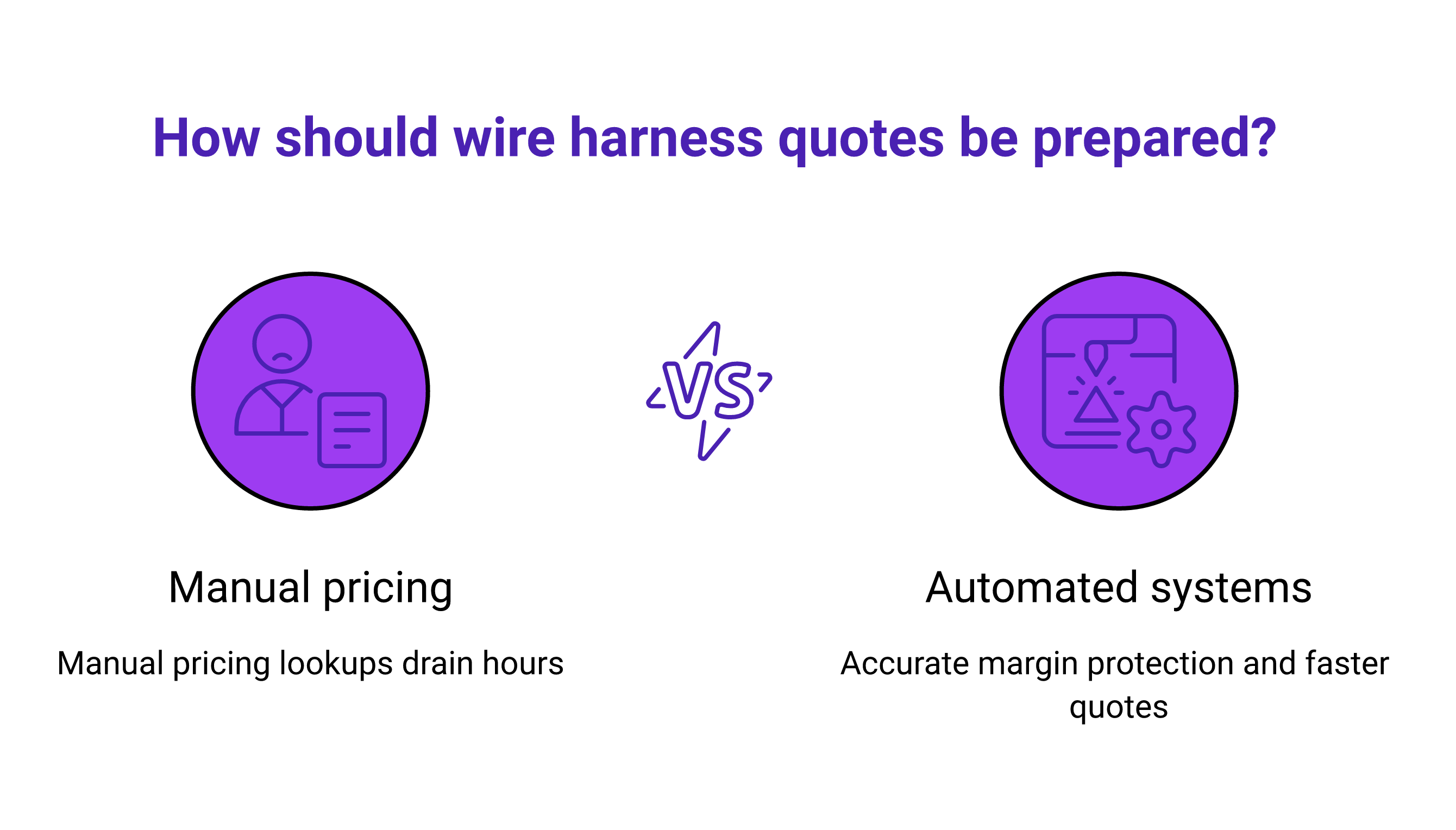
Manual lookup does not just waste time. It creates inconsistency. One estimator may pick a preferred distributor, another may default to a local source, and a third may accept a quote sheet that is already stale by the time the review starts.
Cableteque says 90% of RFQs arrive as PDFs, and manual BOM recreation from the drawing takes 30 to 45 minutes per assembly. In a shop quoting several assemblies a day, that adds up fast. A 20-minute pricing hunt for each connector, seal, terminal, or backshell multiplies across the quote and turns a single RFQ into an all-day interruption.
I have seen this happen on jobs with simple topline requirements and complicated connector tables. The wire gauge is right, the part description is right, and the pricing is still wrong because the estimator pulled the wrong source or missed a customer-specific alternates list. The error does not look dramatic in the moment. It shows up later, in a quote that wins work at the wrong price.
How The Workflow Works In Practice
The cleanest workflow is more practical than flashy. The customer sends a PDF package. The software extracts the BOM and wire list, matches parts, checks source preferences, and pulls live distributor pricing into the line items. Then the estimator reviews the exceptions instead of building every line from zero.
Cableteque says its AI-powered BOM creation can save up to 96% of the time spent rebuilding BOMs from customer drawings and PDFs. That figure should not be read as a promise that every quote becomes instant. It should be read as a signal that the platform removes most of the manual recreation burden, which is where quoting departments lose the most hours.
The hidden value is control. When the software stores customer part numbers, maps them to manufacturer part numbers, and adds approved alternates, the estimator can see exactly why a price landed where it did. That makes review easier, speeds approvals, and reduces the back-and-forth between engineering, supply chain, and sales.
What A Serious Platform Should Do
A real system should do more than search a catalog. It should read the RFQ package, standardize the BOM, apply contract pricing, and flag the gaps that still need human judgment. If it cannot do all four, the team ends up doing the hardest part manually anyway.
Cableteque's buyers guide says a good platform should automatically generate a structured BOM and use real-time pricing from distributors. Its quoting page also describes a workflow that sources every part at negotiated rates and returns a customer-ready quote in days, not weeks. That is the practical bar for wire harness quoting software, not a generic promise of automation.
If you manage estimating, you should ask one direct question in any demo: can the system import distributor pricing into the BOM using our contract terms, not public list price? If the answer is vague, the rest of the demo is decoration.
When The Quote Is Ready For Review
The quote is ready when the BOM is clean, the price source is traceable, and the exceptions are small enough for an engineer to review in minutes. That is the point where quoting stops being a scavenger hunt and starts being a controlled process.
For wire harness manufacturers, the practical gain is speed without losing the tie to real material cost. That is the difference between a quote that gets reviewed on time and one that misses the window. In a market where 7 to 10 day quoting cycles still happen, a system that closes the loop in a single workflow changes how many RFQs your team can actually answer.
If your current process still depends on manual price hunting, then the real question is simple: how many good jobs are you losing while someone checks a distributor quote by hand?
FAQ
Q: Can quoting software import pricing from a distributor quote PDF?
A: It can, but only if the platform is built to connect distributor data to the BOM. In practice, the better systems do not rely on a PDF alone. They use distributor integrations, contract pricing tables, or approved supplier feeds. That lets the software map live pricing to each BOM line instead of guessing from a static file.
Q: Why is list price a problem in wire harness quoting?
A: List price rarely matches what a manufacturer actually pays. Wire harness shops often buy through negotiated agreements, preferred suppliers, or customer-specific pricing rules. If the quote uses list price, the margin can look better than it really is. That creates risk for both the estimate and the final job.
Q: What happens if the RFQ includes several PDFs and spreadsheets?
A: A strong quoting platform should ingest the package, extract the BOM, and keep the source documents connected. That is important because pricing, part numbers, workmanship notes, and alternates often live in different files. When the software ties them together, the estimator spends time on review instead of reconstruction. That also reduces rework during approval.
Q: How does this help an operations manager?
A: It shortens the time between RFQ intake and quote release. Faster quoting means more bids answered and fewer opportunities lost to delay. It also reduces the load on senior engineers, who otherwise spend too much time on repetitive part lookup and price checks. The process becomes more repeatable, which helps planning and margin control.
Q: What should a demo prove before you buy?
A: It should prove that the software can take a customer RFQ, build a structured BOM, and pull live pricing from your distributor sources or contract terms. You should also see how it handles alternates, customer part numbers, and missing information. If the tool cannot show those steps clearly, it is not ready for a production quoting team.
Q: Is this only useful for large wire harness shops?
A: No. Smaller teams feel the pain even more because one estimator often carries too many quotes at once. When pricing lookup is manual, every delay compounds. A smaller shop gains the most from removing repeated lookup work and cutting the time spent on each assembly.
About Cableteque
Cableteque combines over three decades of hands-on industry expertise with a commitment to innovation in wire harness software. Founded by Arik Vrobel, our team brings together engineers, operators, and business leaders who deeply understand the challenges related to wire harnesses.
We focus on solving the toughest problems across the entire design-through-manufacturing lifecycle, helping teams work smarter, faster, and with greater precision.
Our company thrives on innovation, inclusivity, and collaboration. We value individuality, sustainability, and making a positive impact, building trust and shared success every step of the way. We are the only company creating software designed by wire harness people, for wire harness people. Our goal is to simplify communication between OEMs and contract manufacturers, streamline operations, and help businesses grow.
Cableteque isn't just a tool. It is an evolving platform built to support engineers, supply chain specialists, sales teams, and manufacturing professionals in doing their best work. Our company thrives on innovation, inclusivity, and collaboration.