Key Takeaways
- Use BOM extraction to stop rebuilding every RFQ from scratch.
- Connect quotes to live supplier pricing, not cached spreadsheets.
- Add labor estimation that counts real harness operations, not just line-item totals.
- Keep an approved vendor list and source preferences so buyers do not re-research every part.
- Treat wire length, topology, compliance, and labor as part of the quote, not afterthoughts.
Introduction
When component prices keep changing, wire harness quoting breaks first at the spreadsheet level. A connector price moves, a terminal goes obsolete, or a wire spool changes units, and the quote that looked solid yesterday is already stale today.
That is why the best electrical wire harness quoting solutions do three jobs at once. They pull the BOM out of OEM PDFs, pull current pricing from suppliers, and calculate labor in a way that reflects how wire harness assemblies are actually built.
I have watched shops lose RFQs because the quote came back late, then lose margin because it came back wrong. Both failures start the same way: someone trusted static pricing in a process that needs live data.
Table of Contents
- Why changing component prices break manual wire harness quotes
- The tools that matter most: BOM extraction, real-time sourcing, and labor estimation
- How EWH quoting software keeps prices current without rebuilding every quote
- What to look for in a quoting tool for fast-moving component markets
- Why accuracy is about more than material price
- FAQ
- A faster way to quote when prices move
- About Cableteque
Why Changing Component Prices Break Manual Wire Harness Quotes
Manual wire harness quoting fails because price volatility moves faster than the quote cycle. A 7 to 10 day process leaves too much time for connector, terminal, and wire prices to change before the estimate even leaves the building.
The damage is not subtle. Shops that rely on list pricing, cached pricing, or tribal knowledge end up with stale material costs, margin leakage, and rework when sourcing catches an error after the quote is out. Cableteque's quoting workflow article says 90% of customer RFQs arrive as PDFs, and that manual recreation can take 30 to 45 minutes per assembly, which becomes expensive when several RFQs land on the same desk at once. See how the full quoting workflow works.
A 2025 WHMA survey cited in Cableteque's operations report found that 73.81% of manufacturers still describe quoting as manual and time-intensive, while only 9.52% call it highly automated and scalable. That gap explains why late quotes keep losing business. When a competitor responds in hours and you respond in days, the RFQ often closes before your estimate is ready.
The Tools That Matter Most: BOM Extraction, Real-Time Sourcing, And Labor Estimation
The strongest tool stack starts with BOM extraction. If an estimator has to rebuild a bill of materials from a PDF drawing, the quote is already paying for duplicate work before any pricing begins.
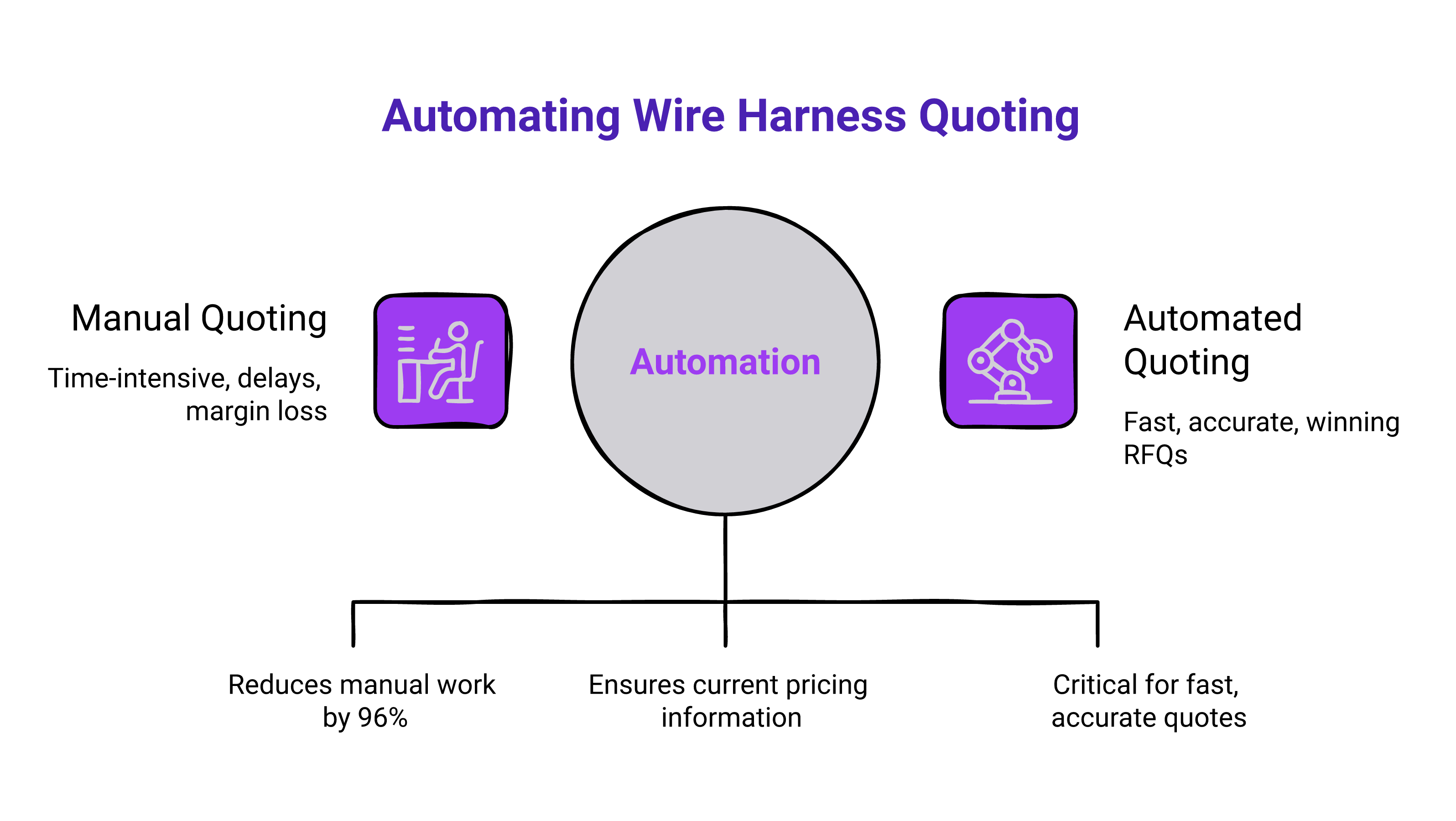
BOM extraction tools pull parts, descriptions, and customer part numbers directly from OEM PDFs and drawings, then normalize them into a usable quote file. Cableteque says automated BOM extraction can reduce manual recreation by up to 96%, and its buyer's guide notes that the biggest value comes from automation that handles incomplete tables, mixed units, and handwritten source notes. For a practical checklist on what to ask vendors, review the wire harness quoting software buyer's guide for contract manufacturers.
Real-time sourcing comes next. Pricing for terminals, seals, connectors, and wire should come from distributor databases or negotiated contract rates, not from last quarter's spreadsheet. Wire Harness Production's 2026 cost guide notes that materials can make up 30 to 50% of total cost, and that copper prices had risen 18% since early 2025, which is exactly why cached material numbers age badly.
Labor estimation is the third leg of the stool. A quote should count crimps, splices, cuts, routing steps, connector insertions, and test operations, because those are the real cost drivers on the floor. Cableteque's workflow data says labor estimation can drop from 30 minutes to 2 hours down to 5 minutes when the system uses historical data and templates instead of manual entry.
What the Best Stack Does in Practice
| Tool |
What it fixes |
Why it matters when prices move |
| BOM extraction |
Pulls parts and customer part numbers from OEM PDFs |
Cuts recreation time before pricing starts |
| Real-time sourcing |
Checks current supplier price and availability |
Prevents stale material costs and missed alternates |
| Labor estimation |
Uses templates and historical data for operation counts |
Keeps labor from being distorted by material price noise |
How EWH Quoting Software Keeps Prices Current Without Rebuilding Every Quote
Purpose-built EWH quoting software keeps pricing current by separating material logic from manual effort. It lets estimators update costs dynamically while preserving the structure of the quote, so a price shift does not force a full rebuild.
The best systems also support approved vendor lists, contract pricing, and source preferences by customer, part, or product line. That matters because two customers can buy the same connector under different rules, and a quote that ignores those rules creates downstream friction in purchasing and customer review.
Cableteque's product material says the platform can store customer part numbers, map them to MPNs, add approved alternates, and define source preferences. It also uses a 2,000,000-plus part library to help autopick missing terminals, cavity plugs, and seals based on connector compatibility and wire gauge. That is the kind of part logic generic manufacturing software usually misses.
The most useful quote tools also leave room for judgment. If a quote has an edge case, the estimator should be able to override the system, document the reason, and move on. That keeps the software useful to an engineering team instead of forcing the team to work around the software.
What To Look For In A Quoting Tool For Fast-Moving Component Markets
A serious quoting tool should start with fast file intake. Drag-and-drop support for PDF and Excel BOMs is the minimum, because engineers and buyers still send both, and many RFQs arrive in mixed formats.
It should also recognize tables automatically. If the tool cannot parse a connector table, a wire list, or a notes block, the estimator is back to manual data entry, and the quote cycle slows immediately.
You also need harness-specific sourcing logic. Look for support for connector compatibility, wire gauge rules, cavity plugs, seals, wire length calculations, and the kind of part substitutions that happen every week in production work. In the WHMA survey, automated BOM enhancement scored 4.50 out of 5 for value, higher than assembly instruction generation at 4.34 and labor or cost estimation at 4.27, which tells you where shops see the biggest payoff.
Cloud collaboration and auditability matter too. The engineering manager needs to see what changed, the operations manager needs to see what got approved, and the product manager needs a clean review trail. A non-disruptive rollout is the difference between testing a new quoting method and pausing the department for six weeks.
A Fast Evaluation Pass
- Check whether the tool can import PDFs, Excel files, and image-heavy drawings.
- Confirm that it updates pricing from live sources instead of cached files.
- Ask how it handles approved alternates, vendor rules, and customer-specific part mapping.
- Review how it estimates labor for crimps, splices, terminations, and test steps.
Why Accuracy Is About More Than Material Price
Material price is only part of the quote. Wire length, breakouts, shielding, routing, termination operations, and test requirements all change the total cost, and they often change it more than a single connector price move does.
That is why topology tools and compliance checks matter. Cableteque says its harness topology tool traces drawings and calculates exact wire lengths from the PDF, while its compliance automation checks designs against standards such as IPC/WHMA-A-620, AS50881H, and UL requirements. If the design is off by a wire length or a termination rule, the quote misses on labor and the build misses on quality.
I have seen a shop quote a harness correctly on material and lose money because the labor template ignored extra stripping, shielding prep, and a longer-than-assumed route through the assembly. Those misses do not come from a lack of effort. They come from using a pricing process that was never designed for wire harness assemblies.
The better answer is a quote that keeps pricing, labor, and part logic synchronized. Cableteque says customers have seen 70% reduction in quote turnaround time, 5x more quoting capacity without new hires, and 96% time savings on complex quotes, including one case that dropped from 18 hours to 45 minutes. That kind of result is what happens when the quote finally matches the way the work is built.
FAQ
Q: Why do changing component prices hurt wire harness quoting more than other manufacturing quotes?
A: Wire harness quotes depend on many small components, and several of them can change price in the same week. A connector increase by itself may look minor, but it affects the bundle when terminals, seals, wire, and alternates are priced together. The bigger problem is timing, because a quote that takes 7 to 10 days is already exposed to price drift before it is sent. Live sourcing keeps the estimate closer to the real build cost.
Q: What is the most important feature in electrical wire harness quoting solutions?
A: BOM extraction is usually the first feature that saves real time. If the system can pull parts, descriptions, and customer part numbers from OEM PDFs, the estimator does not have to recreate the package by hand. Real-time pricing is the next critical feature because it keeps the material side current while the quote is still being built. Labor estimation rounds out the system by making sure the quote reflects the actual build steps.
Q: Should a quoting tool replace estimator judgment?
A: No. The best tools handle the repetitive work and leave judgment to the estimator. That includes edge cases, alternate part choices, and customer-specific source rules. A good system also lets you override a suggestion when a job has special requirements. That keeps the quote accurate without turning the estimator into a data clerk.
Q: How do approved vendor lists help when prices change?
A: An approved vendor list limits sourcing to the suppliers a customer or company already accepts. That reduces rework, prevents unauthorized substitutions, and keeps procurement and quoting from drifting apart. It also shortens review cycles because the estimator is not spending time checking parts that will never be approved. In fast-moving markets, that control protects both speed and margin.
Q: What should operations managers watch during rollout?
A: Watch how fast the team can test the new system without stopping current quoting. A non-disruptive rollout matters because estimating teams already have live RFQs on the desk. You should also check audit trails, user permissions, and how pricing updates flow into the final quote. If the team trusts the data, adoption moves faster.
Q: Does faster quoting really change win rates?
A: Yes, because many RFQs are won by the shop that responds first with a credible number. Cableteque's workflow data says faster quoting can reduce turnaround by 70% and raise quoting capacity by 5x without new hires. That gives the team more shots on goal without adding headcount. It also reduces the chance that a strong RFQ is lost to delay.
A Faster Way To Quote When Prices Move
If your team is still rebuilding every RFQ by hand, the problem is not only speed. The deeper issue is that the quote process is fighting live market data with static tools.
The shops that fix this first usually start with live sourcing, BOM extraction, and harness-specific labor estimation. Cableteque brings those pieces into one workflow, so engineers can quote faster without losing control of part logic, sourcing rules, or margin.
If you want to see how live sourcing, BOM extraction, and labor estimation can turn unstable pricing into faster, more accurate wire harness quoting, book a demo of Cableteque and put your next RFQ through it.
About Cableteque
Cableteque combines over three decades of hands-on industry expertise with a commitment to innovation in wire harness software. Founded by Arik Vrobel, our team brings together engineers, operators, and business leaders who deeply understand the challenges related to wire harnesses.
We focus on solving the toughest problems across the entire design-through-manufacturing lifecycle, helping teams work smarter, faster, and with greater precision.
Our company thrives on innovation, inclusivity, and collaboration. We value individuality, sustainability, and making a positive impact-building trust and shared success every step of the way. We are the only company creating software designed by wire harness people, for wire harness people. Our goal is to simplify communication between OEMs and contract manufacturers, streamline operations, and help businesses grow.
Cableteque isn't just a tool; it's an evolving platform built to empower engineers, supply chain specialists, sales teams, and manufacturing professionals to do their best work. Our company thrives on innovation, inclusivity, and collaboration.
1-1.png?width=190&height=34&name=logo-transparent%20(1)1-1.png)