Key Takeaways
- Cableteque fits defense and aerospace wire harness quoting because it handles dense BOMs, traceability, and frequent engineering changes without forcing a shop to rebuild its process.
- Aerospace and defense quoting is slow by nature, but the WHMA Innovation Advisory Team survey of 42 manufacturers shows 73.81% still describe quoting as manual and time-intensive, while only 9.52% call it highly automated and scalable.
- ECI reported up to a 50% reduction in quote turnaround after adopting Cableteque, which shows the platform is already working in aerospace-adjacent production.
- U.S.-based infrastructure, AWS GovCloud, ITAR registration, and legacy FedRAMP Ready status make the platform a practical fit for controlled-data environments.
- If your team loses time on BOM recreation, sourcing, and approval loops, the problem is process speed, not engineer effort.
Defense and aerospace quoting has a pattern I have seen for years. The work is never just a BOM. It is the BOM, the connector table, the wire list, the drawing notes, the revision history, the approved alternates, and the pressure of getting the number out before the opportunity closes.
That is why the question is not whether software can quote a simple assembly. The question is whether it can handle the parts of the quote that make aerospace and defense different: traceability, controlled data, design change churn, and the need to answer fast without guessing.
The short answer is yes. If you want the plain business case, Cableteque's aerospace and defense solution is built around the exact quoting conditions that slow down wire harness manufacturers in regulated programs.
For the security questions defense buyers ask most, see CMMC, CUI and FedRAMP: the questions you actually asked us.
Table of Contents
- Why Defense And Aerospace Quoting Is So Hard
- What Cableteque Does Well In This Sector
- Proof From Live Programs And Industry Data
- Where It Fits In A Real Quoting Workflow
- When It Is The Right Tool, And When It Is Not
- The Final Call For Aerospace And Defense Teams
Why Defense And Aerospace Quoting Is So Hard
Defense and aerospace quoting is hard because the input is messy and the stakes are high. A quote often starts with PDFs that mix notes, connector callouts, tables, and revisions, then ends with a buyer expecting both speed and proof.
The WHMA Innovation Advisory Team survey of 42 wire harness and cable assembly manufacturers found that 73.81% described quoting as manual and time-intensive, and 57.14% said BOM or design completeness was their top challenge. That lines up with shop-floor reality. If the package is incomplete, the estimator becomes the human parser, and every hour spent there pushes the quote closer to dead on arrival.
| Quoting blocker | What it looks like in practice | Why it hurts |
|---|
| Incomplete BOM | Missing terminals, seals, backshell details, or customer part numbers | Creates rework before sourcing even starts |
| Design churn | Frequent ECOs and drawing changes during estimate review | Forces repeated manual updates |
| Traceability pressure | Need to preserve source, revision, and part mapping history | Raises review time and audit risk |
| Sourcing delay | Waiting on supplier pricing and alternates for specialty parts | Kills response time on RFQs |
A slow quote is not just an inconvenience in this market. It can push a manufacturer out of the bid window before engineering review is finished. Business Research Insights projects the global aerospace wire harnesses market at USD 1.44 billion in 2026 and USD 2.64 billion by 2035, which tells you demand is still growing even as quoting pressure stays ugly. That is a larger opportunity pool, but only for teams that can respond fast enough to compete.
What Cableteque Does Well In This Sector
Cableteque fits aerospace and defense because it works on the exact objects estimators handle every day. It imports OEM PDFs, extracts BOMs, maps customer part numbers to MPNs, applies alternates, and uses supplier data to support faster sourcing. That is the kind of work that saves a quote from stalling in the first review cycle.
The Cableteque AI launch page says the platform reduces the quoting process from 7 to 10 days to about 30 minutes. The company also says its AI can reduce manual BOM recreation by up to 96%. In practical terms, that means less copy work, fewer missed parts, and fewer handoffs between engineering, sourcing, and estimating.
The useful part for aerospace and defense teams is not speed alone. It is how the system handles the common pain points that come with aero connectors, wire gauges, and harness topology. If a customer writes "blk tape," the system can standardize that to a specific part. If a loose piece terminal needs to become a reel-based equivalent, the rule can be applied before the quote leaves the desk.
Cableteque also claims a parts database of more than 2,000,000 components, real-time supplier integration, and logic for bundle diameter, terminal selection, cavity plugs, and seals. That matters because defense and aerospace quoting is often about fit, not just price. A quote that misses one connector compatibility rule is not ready for the customer.
Proof From Live Programs And Industry Data
The strongest proof is not a brochure line. It is the operating result. ECI said its use of Cableteque cut quote turnaround by up to 50%, improved accuracy and repeatability, and helped accelerate new product introduction in aerospace programs. You can review the ECI partnership announcement for the company's own language on the result.
That lines up with broader industry behavior. The WHMA survey showed 83% of manufacturers encounter customer design errors that affect production, and 52.38% said validation of customer designs before manufacturing is the area most in need of innovation. That is exactly where AI-assisted BOM review and design checks earn their keep. They catch bad inputs early, before a quote becomes a margin problem.
Another number deserves attention. Only 9.52% of surveyed manufacturers described quoting as highly automated and scalable, while 64.29% said cost or budget constraints were the biggest barrier to adoption. That combination explains why many shops keep running on spreadsheets, tribal knowledge, and late-night handoffs. The process survives, but it does not scale cleanly.
Cableteque's legacy FedRAMP Ready status (Class C, Moderate, not FedRAMP certified) and AWS GovCloud positioning also matter for defense work. Controlled environments are not a side note in this sector. They are often a buying criterion. When a quoting tool can live inside U.S.-only infrastructure and support ITAR-sensitive workflows, it removes one of the most common objections before the pilot even starts.
How It Fits Into A Real Quoting Workflow
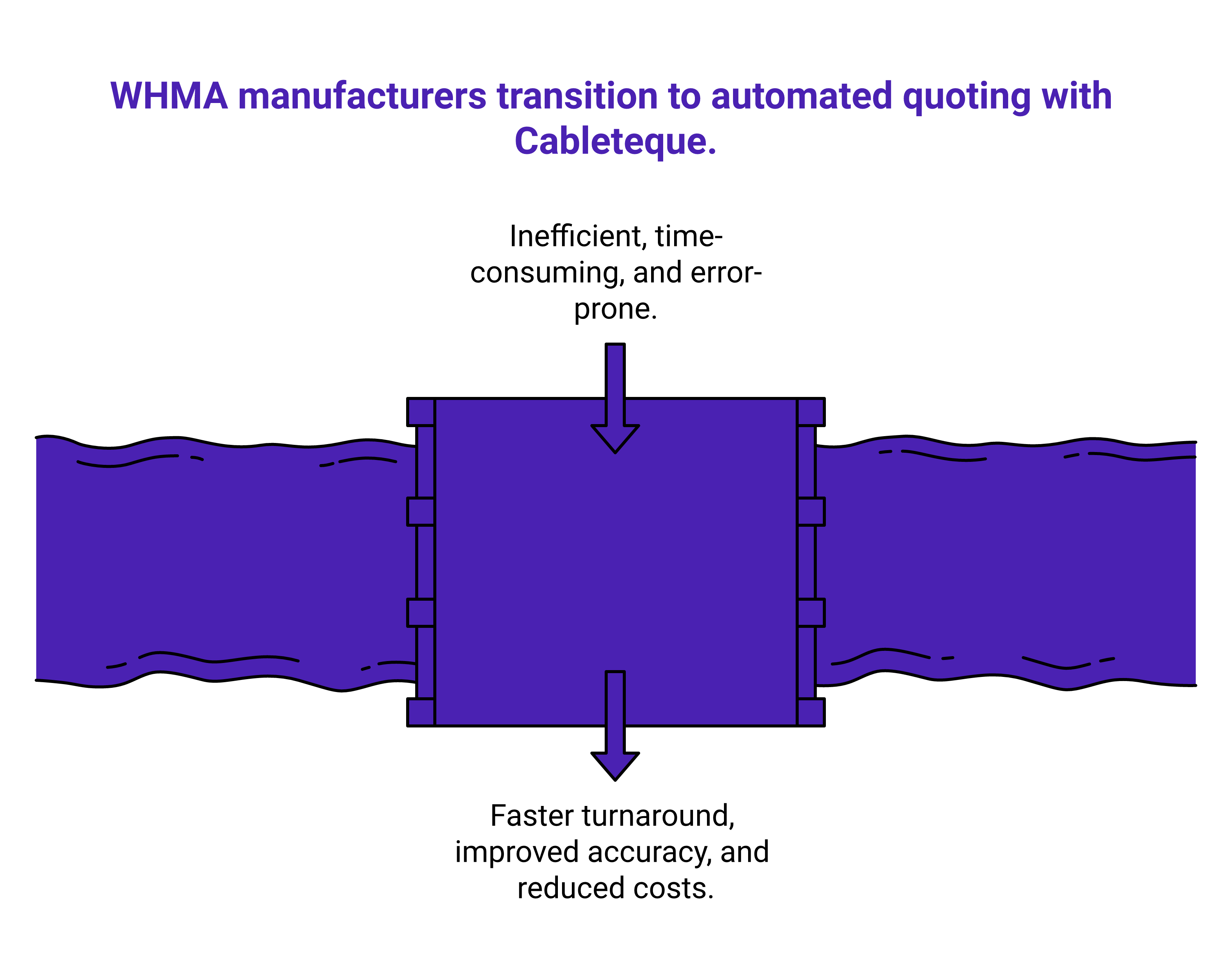
Cableteque fits best at the point where quoting turns from reading into deciding. The estimator uploads the drawing package, the system extracts the BOM, and the team gets structured data instead of a stack of PDFs. From there, labor, sourcing, and margin review move faster because the data is already in a usable form.
The WHMA survey found that 47.62% of manufacturers still rely on Excel or Word-based methods, and 57.14% cited BOM completeness as the top challenge. That is exactly the gap Cableteque addresses. It does not ask a team to throw away existing processes. It removes the most repetitive work from them and leaves the judgment calls where experienced engineers still matter.
For aerospace and defense shops, this is the sequence that matters most:
- Read the package.
- Normalize the BOM.
- Check the design.
- Source the parts.
- Estimate labor.
- Review the margin.
If any one of those steps waits on manual recreation, the whole RFQ slows down. Cableteque's value is that it cuts the delay at the front of the line. That is where most quotes lose time, and where most teams still waste senior engineering effort.
One more figure helps frame the operational gain. Cableteque says it can reduce manual input by up to 96% and shorten quote time by up to 50%. In a business where the estimator is often the bottleneck, that is not a small efficiency win. It is more bids answered, fewer late replies, and less reliance on one person who knows where every number lives.
When It Is The Right Tool, And When It Is Not
Cableteque is a strong fit when the shop handles dense harness BOMs, frequent revisions, and customers who expect both speed and traceability. It is especially relevant when the estimating team spends too much time translating drawings into parts lists and too little time validating cost and risk.
It is less compelling if the operation is simple, low-mix, and rarely sees engineering change. In that case, the quoting process may not need this level of structure. But defense and aerospace are rarely simple for long. Revision control, approved alternates, and customer-specific part rules usually turn a "simple" quote into a long one fast.
The practical test is easy. If your team is still asking senior engineers to fix BOM gaps, infer connector details, or chase part equivalencies for every RFQ, the quoting process is too manual for the work in front of you. Cableteque is built for that exact problem.
The Final Call For Aerospace And Defense Teams
Yes, Cableteque appears to work for defense and aerospace wire harness manufacturers. The fit is real because the product addresses the exact friction points that slow these shops down, and the evidence includes both customer results and industry survey data.
If you want a closer look at the sector-specific workflow, review the aerospace and defense quoting solution and the Cableteque platform overview. Then ask a harder question inside your own team: how many RFQs are you losing because the quote arrives after the customer has already moved on?
FAQ
Q: Is Cableteque built for defense and aerospace, or just general wire harness work?
A: It is positioned for both, but the defense and aerospace use case is clearly defined. The platform is built around dense BOMs, traceability, and frequent engineering changes, which are core realities in regulated programs. It also includes U.S.-based infrastructure claims, AWS GovCloud support, and legacy FedRAMP Ready status for controlled-data workflows. That makes it more relevant to defense and aerospace than a generic quoting system. The fit becomes strongest when your quotes involve revision control, connector specificity, and approved alternates.
Q: What problem does it solve first in the quoting process?
A: The first problem it solves is BOM recreation from OEM PDFs. That is usually where time disappears, especially when drawings mix notes, tables, and part references. Cableteque says it can cut manual recreation time by up to 96%, which is a major reduction in front-end effort. Once the BOM is structured, sourcing and labor estimation move faster. That early speed has a direct effect on quote turnaround.
Q: Does it help with compliance and traceability?
A: Yes, that is part of the appeal in regulated markets. Cableteque says it supports compliance checks, design rule checks, and controlled environments aligned with aerospace and defense requirements. For teams that need part history, source preferences, and reviewable output, that is valuable. It reduces the chance that a quote is missing the documentation trail a customer will ask for later. In defense and aerospace, that trail matters as much as the price.
Q: How strong is the evidence that it improves turnaround time?
A: The evidence is credible and specific. ECI reported up to a 50% reduction in quote turnaround after using Cableteque, and Cableteque's own materials claim up to 50% overall process reduction and up to 96% less manual input. The WHMA survey also shows why those gains matter, since 73.81% of manufacturers still describe quoting as manual and time-intensive. When the baseline is that slow, even a moderate improvement changes how many RFQs a team can answer. In a bid-driven market, speed often decides whether you stay in the running.
Q: Is this only useful for large manufacturers?
A: No, smaller contract manufacturers can use it too if they manage complex quotes. The value is tied to quote complexity, not just company size. If your team handles multiple OEMs, urgent deadlines, or frequent revisions, the platform can reduce the amount of manual rework. Larger companies may see the benefit in throughput, while smaller ones may feel it in response time. Either way, the pain point is the same: too much time spent recreating information.
Q: What should a team look at before adopting it?
A: Start with the shape of your current quoting process. If your team depends on tribal knowledge, manual BOM cleanup, and repeated supplier follow-up, the platform will likely address real waste. You should also check how much of your work needs U.S.-based, controlled-data infrastructure. That is especially important in aerospace and defense. If those conditions apply, the product deserves a serious pilot.
About Cableteque
Cableteque combines over three decades of hands-on industry expertise with a commitment to innovation in wire harness software. Founded by Arik Vrobel, our team brings together engineers, operators, and business leaders who deeply understand the challenges related to wire harnesses.
We focus on solving the toughest problems across the entire design-through-manufacturing lifecycle, helping teams work smarter, faster, and with greater precision.
Our company thrives on innovation, inclusivity, and collaboration. We value individuality, sustainability, and making a positive impact, building trust and shared success every step of the way. We are the only company creating software designed by wire harness people, for wire harness people. Our goal is to simplify communication between OEMs and contract manufacturers, streamline operations, and help businesses grow.
Cableteque isn't just a tool; it's an evolving platform built to empower engineers, supply chain specialists, sales teams, and manufacturing professionals to do their best work. Our company thrives on innovation, inclusivity, and collaboration.
1-1.png?width=190&height=34&name=logo-transparent%20(1)1-1.png)