
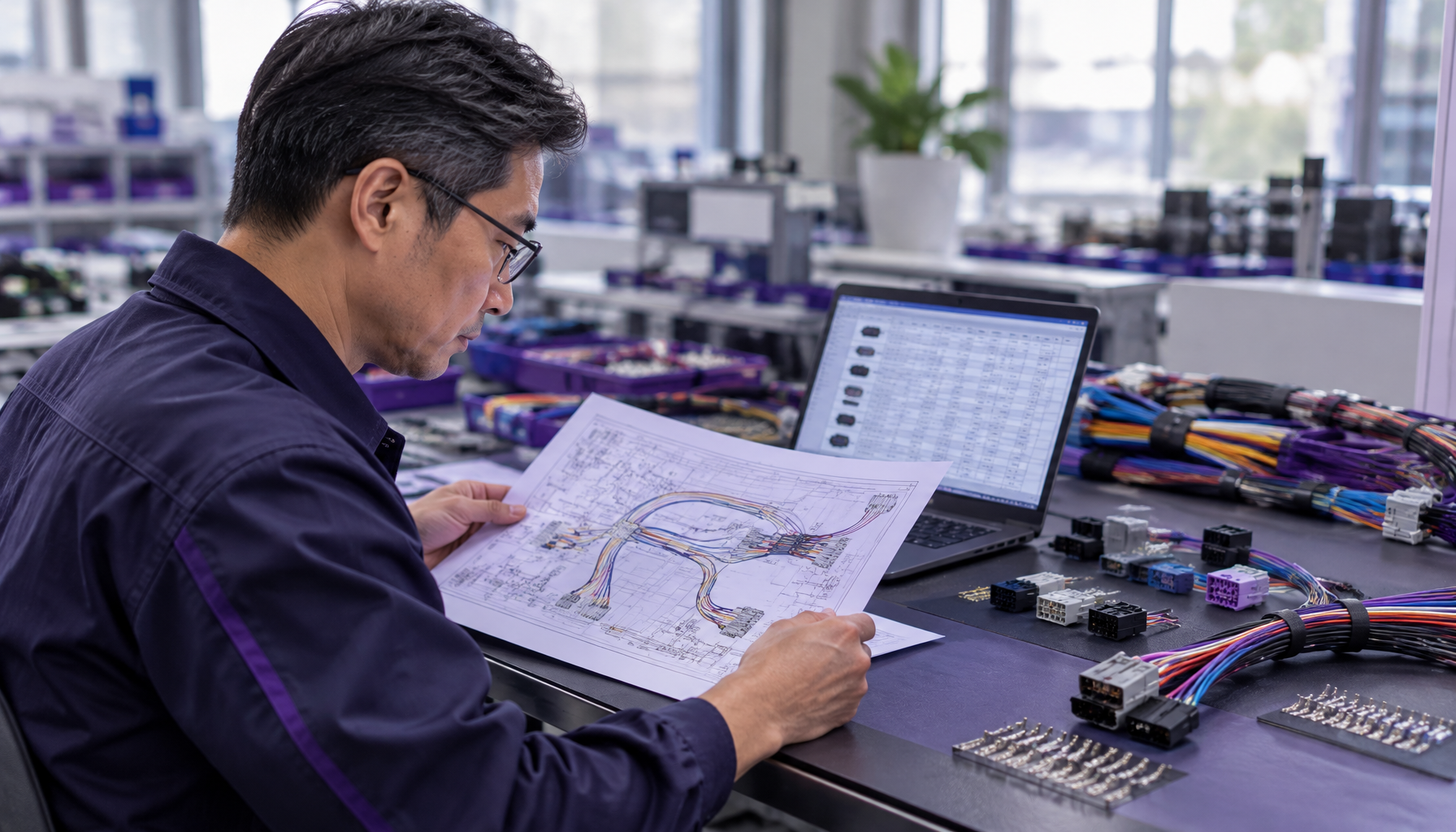
- A manufacturable wire harness assembly definition connects the drawing, BOM, wire list, and assembly operations.
- Missing part numbers and unclear connectivity can delay sourcing and leave material costs out of a quote.
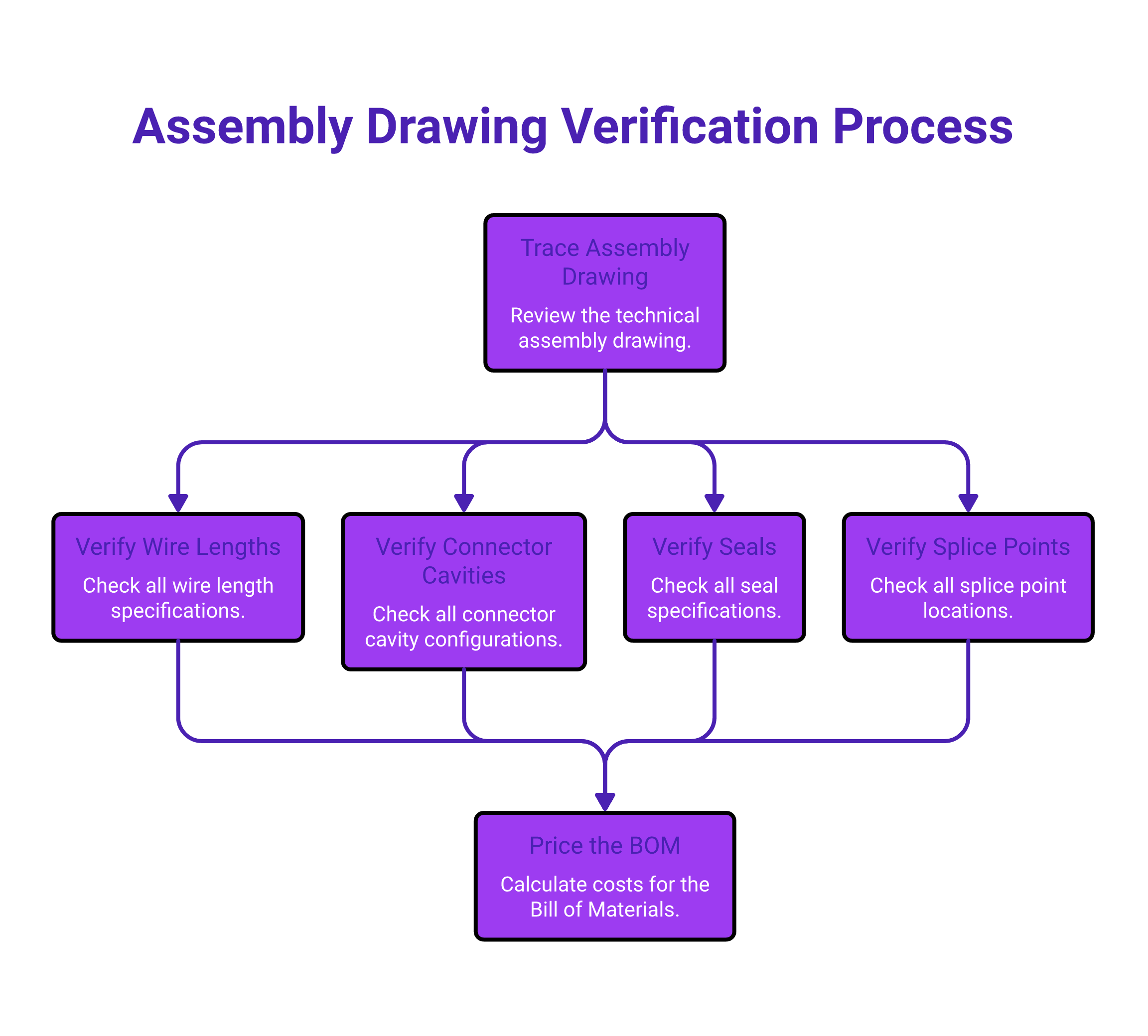
- Check connector compatibility, wire lengths, seals, and splice points before estimating labor.
- Record assumptions and unresolved questions so engineering, purchasing, and estimating can review the same package.
Five steps turn wire harness assemblies into a reviewable build package and quote.
One often-missed step: checking the routing before pricing the BOM.
For a manufacturing engineer, the work starts with an RFQ that may contain a drawing, a parts list, and unanswered questions. A disciplined review turns those inputs into a verified BOM, an operation-based estimate, and a handoff that the shop can use.
In our State of Wire Harness Operations 2026, 70% of 23 survey respondents cited BOM or design completeness as a challenge. The survey is directional, rather than representative of the entire industry.
Build a Wire Harness Assembly Quote
Follow these five steps from RFQ receipt through engineering handoff.
-
Check the RFQ package. Identify each assembly, drawing revision, BOM, connector table, and from-to wire list. Record missing files and unclear requirements before asking the customer for clarification.
-
Build and verify the BOM. Match each customer part number and description to a manufacturer part number where available. Cross-check quantities against the drawing and mark alternates as pending until approved.
-
Trace the assembly. Review wire gauges, lengths, breakouts, splice points, connector cavities, and protective coverings. Check terminals, seals, and cavity plugs against the specified connectors and wires.
-
Price materials and operations. Capture supplier prices, lead times, units of measure, and sourcing assumptions. Estimate cutting, stripping, termination, splicing, bundling, labeling, inspection, and test preparation as applicable.
-
Review and release the quote. Bring engineering, purchasing, and estimating together to resolve open questions. Record material, labor, overhead, margin, and approval assumptions in the handoff.
The failure point is often a BOM that looks complete before anyone traces the drawing. An omitted seal or an unresolved wire length can move from an engineering question into an understated material or labor estimate.
Record the Information the Shop Needs
A useful RFQ check gives each open issue an owner and a next action. The minimum data set discussion addresses the need for usable information from quote through build.
For a sample assembly, an intake record could read:
- Drawing and revision: Received and legible; confirm the latest revision.
- Connector and terminal: Connector identified; terminal part number missing. Engineering requests clarification.
- Wire list: Gauge and endpoints supplied; one branch length unclear. Engineering checks the drawing.
- Sourcing: Purchasing records price, lead time, and any proposed alternate after identification.
Our 2026 operations report found that 57% of respondents reported elapsed RFQ turnaround of at least six business days. Supplier pricing and customer clarification were the most frequently cited delay drivers, so send questions and supplier requests as soon as the gaps are known.
Connect Topology to Materials and Labor
A BOM identifies components; the assembly drawing explains how they connect and where work occurs. A breakout changes routing and covering needs, while a splice joins conductors and adds a termination operation.
Check each wire from its starting cavity to its destination. Include branch lengths, connector accessories, shielding or backshell work where specified, and the covering needed for each bundle. Keep unconfirmed details visible so the estimator can qualify the quote.
A labor template can capture the work without assigning unsupported standard times:
- Operation: Crimp terminals.
- Quantity or driver: Number of applicable terminations.
- Setup or handling note: Terminal and tooling requirements from the build package.
- Time basis: Shop historical data or estimator input.
- Review: Record an override and its reason for unusual work.
Historical data and estimator overrides are useful inputs to wire harness labor estimation. An estimate should also account for operations such as shield termination and test preparation when the assembly calls for them.
Document the Quote and Handoff
Separate material, labor, overhead, and margin so a reviewer can see what changed when an assumption changes. Attach open questions and customer-approved alternates to the same assembly revision.
A practical quote breakdown contains:
- Materials: Wire, connectors, terminals, seals, coverings, and approved alternates.
- Labor: Operation quantities, time basis, setup notes, and overrides.
- Sourcing: Supplier, price, lead time, and unit of measure.
- Commercial review: Overhead, margin, qualifications, and approval status.
A spreadsheet can hold this structure for a small workload. For repeated RFQs, our quoting automation overview discusses ways to reduce repeated data entry while keeping the engineer responsible for validation.
Test the Process on Your Next RFQ
Choose one incoming assembly and track its open questions from receipt through quote approval. Compare the elapsed time with active estimating time, then use the record to decide which handoffs need attention.
A verified assembly package gives your team a basis for faster quotes, and our tools can reduce the manual work needed to prepare it.
FAQ
Q: What is a wire harness assembly?
A: A wire harness assembly is a set of wires and components arranged to connect electrical points. Its build definition can include connectors, terminals, protective coverings, splice points, and routing details.
Q: What should a manufacturing engineer check first?
A: Start with the completeness and revision of the RFQ package. Missing part numbers, illegible drawings, or unclear connectivity can hold up both sourcing and the estimate.
Q: How do wire lengths affect a quote?
A: Lengths affect wire quantities and can influence handling and routing work. Trace each path and flag dimensions that require customer confirmation.
Q: Can an alternate component be included in a quote?
A: An alternate can be proposed when the specified part is unavailable or another source is being considered. Record its approval status and confirm compatibility before treating it as an accepted build component.
Q: How should a team estimate assembly labor?
A: Break the assembly into applicable operations and use shop historical data as the time basis. Document setup needs and estimator overrides for work that differs from past builds.
About Cableteque
Cableteque combines over three decades of hands-on industry expertise with a commitment to innovation in wire harness software. Founded by Arik Vrobel, our team brings together engineers, operators, and business leaders who deeply understand the challenges related to wire harnesses.
We focus on solving the toughest problems across the entire design-through-manufacturing lifecycle, helping teams work smarter, faster, and with greater precision.
Our company thrives on innovation, inclusivity, and collaboration. We value individuality, sustainability, and making a positive impact, building trust and shared success every step of the way. We are the only company creating software designed by wire harness people, for wire harness people. Our goal is to simplify communication between OEMs and contract manufacturers, automate workflows and help businesses grow.
Cableteque isn’t just a tool; it’s an evolving platform built to empower engineers, supply chain specialists, sales teams, and manufacturing professionals to do their best work. Our company thrives on innovation, inclusivity, and collaboration.