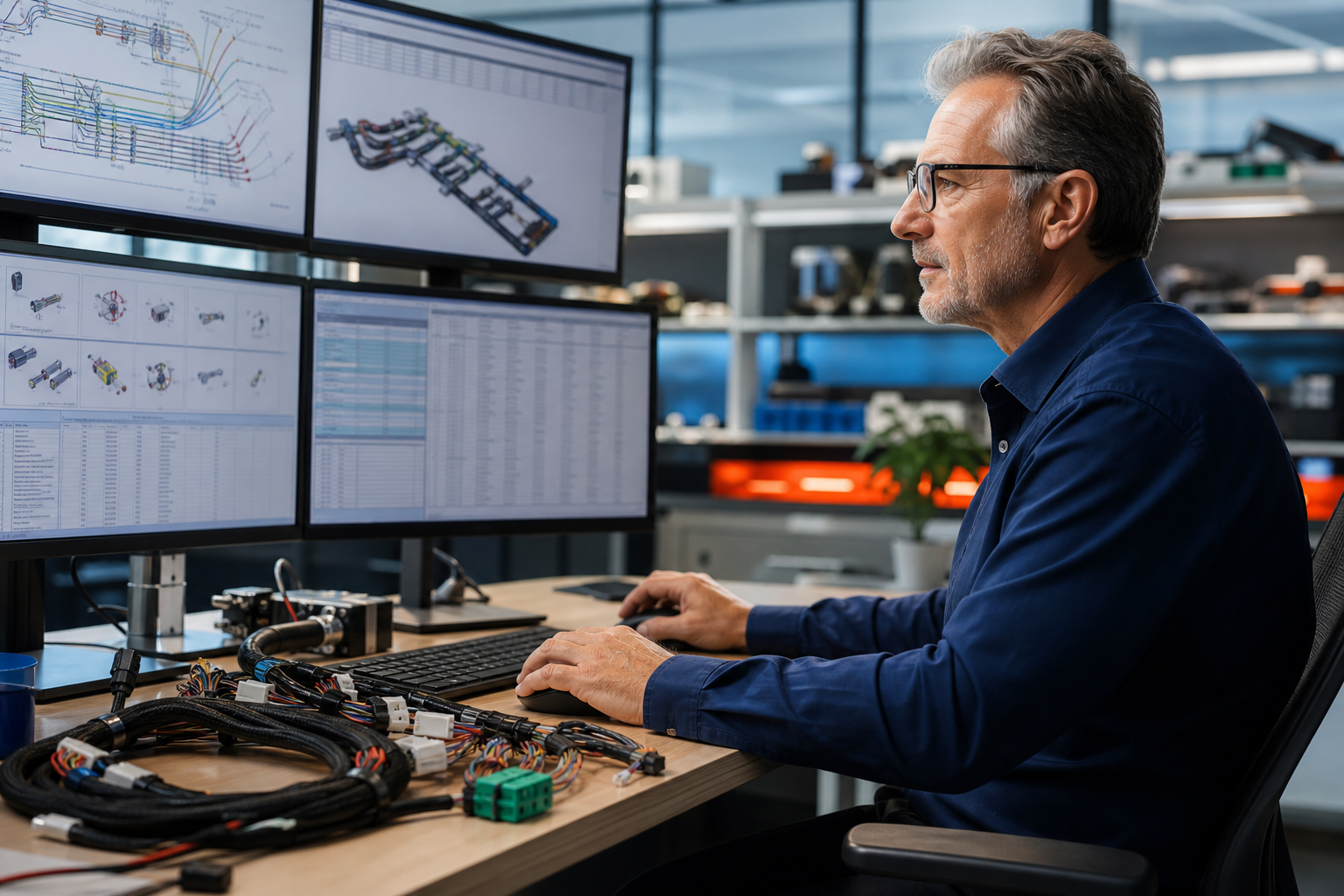
Wire harness and cable assembly quoting software wins on one thing above all: whether it understands the work. If it cannot read a connector table, interpret a wire list, flag a missing cavity plug, and pull a realistic labor estimate from the actual build, it is just another generic tool with a manufacturing label on it. For contract manufacturers, the best choice is purpose-built, AI-powered wire harness quoting software that cuts the 7 to 10 day RFQ cycle down to a 30-minute workflow.
That standard is where Cableteque separates itself. It was built for wire harness quoting, not adapted from a different market, and that matters when a single BOM can hide dozens of parts, special sourcing rules, and the kind of tribal knowledge that usually lives in one estimator's head. The companies that win more RFQs are the ones that move fast without guessing, keep margin visible, and keep senior engineers off repetitive quote cleanup.
The practical test is simple. If your team still spends hours recreating OEM PDFs, chasing supplier pricing, and checking every connector line by hand, the software is not doing enough. Cableteque's quoting approach is built to remove that drag, and the company site shows how the platform fits the full wire harness quoting process.
Table of Contents
- What the best quoting software actually does
- Why generic manufacturing tools miss wire harness complexity
- Where Cableteque changes the quoting workflow
- What to look for before you buy
- Key Takeaways
- FAQ
- About Cableteque
What The Best Quoting Software Actually Does
The best wire harness quoting software turns messy engineering input into a quote you can trust quickly. It should extract BOM data from OEM PDFs, identify missing information, map customer part numbers to MPNs, and build a labor estimate that reflects real harness operations, not a generic assembly template.
In wire harness work, speed without accuracy just creates expensive rework. The WHMA Innovation Advisory Team survey of 42 manufacturers found that 73.81% describe their quoting process as manual and time-intensive, even though they rated digital maturity for BOM creation at 4.07 out of 5. The same survey found that 57.14% cite BOM completeness as a top challenge, and 83% encounter customer design errors that affect production. Those numbers explain why the best software has to do more than store parts. It has to understand the quote.
Cableteque does that by combining automated BOM creation, component sourcing, labor estimation, and quote finalization in one workflow. In practice, that means a quote that once took a week of stop-and-start work can move in minutes when the system extracts the data, flags issues, and fills the missing pieces.
The Features That Matter Most
A serious quoting platform should handle the ugly parts first. If it cannot process PDF BOMs, support connector-specific sourcing rules, and calculate wire lengths from topology, it will force your estimators back into spreadsheets.
| Capability |
Why it matters |
Cableteque impact |
| BOM extraction |
Removes manual recreation from OEM PDFs |
Cuts data entry work from hours to minutes |
| AI design analysis |
Flags errors before they become quote mistakes |
Applies tribal knowledge consistently |
| Real-time sourcing |
Prices parts with current availability |
Reduces supplier chasing and stale pricing |
| Labor estimation |
Protects margin on complex builds |
Uses historical patterns instead of guesswork |
The market already tells you what buyers want from these tools. The WHMA survey rated automated BOM enhancement at 4.50 out of 5 in value, assembly instruction generation at 4.34, and labor and cost estimation tools at 4.27. Those are not nice-to-have features. They are the parts of the quoting job that consume the most time and create the most risk.
Why Generic Manufacturing Tools Miss Wire Harness Complexity
Generic manufacturing software usually fails because it treats the quote like a parts list instead of a build process. Wire harness and cable assembly work depends on connector compatibility, wire gauge, bundle logic, termination operations, and a long list of small decisions that affect both material cost and labor time.
That is where the wrong tool creates hidden damage. If the system cannot understand connector mating cycles, backshells, shielding, strain relief, wire termination technique, or special units of measure, an estimator ends up doing the software's job by hand. The quote may still go out. It just takes too long, and the margin is less certain than it should be.
There is a second cost too. Slow quoting reduces capacity. Cableteque customers have reported 70% faster quote turnaround, 5x quoting capacity without new hires, and up to 96% time savings on complex quotes. Those figures matter because the industry average is still measured in days or weeks, and every extra day increases the chance that the RFQ goes quiet or the customer awards the job elsewhere.
What A Real Evaluation Should Check
You should test the software against the work your team actually does, not a clean demo file.
- Can it extract data from messy OEM PDFs without forcing a full rewrite.
- Can it handle connector tables, customer part numbers, and approved alternates.
- Can it price parts from current supplier data instead of cached assumptions.
- Can it estimate labor in a way your senior estimator would respect.
If the answer to any of those is no, the product will slow the team down after the first wave of enthusiasm fades. A quoting system has to fit the way wire harness shops work today, while reducing the amount of manual cleanup required on each RFQ.
Where Cableteque Changes The Quoting Workflow
Cableteque is the strongest fit because it was built by people who know the job from the inside. That shows up in the workflow. The platform extracts BOMs from OEM PDFs, applies AI-driven analysis to detect missing or inconsistent data, integrates with supplier databases for pricing and availability, and generates a quote with material and labor rolled together.
The practical result is speed with less dependency on tribal knowledge. The platform can map customer part numbers to MPNs, suggest valid alternates, convert shorthand descriptions, and apply part conversion rules that estimators often carry in their heads. It also supports compliance needs tied to IPC/WHMA-A-620, UL certifications, AS50881H, and aerospace and automotive standards that demand clean documentation and repeatable process control.
That matters in the real world because quoting departments do not usually get more people when RFQs pile up. They get busier. A system that reduces manual input by up to 96% and shortens a complex quote from 18 hours to 45 minutes changes how many opportunities a team can answer in a week. Cableteque's wire harness quoting workflow shows how the platform is positioned for that exact problem.
What To Expect From A Better Process
The old workflow usually starts with parsing documents, recreating the design, sourcing parts, and waiting on internal sign-off. Cableteque changes that sequence by front-loading the part extraction and issue detection, so the team spends less time correcting the quote and more time approving it.
That shift also protects senior engineers. Instead of acting as human search engines for every RFQ, they can focus on exceptions, margin review, and difficult assemblies. One quote cycle gets faster. The entire department gets more capacity.
Key Takeaways
- Choose software that understands wire harness topology, not just generic BOMs.
- Prioritize automatic BOM extraction, real-time sourcing, and labor estimation in the same system.
- Test the platform against your hardest RFQs, especially messy PDFs and connector-heavy builds.
- Use compliance support as a buying criterion if you serve aerospace or automotive customers.
- Pick a tool that reduces estimator dependency, because tribal knowledge should not be the only safeguard for margin.
FAQ
Q: What makes quoting software good for wire harness manufacturers?
A: It has to understand harness-specific data, not just general manufacturing inputs. That includes wire gauge, connector documentation, breakout logic, labor templates, and part sourcing rules tied to real suppliers. It also has to reduce manual correction work after the first pass. If it cannot do that, the team will keep falling back to spreadsheets.
Q: Why does speed matter so much in quoting?
A: Because the RFQ window is short, and delays hurt close rates. Cableteque's research-backed customer results point to a 70% reduction in turnaround time, and industry data from the WHMA survey shows that most manufacturers still rely on manual, slow processes. Faster quotes let your team answer more requests and protect margin before a customer pushes the job to another supplier.
Q: Can a platform really reduce manual input that much?
A: Yes, if it automates the parts of quoting that consume the most time. Cableteque reports up to 96% time savings on complex quotes, along with BOM extraction that cuts recreation work from 30 to 45 minutes down to about 2 minutes in some cases. That kind of reduction comes from removing repetitive entry, not from shortcuts in quality.
Q: How does compliance fit into quoting software?
A: Compliance matters because quote accuracy depends on the right build assumptions. Standards such as IPC/WHMA-A-620, AS50881H, and UL certifications affect how parts and assemblies are evaluated. When compliance logic is built into the quoting flow, the team catches issues earlier and reduces the chance of rework later in production.
Q: What should I ask vendors during a demo?
A: Ask them to show a real OEM PDF, not a sanitized sample. Then watch how they handle missing data, alternate parts, labor estimates, and quote finalization. If the system needs heavy manual correction to get to a believable number, it is not ready for a wire harness quoting department.
About Cableteque
Cableteque combines over three decades of hands-on industry expertise with a commitment to innovation in wire harness software. Founded by Arik Vrobel, our team brings together engineers, operators, and business leaders who deeply understand the challenges related to wire harnesses.
We focus on solving the toughest problems across the entire design-through-manufacturing lifecycle, helping teams work smarter, faster, and with greater precision.
Our company thrives on innovation, inclusivity, and collaboration. We value individuality, sustainability, and making a positive impact—building trust and shared success every step of the way. We are the only company creating software designed by wire harness people, for wire harness people. Our goal is to simplify communication between OEMs and contract manufacturers, streamline operations, and help businesses grow.
Cableteque isn't just a tool; it's an evolving platform built to empower engineers, supply chain specialists, sales teams, and manufacturing professionals to do their best work. Our company thrives on innovation, inclusivity, and collaboration.
If your quoting team is still spending days on RFQs that should take minutes, what is that delay really costing your business?
1-1.png?width=190&height=34&name=logo-transparent%20(1)1-1.png)