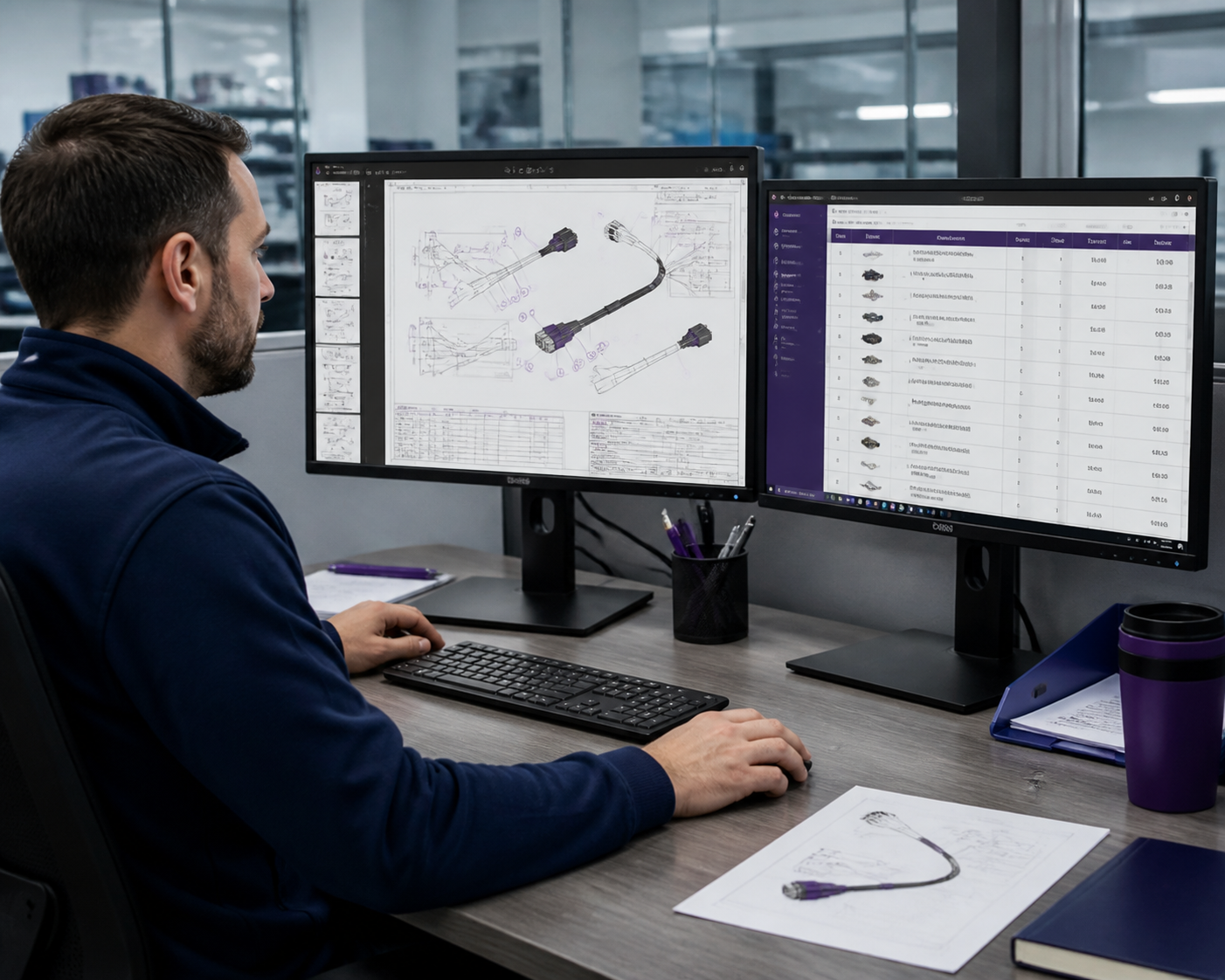
The best wire harness quoting software is purpose-built for the way harness quotes actually work: PDF drawings in, structured BOMs out, real-time pricing from your distributors, and labor estimated from actual operation counts. General quoting tools, ERP modules, and search aggregators fall short because they weren't built for this workflow. For a full breakdown of why search aggregators specifically fall short, see Beyond Search: Why Wire Harness Quoting Requires Purpose-Built Intelligence. This guide walks through what to look for and how to evaluate fit for your operation, wherever you're quoting from.
Why most quoting tools are the wrong tool for wire harnesses
Before evaluating specific platforms, it helps to understand why so many manufacturers end up with tools that don't fit. Wire harness quoting has three characteristics that trip up general-purpose software:
Unstructured inputs.
Wire harness manufacturers receive customer drawings, not clean digital BOMs. 90% of RFQs arrive as PDFs. A quoting tool that requires a structured BOM as its starting point forces your estimator to manually recreate that BOM from the drawing first. That manual step, which takes 30 to 45 minutes per assembly, is where most quoting time disappears.
Wire-specific sourcing complexity.
Wire and cable are priced by the foot, meter, inch, spool, or reel depending on the distributor. A tool that handles discrete electronic components but can't normalize wire pricing units will produce inaccurate BOMs no matter how good its part library is.
Labor estimation from drawing operations.
Wire harness labor is estimated by counting operations: crimps, splices, cuts, routing steps, connector insertions. A general quoting tool with no concept of harness topology can't generate labor estimates from the drawing. That calculation stays manual.
Any software you evaluate should answer yes to all three: can it extract BOMs from PDFs automatically, handle wire and cable units correctly, and estimate labor from drawing operations?
The five criteria that matter most
1. BOM extraction from customer drawings
This is the most important capability. If the software can't read a customer PDF and automatically generate a structured BOM, your estimator is still doing the most time-consuming part of the job by hand. Look for AI-powered extraction that handles multiple drawing formats (PDF, TIFF, Excel, CSV, native CAD exports), flags low-confidence items for human review rather than guessing, and handles multi-assembly packages in a single upload.
2. Distributor integrations and contract pricing
The pricing data in your quote needs to reflect what you'd actually pay, not catalog list pricing. The integrations that matter are the distributors your team actually buys from, and that list looks different depending on where you operate and what you build. A platform built around one region's supply chain won't price accurately for another, so look for real contract pricing coverage across the distributors your team uses, wherever you buy. For a closer look at how this works in a live quote, see how Cableteque Quote uses your negotiated distributor pricing instead of list prices.
3. Wire-specific sourcing support
This is where most general tools fail entirely. Your platform needs to handle wire and cable descriptions accurately: descriptive inputs like "16 GXL Red" should map to real MPNs, unit of measure conversions should be automated (feet to meters, inches to spools), and harness-specific consolidation logic should calculate total wire length needed across circuits rather than treating every run as a separate line item.
4. Labor estimation from operation counts
The platform should read your customer's drawing and count operations, the way an experienced estimator does, rather than relying on historical part-level times. Labor typically represents 40 to 60% of a wire harness assembly's total cost, so getting this estimate right matters more than any other single input in your quote. Preconfigured templates with your company's time standards, 50 to 70% auto-population of operation counts from the BOM, and manual override for complex situations is the right model.
5. Compliance capability for your customer mix
Compliance requirements follow your customer base, not your headquarters. If you work on defense, aerospace, or other controlled programs, you need ITAR registration, CMMC compliance, data isolation between commercial and controlled projects, and, for US federal work, an AWS GovCloud deployment option. If your customer base spans multiple regions, look for a platform that treats compliance as core to its architecture rather than a regional add-on, so the same rigor applies wherever a project originates.
What is currently available
Most manufacturers evaluating a change today are choosing between a few broad categories of tools.
Manual processes and spreadsheets
Still the most common approach across the industry. The WHMA survey shows 73.81% of manufacturers describe their quoting as manual and time-intensive. Spreadsheets give you flexibility but no automation, no real-time pricing, no way to capture what your best estimators know, and no consistency across the team. Every senior estimator does it a little differently, and when they leave, that knowledge leaves with them.
ERP quoting modules
ERPs are excellent systems of record for production, inventory, and accounting, but their quoting modules weren't designed for the front end of wire harness quoting. Manual BOM entry is required, pricing data is often static, and there's no PDF extraction or harness topology awareness built in. An ERP belongs downstream of the quote, handling what happens after a job is won, not at the front end where speed and accuracy matter most.
Design-linked quoting tools
Tools built into CAD environments work well for manufacturers that receive customer designs already in a compatible CAD format and can recreate or access the native design files. The limitation for most contract manufacturers is that this requires the design to be in CAD first. Wire harness CMs typically win around 20% of the jobs they quote, so recreating every customer drawing in CAD before pricing isn't realistic at the volume most manufacturers work at. For a closer look at how the two approaches stack up, see our full comparison in wire harness quoting vs cad tools.
General-purpose quoting and CPQ platforms
These cover a wide range of manufacturing categories, but wire harness assemblies have requirements those platforms weren't built to handle: wire and cable priced by the foot or meter instead of by unit, labor driven by crimps and splices instead of part counts, and BOMs that arrive as PDF drawings instead of structured data. A platform without harness-specific logic behind it needs workarounds for all three.
Purpose-built wire harness quoting platforms
A newer category, built around BOM extraction from customer drawings, wire-specific sourcing, and operation-based labor estimation as core features rather than workarounds bolted onto a general tool. Cableteque falls into this category: BOM extraction from AI trained specifically on wire harness drawings, building the BOM and wire list automatically, real-time distributor pricing at contract rates, and labor estimation driven by drawing operations rather than historical averages.
The benchmark for any software you evaluate is whether it meaningfully improves on the categories above: accurate BOM extraction from customer drawings, real-time pricing, and labor estimation that doesn't rely on one person's head.
Where Cableteque fits
Cableteque's approach to the purpose-built category above looks like this in practice, and it's built from the ground up to support operations across regions, not just a single domestic market.
BOM extraction and drawing interpretation run on AI trained specifically on wire harness drawings, pulling structured BOMs from PDF, TIFF, Excel, CSV, and native CAD exports, including formats like Zuken and Capital, in whatever format your customers actually send. Wire-specific sourcing covers more than 80,000 wire description mappings, so a callout like "16 GXL Red" resolves to a real manufacturer part number instead of a manual lookup. Labor estimation runs from template-driven operation counts pulled straight from the drawing, the way an experienced estimator would count crimps, splices, and routing steps, with your own company's time standards built into the templates.
On sourcing, Cableteque runs more than 20 live distributor integrations at contract pricing, including TTI, Heilind, Avnet, Arrow, DigiKey, Mouser, IEWC, and Anixter. These are live connections, not a static price list. Pricing and availability pull automatically at your own negotiated rates, so a quote reflects what you'd actually pay that day instead of a list price that's gone stale by the time the job is won. That matters most on the parts that move fastest, connectors and terminals with volatile lead times, where a quote built on outdated pricing either erodes margin or loses the bid.
Cableteque also runs a free tool search platform at tooling.cableteque.com, where teams look up compatible tooling by part number against a searchable component data library, cutting out the manual cross-referencing that otherwise eats time when specing a new job.
On compliance, Cableteque is ITAR registered, with CabletequeGov hosted on AWS GovCloud, listed as Legacy FedRAMP Ready, Class C (Moderate), and supporting customers working toward CMMC requirements, plus data isolation between commercial and controlled projects. As the platform's customer base grows outside North America, that same compliance-first architecture underpins meeting each region's requirements, rather than treating them as an afterthought.
The results show up in the numbers. KCM Cable reduced a single complex quote from 18 hours to 45 minutes. Resco Electronics went from 30-day backlogs to 2 to 3 day turnaround. Derrick Lang, with 30 years in wire harness manufacturing, cut turnaround by 70% and increased quoting capacity 5x without adding headcount.
Questions to ask before you buy
-
Can I upload one of our actual customer PDFs in a demo and watch the BOM and wire list get built live?
-
Which specific distributors does the platform integrate with, and does that include my actual suppliers?
-
Does it pull my negotiated contract pricing or generic list pricing?
-
How does it handle wire and cable pricing when units of measure differ between my spec and the distributor listing?
-
How does labor estimation work, and does it count operations from the drawing or rely on historical averages?
-
If we work on ITAR-controlled programs, what compliance infrastructure does the platform have?
-
What does onboarding look like, and how long before we're quoting live jobs through the platform?
Red flags to watch for
A few signals are worth flagging before you sign anything. If a vendor can't explain how their system handles wire length calculations, crimp operations, or harness topology specifically, in plain terms and with more detail than "we support manufacturing," they weren't built for wire harnesses. If the platform relies on a single distributor feed or cached pricing data instead of live integrations across multiple suppliers, your quotes will be built on numbers that are already stale. If regulated work is part of your business and the vendor treats compliance as an afterthought rather than something built into the platform from the start, that gap will show up eventually, usually at the worst time. And if the implementation timeline runs past a few months, that's often a sign of more complexity than the problem actually requires.
What good quoting software does for your business
The operational impact of the right quoting platform compounds over time. Faster turnaround means you can answer more RFQs in the same window. More accurate pricing means fewer post-award cost surprises and better margin on won jobs. Codified tribal knowledge means junior estimators produce quotes with veteran-level consistency. And reduced dependence on one or two key people means your quoting operation survives turnover without a capacity crisis.
The WHMA survey found that 73.81% of manufacturers still describe their quoting as manual and time-intensive. The manufacturers that change that equation first are building an advantage that compounds. See how Cableteque works for wire harness manufacturers.
Download: Making the Decision to Transform Quoting
FAQ
What is the best wire harness quoting software for contract manufacturers?
The best wire harness quoting software is purpose-built for the wire harness workflow: BOM extraction straight from customer drawings, wire-specific sourcing at real contract pricing, operation-based labor estimation, and compliance infrastructure that matches your customer mix. Cableteque is built around all of these requirements, with a distributor network and compliance architecture designed to support operations across North America and Europe.
How is wire harness quoting software different from general quoting or CPQ tools?
General quoting and CPQ tools expect a structured BOM as their starting point. Wire harness manufacturers receive PDF drawings, not structured BOMs, so a general tool still requires manually recreating the BOM first. Wire harness quoting software also has to handle wire-specific pricing units, harness topology for consolidation and wire length calculation, and operation-based labor estimation, none of which exist in general CPQ tools.
Does wire harness quoting software work with the CAD tools we already use?
It should. Cableteque works from customer drawings in any format, PDF, TIFF, Excel, CSV, or native CAD exports including Zuken and Capital, without requiring a design to be recreated in a specific CAD system first. For contract manufacturers quoting from customer PDFs day to day, that input flexibility determines whether the tool fits your workflow.
Can wire harness quoting software integrate with my ERP?
Yes. Cableteque integrates with common ERP and MRP systems to show current inventory alongside market availability, supporting make-versus-buy decisions at the quoting stage. The ERP handles production, inventory, and accounting downstream while Cableteque handles the front-end quoting workflow where speed and accuracy matter most.
How long does it take to implement wire harness quoting software?
Most manufacturers are quoting live jobs through Cableteque within a few weeks. Onboarding covers configuring your labor templates with your company's time standards, connecting your distributor accounts for contract pricing, and setting up your approved vendor list. Cableteque's team supports you throughout the process. A pilot on 10 to 20 representative quotes is the recommended starting point to validate the approach before full rollout.
Quoting from Europe? See What Is the Best Wire Harness Quoting Solution for European Manufacturers? for data hosting, European distributor pricing, and language support.
References
"WHMA Wire Harness Industry Survey Data." Wire Harness Manufacturers Association.
"Wiring Harness Software at a Crossroads: Looking Back, Looking Forward." Wiring Harness News, May 2025.
"Accelerating Wire Harness Design, Quoting, and Manufacturing with Digital Thread Integration." Wiring Harness News, April 2026.