Key Takeaways
- Excel is familiar, but it depends on manual entry, version discipline, and tribal knowledge that break down when RFQs pile up.
- Wire harness quoting is full of connector tables, wire lengths, alternates, units of measure, and labor logic that spreadsheets do not standardize well.
- A WHMA Innovation Advisory Team survey of 42 manufacturers found 73.81% still describe quoting as manual and time-intensive, while 47.62% still use Excel or Word-based methods.
- Purpose-built electrical wire harness quoting solutions cut BOM creation, material sourcing, and quote turnaround time far more consistently than spreadsheet quoting.
- The business case is simple, faster quotes protect margin, reduce estimator load, and keep senior engineers focused on exceptions instead of repeat data cleanup.
Introduction
Wire harness quoting has outgrown the spreadsheet. Excel still gets used because it is already installed, easy to bend into a BOM template, and familiar to estimators who have been cleaning up OEM PDFs for years. But when the package includes connector tables, wire gauges, alternates, lengths, terminations, and unit conversions, the manual quoting process starts to fail in predictable ways.
That failure shows up in the numbers. In the WHMA Innovation Advisory Team survey of 42 contract manufacturers, 73.81% described quoting as manual and time-intensive, and only 9.52% said their process was highly automated and scalable. For teams handling Automotive, Aerospace, Industrial, EV, Medical, and Machinery work, the question is no longer whether Excel can hold the data. The question is whether it can keep pace with wire harness assemblies that arrive as PDFs, need fast BOM creation, and demand accurate material sourcing before the RFQ window closes.
I have seen estimating teams lose a job by a day, then lose the margin on the next one by a bad cell. The pattern is familiar. Someone copies a connector cross-reference from one sheet, another person updates labor estimation in a different file, and a third version lands in an inbox with a stale alternates list. The quote looks organized right up until the customer asks for clarification.
Table of Contents
- Why Excel Still Shows Up in Wire Harness Quoting
- Where Excel Breaks Down in Real Wire Harness Quotes
- What Cableteque Automates That Excel Cannot
- Excel vs Cableteque: Speed, Accuracy, and Margin
- When to Move Beyond Spreadsheets
- Why Cableteque Is Built for Wire Harness People
- FAQ
- A Better Way to Handle the Next RFQ
- About Cableteque
Why Excel Still Shows Up in Wire Harness Quoting
Excel stays in the quoting department because it is familiar, cheap, and already approved by IT. Teams use it for BOMs, labor templates, part cross-references, and quote tracking because it can be made to fit almost any process with enough manual work. That flexibility has real value for small teams that do not want a long software rollout before the next RFQ lands.
The appeal is practical. There is no implementation project, no training program that stalls production, and no new login to chase down when someone needs a quick number. For a small estimating team, that can feel like the safest path.
The cost shows up later. Spreadsheets depend on disciplined version control, consistent naming, and people who already know the product family by heart. Once RFQ volume rises, those habits get tested. The WHMA survey found 57.14% of manufacturers named BOM or design completeness as their top challenge, and 47.62% cited sourcing and materials difficulty. That is exactly where Excel starts asking people to remember what software should have remembered for them.
Why Familiar Tools Persist
A spreadsheet can hold a part list. It can also hide a mistake very well. That is the problem.
For simple jobs, Excel can feel good enough. For wire harness quoting, good enough often means one missed alternates rule, one outdated customer part number, or one broken link between the BOM and labor estimate.
| Reason teams keep Excel |
What it helps with |
Where it breaks |
| Familiarity |
Quick setup and low training burden |
No built-in logic for wire harness assemblies |
| Flexibility |
Custom columns, formulas, and formatting |
Each estimator builds a different method |
| Low upfront cost |
No software budget decision |
Manual cleanup grows with quote volume |
Where Excel Breaks Down in Real Wire Harness Quotes
Excel breaks when the quote is no longer just a list of parts. The moment a package includes multiple assemblies, inconsistent naming, scanned drawings, or missing notes, the spreadsheet turns into a bookkeeping task instead of a quoting system. That slows BOM creation and makes material sourcing dependent on memory.
The biggest drag is manual recreation from OEM PDFs. Someone reads the drawing, copies the BOM into a sheet, cleans up descriptions, checks customer part numbers, and then starts cross-referencing MPNs and alternates. Cableteque's comparison material notes that this kind of line-by-line recreation can take hours per assembly, and in the same market, average quote turnaround still runs 1 to 3 weeks while customers expect same-day or next-day responses.
Excel also struggles with the technical detail that wire harness quoting demands. Wire lengths, connector compatibility, protective covering, cavity plugs, seals, pull-force expectations, and labor estimation all need rules, not just rows. When one estimator knows the tribal knowledge and another does not, the quote may still look complete, but the first production issue shows the gap.
Version sprawl makes things worse. One file tracks sourcing, another tracks costing, and a third has the latest customer revision. If multiple people touch the same package, it only takes one bad cell to distort margin, delay the response, or push a quote out of the win window. Cableteque's own business case ties slow turnaround to revenue leakage and estimates a 10% to 30% win-rate loss for every week of quote delay beyond three days.
The Hidden Cost of Spreadsheet Quoting
This is where the process turns expensive. Not because Excel is broken in general, but because it depends on the right person correcting the right cell at the right time.
The WHMA survey makes the pattern hard to ignore. 83% of respondents said they encounter customer design errors affecting production, and 45.24% said there is too much variability to standardize. Those numbers explain why a spreadsheet can feel manageable in the morning and fragile by the afternoon.
What Cableteque Automates That Excel Cannot
Cableteque automates the parts of wire harness quoting that spreadsheets force people to do by hand. It starts with instant design import, which pulls BOM data from OEM PDFs and cuts the manual recreation step by up to 96%. That alone changes the pace of BOM creation and gets estimators to a usable package far earlier.
From there, AI-powered analysis standardizes descriptions, maps customer part numbers to MPNs, and flags missing information before it becomes a late-stage surprise. It can convert notes like "blk tape" into black Tesa 3/4 inch tape, apply part conversion rules, and store approved alternates and source preferences by customer, part, or product line. For teams living inside Excel quoting, that kind of rule application is where the time disappears.
The sourcing layer adds more lift. Real-time supplier integration gives pricing and availability for thousands of components, backed by a parts database of more than 2,000,000 items. Cableteque also uses harness topology logic to calculate exact wire lengths from the PDF, identify missing terminals, cavity plugs, and seals, and estimate protective covering from bundle diameter logic. That is specialized work, and it is the kind of work a generic spreadsheet never learned to do.
The final step is quote generation. Instead of bouncing between sourcing, costing, and approval tabs, the platform aggregates material, labor, and overhead in one flow. Cableteque says that compresses a traditional 7 to 10 day quoting cycle into about 30 minutes.
What Changes When the Software Knows the Work
When the system knows what a connector table means, the estimator is no longer translating every line by hand. The quote becomes repeatable.
That repeatability matters because wire harness quoting is not a one-off task. It is a high-volume operating process. Cableteque's blog on how quote turnaround becomes a competitive advantage shows how faster sourcing and labor estimation remove the waits that compound across a full RFQ cycle.
Excel vs Cableteque: Speed, Accuracy, and Margin
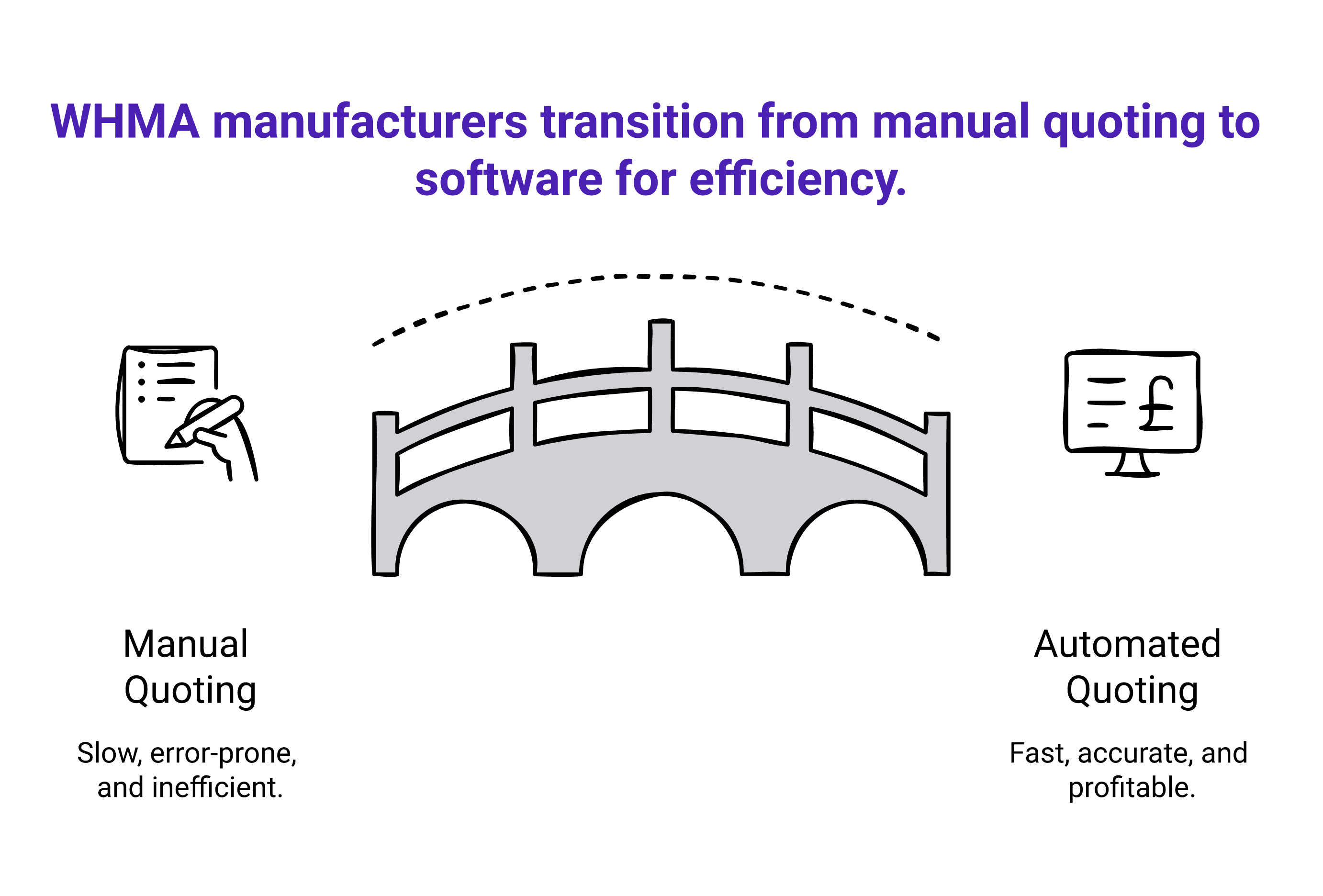
Excel is flexible, but Cableteque is faster when the RFQ includes multiple assemblies, PDF BOMs, and complex sourcing rules. The difference is not cosmetic. It changes how many quotes a team can touch in a week and how much review time senior engineers spend on exceptions instead of cleanup.
The WHMA survey gives the context. 47.62% of manufacturers still use Excel or Word-based quoting methods, while only 9.52% describe their process as highly automated and scalable. If nearly half the market is still leaning on manual office tools, the operational upside of purpose-built EWH quoting software is obvious.
A spreadsheet quote depends on estimator memory. A platform applies rules consistently. That matters when the same connector family appears across several harnesses and the source preference changes by customer or product line. It also matters when labor estimation needs historical data, not guesswork.
| Quoting task |
Excel workflow |
Cableteque workflow |
| BOM creation |
Manual copy from PDFs and cleanup |
Automated PDF import and extraction |
| Material sourcing |
Search by hand and update cells |
Real-time pricing and availability |
| Labor estimation |
Template-driven and person-dependent |
Historical logic and rule-based estimates |
| Error detection |
Found during review, if found at all |
Flags missing info on the first pass |
The margin impact is straightforward. A late quote loses attention before the price is even reviewed. A fast quote with better data gives the buyer less reason to delay. In a market where 73.81% of manufacturers still call quoting manual and time-intensive, shaving days off turnaround is not a convenience feature. It is a sales advantage.
When to Move Beyond Spreadsheets
The tipping point usually shows up before leaders admit it. Quote volume grows, the same two experts handle every hard RFQ, and turnaround time starts slipping from hours into days. Once that happens, Excel is no longer a cheap tool. It is a bottleneck with a familiar interface.
You should start looking harder at electrical wire harness quoting solutions when estimates vary by person, when one engineer becomes the only source of truth, or when a customer expects a response before your spreadsheet has been cleaned. The problem is not whether Excel can function at all. The problem is whether it can scale without adding more manual friction.
I have seen teams postpone the move because they fear disruption. That is reasonable. The better path is to run a new system in parallel with the existing quoting process, compare results on live RFQs, and let the numbers settle the argument. Cableteque is built to be non-disruptive to existing processes, so teams can test it without tearing out what already works.
The Sign You Have Outgrown Excel
If the first hour of a quote is spent finding the right version, you have already lost time.
If the second hour is spent reconciling part numbers, you have already lost focus.
If the third hour is spent asking senior engineering to recheck a labor line, you have already found the limit of spreadsheet quoting.
Why Cableteque Is Built for Wire Harness People
Cableteque is built for the work, not around it. The platform combines industry knowledge with AI so wire harness quoting, BOM creation, material sourcing, and labor estimation happen in one flow instead of across disconnected sheets and inbox threads.
Cableteque combines over three decades of hands-on industry expertise with a commitment to innovation in wire harness software. Founded by Arik Vrobel, our team brings together engineers, operators, and business leaders who deeply understand the challenges related to wire harnesses.
We focus on solving the toughest problems across the entire design-through-manufacturing lifecycle, helping teams work smarter, faster, and with greater precision.
Our company thrives on innovation, inclusivity, and collaboration. We value individuality, sustainability, and making a positive impact, building trust and shared success every step of the way. We are the only company creating software designed by wire harness people, for wire harness people. Our goal is to simplify communication between OEMs and contract manufacturers, streamline operations, and help businesses grow.
Cableteque isn't just a tool; it's an evolving platform built to empower engineers, supply chain specialists, sales teams, and manufacturing professionals to do their best work. Our company thrives on innovation, inclusivity, and collaboration.
That is why the slogan lands: Wire harness software, by wire harness people.
For a deeper look at the operating model, review the wire harness quoting software buyer's guide and the Excel vs Cableteque Quote comparison for wire harness quoting. If your team is still building quotes in spreadsheets, the next RFQ is a good time to test a better process.
FAQ
Q: Why do wire harness teams still use Excel for quoting?
A: Excel is familiar, already installed, and easy to adapt for quick BOM tracking. Many teams started there because it required no rollout and no special training. The problem is that wire harness quoting grows beyond simple rows and formulas very quickly. Once connector tables, wire lengths, alternates, and labor estimation enter the mix, manual spreadsheet work starts to slow the team down.
Q: Where does Excel usually fail first in wire harness quoting?
A: It usually fails at manual BOM recreation and part cross-referencing. A single OEM PDF can require line-by-line cleanup, and that creates room for transcription errors. Version control is another weak point, especially when several people edit the same quote package. One stale cell can affect cost, margin, or the final response time.
Q: What does purpose-built quoting software do better than spreadsheets?
A: Purpose-built software automates the steps that people repeat on every RFQ. It imports BOMs from PDFs, maps customer part numbers to MPNs, and uses sourcing data in real time. It also applies quoting rules consistently, which reduces dependence on senior estimators for every package. That consistency helps protect both speed and margin.
Q: How does Cableteque help with labor estimation?
A: Cableteque uses historical data and quote logic instead of leaving labor to a static template. That matters because wire harness labor is tied to termination operations, breakouts, bundling, and assembly complexity, not just part counts. When labor estimates are generated faster and more consistently, senior engineers can focus on exceptions. The result is less rework and a cleaner review cycle.
Q: Is it hard to switch away from Excel?
A: It does not have to be. A parallel-run approach lets teams test a new system while the current quoting process keeps moving. That lowers adoption risk and gives the team real comparison data. The best decision usually comes from looking at quote turnaround time, estimator load, and win rate, not from preference alone.
Q: Why does quote speed affect win rates so much?
A: Buyers often send several RFQs at once, and the first credible quote usually gets the most attention. If a team takes a week or more to respond, the customer may already be deep into another sourcing path. Slow quoting also invites more back-and-forth, which adds delay and pressure on margin. Faster response times give buyers a reason to keep the conversation moving.
Ready to Compare Your Spreadsheet Workflow to a Faster Quoting Process?
If your team is still rebuilding BOMs, chasing part numbers, and cleaning up quote files by hand, it may be time to compare that workflow against a platform built for wire harness quoting. Cableteque turns slow spreadsheet work into a faster, more accurate process that can help protect margin and free up senior engineers for higher-value decisions.
Would you like to see what your next RFQ looks like when the manual work drops away?
About Cableteque
Cableteque combines over three decades of hands-on industry expertise with a commitment to innovation in wire harness software. Founded by Arik Vrobel, our team brings together engineers, operators, and business leaders who deeply understand the challenges related to wire harnesses.
We focus on solving the toughest problems across the entire design-through-manufacturing lifecycle, helping teams work smarter, faster, and with greater precision.
Our company thrives on innovation, inclusivity, and collaboration. We value individuality, sustainability, and making a positive impact, building trust and shared success every step of the way. We are the only company creating software designed by wire harness people, for wire harness people. Our goal is to simplify communication between OEMs and contract manufacturers, streamline operations, and help businesses grow.
Cableteque isn't just a tool; it's an evolving platform built to empower engineers, supply chain specialists, sales teams, and manufacturing professionals to do their best work. Our company thrives on innovation, inclusivity, and collaboration.
1-1.png?width=190&height=34&name=logo-transparent%20(1)1-1.png)