Key Takeaways
- Wire harness quoting software reads messy OEM inputs, while general EMS quoting tools usually expect a cleaner BOM and a more standard assembly workflow.
- The practical gap is speed. WHMA survey data from 42 contract manufacturers found that 73.81% still describe quoting as manual and time-intensive, while only 9.52% call it highly automated and scalable.
- Harness-specific work includes wire length calculation, terminal and seal compatibility, cavity plug selection, protective covering logic, and topology checks, none of which sit comfortably inside a generic EMS quoting flow.
- Real-time distributor pricing and source rules matter when a 50-line harness BOM can take 2.5 to 4 hours of manual part work, and a 200-line BOM with 50 wire types can run for hours just in conversion.
- If your team quotes wire harnesses, the better tool is the one that interprets the harness before it prices the job.
Introduction
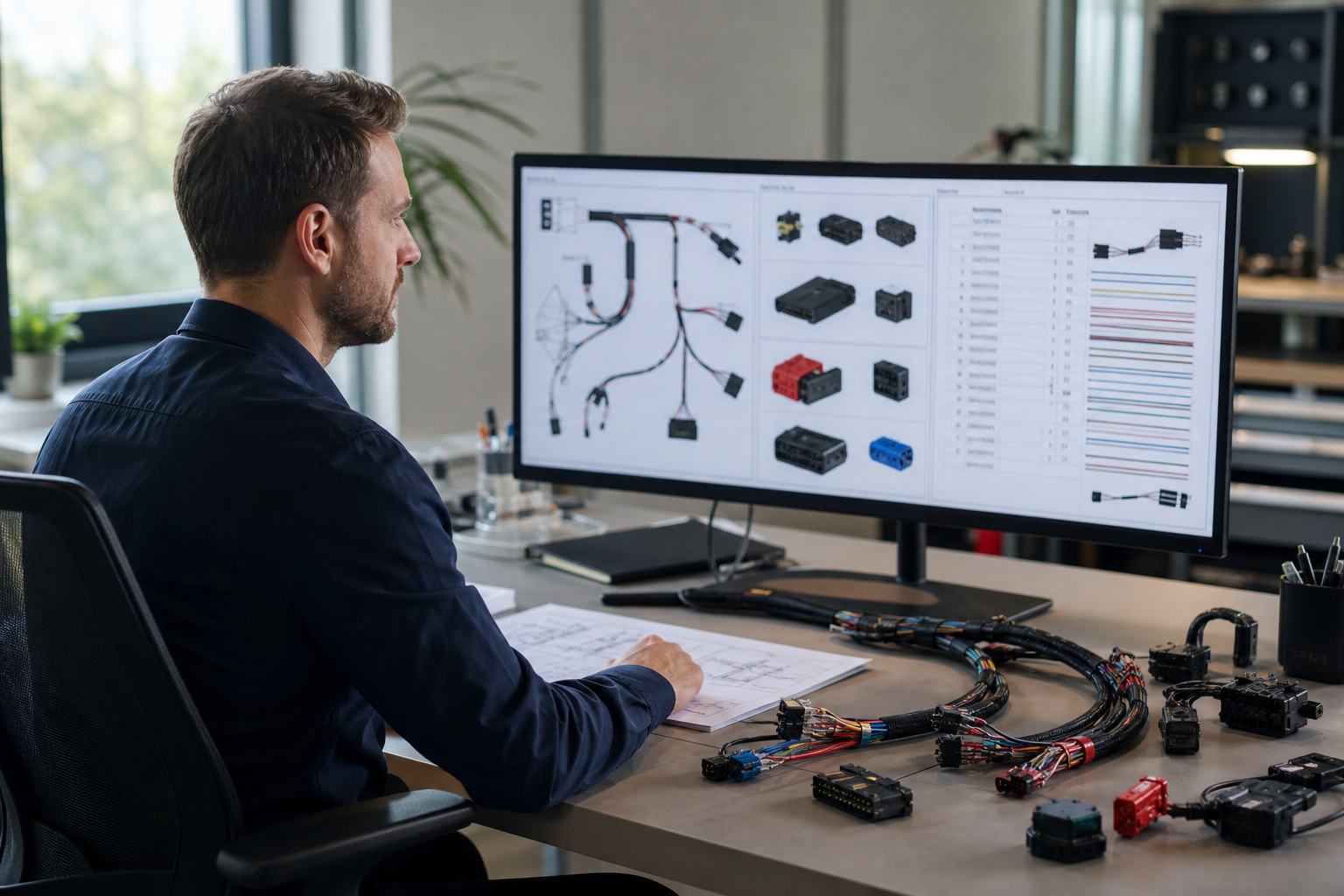
A wire harness quote is not an assembly quote with extra steps. It starts with incomplete drawings, loose descriptions, customer part numbers, connector tables, and a BOM that often needs engineering judgment before anyone can price it. General EMS quoting tools handle structured work well, but wire harness quoting software is built for the mess that lives in OEM PDFs, Excel sheets, and hand-marked drawings.
That difference shows up in the clock. Cableteque says the average wire harness quote still takes one to three weeks in the field, even as customers expect same-day or next-day responses, and its 2025 WHMA-based report says 73.81% of manufacturers still describe quoting as manual and time-intensive. The question is not whether software can quote a BOM. The question is whether it can read the harness first.
For teams that want a deeper look at the workflow gap, see ERP vs Quoteque for Wire Harness Quoting and Beyond Search: Why Wire Harness Quoting Requires Purpose-Built Intelligence. They show why generic quoting logic breaks when the input is a harness package, not a clean manufacturing part list.
Table of Contents
- Why Wire Harness Quoting and EMS Quoting Start From Different Inputs
- Where General EMS Tools Work Well
- Where Wire Harness Quoting Software Goes Further
- Real-Time Sourcing and Engineering Logic
- A Side-By-Side Comparison For Estimating Teams
- What Faster Quoting Changes For Margin And Capacity
- Closing Perspective For Contract Manufacturers
Why Wire Harness Quoting And EMS Quoting Start From Different Inputs
Wire harness quoting software starts with ambiguity and still has to produce a buildable quote. General EMS quoting tools usually start with a structured BOM, a known assembly type, and a costing model that already fits the parts on the page.
That is the first split that matters. In harness work, the quote has to resolve missing seal plugs, wire gauge and cavity combinations, connector compatibility, wire lengths from drawings, and protective covering needs before pricing can even begin. In EMS quoting, the BOM often drives the whole process with far less interpretation.
The WHMA survey makes the gap plain. Out of 42 respondents, 57.14% said BOM or design completeness was their top challenge, 47.62% cited sourcing and materials difficulty, and 83% said customer design errors affect production. Those numbers explain why generic quoting logic can look fine on paper and still fail on a harness RFQ.
Where General EMS Tools Work Well
General EMS quoting tools are strong when the input is already stable. If the BOM is clean, the assembly is standard, and the costing model is mostly transactional, those tools can move quickly and keep pricing consistent.
They also fit well when quoting centers on purchased components, labor buckets, and recurring product families. That is useful in a lot of electronics manufacturing. It just does not solve the extra engineering work that comes with wire color coding, routing, connector pinout validation, and length determination from drawings.
A generic system can also support disciplined workflows, version control, and approval steps. What it usually does not do is infer that "blk tape" should become black Tesa 3/4 inch tape, or that a loose piece terminal should be converted to reel form before sourcing and costing. That is why the best general tools still leave estimators doing the hard interpretation by hand.
Where Wire Harness Quoting Software Goes Further
Wire harness quoting software reads the package the way an estimator reads it on a busy Friday afternoon. It turns PDF drawings, Excel sheets, TIFFs, and native CAD exports into a usable BOM, then applies wire-harness-specific logic before the quote moves forward.
That is where purpose-built systems separate themselves. They can map customer part numbers to MPNs, store approved alternates, apply source preferences by customer or part, and flag incomplete data early. They also use harness topology logic to trace drawings and calculate exact wire lengths, which is the sort of work a generic EMS tool usually leaves to an engineer.
Cableteque says its pilot metrics show parsing and mapping in under 10 minutes, sourcing and pricing in under 15 minutes, and validation in under 5 minutes, for a complete quote in near 30 minutes. One customer example also cut an 18-hour process to 45 minutes. That is a different operating model, not a small feature upgrade.
Real-Time Sourcing And Engineering Logic
The sourcing gap is where many teams lose hours. Search tools with cached data can help find parts, but wire harness work often needs real-time distributor calls, customer-specific contracts, and compatibility checks across terminals, seals, cavities, and wire gauges.
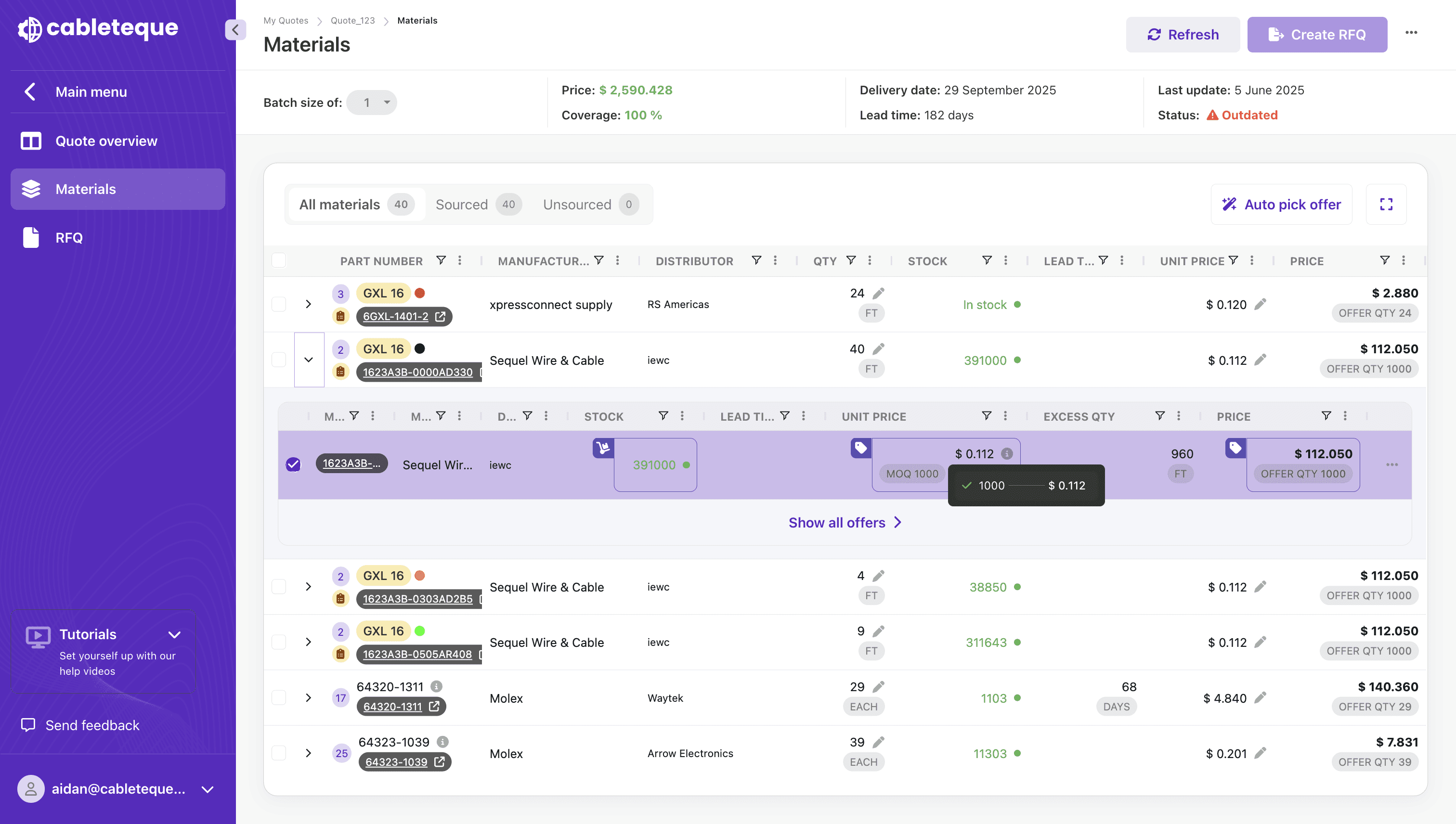
Cableteque's sourcing approach is built around direct API calls to supplier databases and a parts library of 2,000,000+ components. That matters because a 50-line harness BOM can consume 3 to 5 minutes per part, or 2.5 to 4 hours of manual work, and a 200-line BOM with 50 different wire types can still require hours just for conversion. The problem is not search alone. It is interpretation plus sourcing at once.
The broader industry data supports the need for this kind of system. The 2025 WHMA Innovation Advisory Team report, based on 42 manufacturers and 11 survey questions, found that only 9.52% describe quoting as highly automated and scalable. The same report says 52.38% want innovation most in design validation before manufacturing, which is exactly where harness-specific rules matter most.
Side-By-Side Comparison For Estimating Teams
The clearest way to see the split is to compare what each system is built to resolve.
| area |
wire harness quoting software |
general EMS quoting tools |
| input type |
Messy PDFs, drawings, Excel files, and customer part references |
Cleaner BOMs and structured assembly data |
| engineering logic |
Wire length, cavity plugs, seal compatibility, topology, protection, and routing |
Standard costing and transactional quote flow |
| sourcing method |
Real-time distributor pricing, alternates, and source preferences |
Usually depends on existing item masters and standard vendor records |
| best use case |
Incomplete harness RFQs that need interpretation before pricing |
Stable assemblies with known parts and repeatable costing rules |
| time impact |
Can cut weeks to hours or minutes |
Improves standard quote flow, but often leaves harness-specific work manual |
The table is blunt because the work is blunt. If the BOM is already clean, general EMS software can do the job well enough. If the BOM is still hiding missing seals, duplicate parts, and unclear wire lengths, the quote stalls until someone with harness experience fixes it.
What Faster Quoting Changes For Margin And Capacity
Speed changes more than turnaround time. It changes what your team can quote, how many RFQs you can touch in a week, and how much senior engineering time gets eaten by routine cleanup.
Cableteque reports 70% faster quote turnaround, 5x higher quoting capacity without new hires, and 96% time savings on complex quotes. It also cites a 3 to 6 month payback period in typical implementations and a 30 to 45 minute path from BOM extraction to quote finalization in pilot and customer examples. Those numbers matter because slow quoting does not only miss deadlines. It also leaves margin decisions to guesswork and late-night corrections.
I have seen what happens when senior estimators spend their day rebuilding bad inputs instead of pricing real work. The shop does not just move slower. It becomes dependent on a few people who know where the bodies are buried in the spreadsheet, which is a weak way to run a business.
The Quoting System Your Team Actually Needs
If your team quotes wire harnesses, the better question is not which software is more powerful in general. It is which system can read an incomplete harness package, clean it up, source it, and return a quote before the opportunity cools off.
General EMS quoting tools are useful when the assembly is already well defined. Wire harness quoting software is useful when the job starts with engineering uncertainty and ends with a margin decision. That is why purpose-built systems have an edge in automotive, aerospace, EV, medical, industrial, and machinery work, where connector compatibility, shielding, strain relief, wire gauge, and IPC/WHMA-A-620 expectations can change the quote fast.
If you want a deeper look at the functions that standard manufacturing tools miss, review what wire harness quoting software should do that general tools cannot and Cableteque's vision for the future of wire harness quoting in 2026. The market is already telling us which model wins. The shops that can interpret the harness first will keep the work.
FAQ
Q: What is the main difference between wire harness quoting software and general EMS quoting tools?
A: Wire harness quoting software is built to interpret messy harness inputs before pricing starts. It handles wire length, connector compatibility, seal plugs, protective covering, and topology logic. General EMS quoting tools usually work best when the BOM is already clean and the quote is mostly transactional. That makes them useful, but less effective for harness-specific RFQs that need engineering judgment.
Q: Can a general EMS quoting tool still work for wire harness jobs?
A: Yes, but usually only when the input is already well organized. If the BOM is complete and the design is stable, a general system can price the job and route approvals. The problem shows up when drawings are incomplete or the customer sends part descriptions instead of exact MPNs. In that case, the manual cleanup often lands back on the estimator or engineer.
Q: Why does quoting wire harnesses take so long in the first place?
A: The delay comes from interpretation, sourcing, and review. WHMA survey data from 42 manufacturers showed that 73.81% still describe quoting as manual and time-intensive, and 57.14% said BOM or design completeness is their top challenge. Many teams also deal with customer design errors, multiple suppliers, and inconsistent part data. Those issues add up quickly when every quote needs engineering attention.
Q: How fast can purpose-built wire harness quoting software move?
A: Cableteque says its pilot process can get parsing and mapping under 10 minutes, sourcing and pricing under 15 minutes, and validation under 5 minutes, for a complete quote in near 30 minutes. The company also cites cases where an 18-hour process dropped to 45 minutes. In production terms, that can mean same-day responses on RFQs that used to sit for a week or more. The gain is not just speed, it is consistency.
Q: What should operations managers look for when comparing the two systems?
A: Look for support for incomplete inputs, real-time component sourcing, harness-specific logic, and clean handoff from engineering to sales and operations. You should also check whether the system can map customer part numbers, handle alternates, and calculate wire lengths from drawings. If the software expects the BOM to be perfect before it starts, it is probably not built for wire harness work. That is the simplest test.
Q: Why does this difference affect margin so much?
A: Slow quoting delays RFQs and lowers win rates, while bad quoting risks underpricing a build that gets complicated on the floor. Cableteque cites 70% faster turnaround, 5x quoting capacity, and 96% time savings on complex quotes, which points to a direct capacity and margin effect. Faster quote cycles also reduce the load on senior estimators, who can spend their time on exceptions instead of basic cleanup. That is where margin leaks usually begin.
About Cableteque
Cableteque combines over three decades of hands-on industry expertise with a commitment to innovation in wire harness software. Founded by Arik Vrobel, our team brings together engineers, operators, and business leaders who deeply understand the challenges related to wire harnesses.
We focus on solving the toughest problems across the entire design-through-manufacturing lifecycle, helping teams work smarter, faster, and with greater precision.
Our company thrives on innovation, inclusivity, and collaboration. We value individuality, sustainability, and making a positive impact-building trust and shared success every step of the way. We are the only company creating software designed by wire harness people, for wire harness people. Our goal is to simplify communication between OEMs and contract manufacturers, streamline operations, and help businesses grow.
Cableteque isn't just a tool; it's an evolving platform built to empower engineers, supply chain specialists, sales teams, and manufacturing professionals to do their best work. Our company thrives on innovation, inclusivity, and collaboration.
1-1.png?width=190&height=34&name=logo-transparent%20(1)1-1.png)