Wire harness quoting breaks where generic estimating software stays generic. A harness RFQ is packed with connector tables, wire gauges, breakouts, terminations, topology notes, and drawing-dependent logic that a standard ERP or cost tool does not read with any real understanding. That mismatch is why strong shops still lose time, lose margin, and miss quote windows.
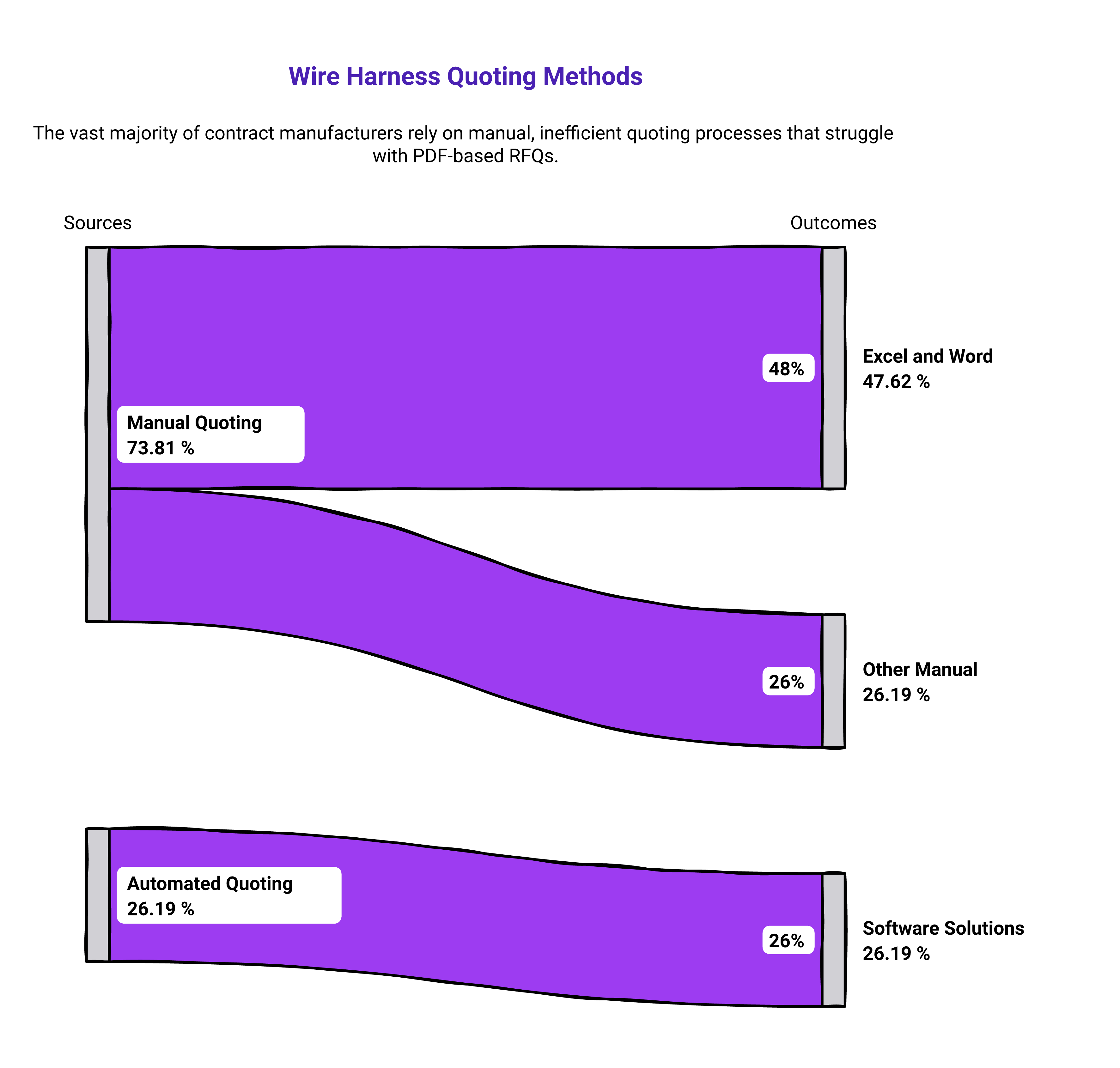
The evidence is plain. The WHMA Innovation Advisory Team survey of 42 contract manufacturers found that 73.81% still describe quoting as manual and time-intensive, while only 9.52% call it highly automated. In the same survey, 57.14% said BOM completeness is their top challenge, and 83% said customer design errors affect production. When the input arrives as a PDF and the output needs to be a defensible price, wire harness quoting software has to do more than count parts.
If you have ever spent two hours turning a customer drawing into a usable BOM, you already know the real issue. The quote is not slow because people type slowly. It is slow because the software stack was built for simpler assemblies.
Table of Contents
- Why general manufacturing tools break down on wire harness quotes
- It must extract and normalize BOMs from OEM drawings, PDFs, and spreadsheets
- It must understand harness-specific sourcing and part logic
- It must calculate labor and wire lengths from actual harness logic, not templates
- It must support fast review, compliance checks, and quote finalization
- Key Takeaways
- FAQ
- About Cableteque
- Ready to cut quote turnaround time?
Why General Manufacturing Tools Break Down on Wire Harness Quotes
General-purpose tools can track cost, but they do not understand the manufacturing logic behind a wire harness BOM. That is the fault line. The moment you need connector compatibility, wire-length logic, cavity plugs, seals, or termination operations, the estimate stops being a standard cost rollup and becomes an engineering exercise.
I have seen this in estimating rooms more than once. A generic tool accepts a part number, but it does not know that a loose-piece terminal may need to become a reel, or that a wire sold by the foot must be normalized against distributor pricing by spool, reel, or meter. The WHMA survey makes the gap obvious: 47.62% still rely on Excel or Word-based methods, and 52.38% say validation of customer designs before manufacturing is the innovation area they need most. That is not a software preference. It is a process gap.
A slow quote also creates quiet business damage. RFQs age out, engineering gets pulled off higher-value work, and sales begins assuming every estimate will take days instead of hours. Cableteque's wire harness quoting buyers guide says 90% of RFQs arrive as PDFs, which explains why generic systems keep tripping at the first step. If the software cannot read the package the customer sent, it has already failed.
What Generic Tools Miss
They miss the parts that live between the lines of the drawing. Cavity plugs, backshells, labels, heat shrink, cable ties, and protective covering often matter to cost even when they are absent from the customer BOM. They also miss the tribal knowledge estimator teams carry around in their heads, which means every new quote depends on the same few people being available.
That is where margin starts leaking. When the tool cannot infer harness-specific dependencies, the estimator compensates with manual checks, side spreadsheets, and review loops. The quote still gets built, but now it takes longer and carries more risk.
| Category |
Generic manufacturing tools |
Wire harness quoting software |
| BOM input |
Expects clean structured data |
Reads PDFs, spreadsheets, and drawings |
| Parts logic |
Tracks discrete items |
Understands connectors, wire gauges, terminals, and alternates |
| Labor model |
Uses broad routing templates |
Counts crimping, splicing, routing, stripping, and testing steps |
| Wire pricing |
Assumes simple unit pricing |
Normalizes length, spool, reel, and contract-rate logic |
| Review flow |
Handles approvals generically |
Flags harness-specific gaps before the quote is sent |
It Must Extract and Normalize BOMs From OEM Drawings, PDFs, and Spreadsheets
The first job is BOM extraction. If the software cannot turn messy customer inputs into a usable BOM quickly, nothing else matters. A harness quoting platform should drag in multiple PDFs and Excel files, extract tables, and build a standardized BOM without manual recreation.
Cableteque says manual BOM recreation can consume 30 to 45 minutes per assembly, and its instant design import reduces that work by up to 96%. That matters because quoting teams do not lose just time, they lose consistency. One estimator may read a shorthand description one way while another maps it differently, and the quote drifts before sourcing even begins.
Normalization is where AI becomes practical instead of decorative. A good system should turn "blk tape" into black Tesa 3/4 inch tape, convert "loose piece terminal" to reel, store customer part numbers, and map them to MPNs. That is the work generic tools skip because they were not built for unstructured engineering inputs.
Cableteque's wire harness quoting overview shows how this front-end step cuts engineering effort before sourcing starts. It also matters that the software flags missing fields and ambiguous references early. The WHMA survey found that 83% of manufacturers encounter customer design errors affecting production, so a quoting system that catches incomplete information on intake is doing real work, not cosmetic work.
Why BOM Extraction Decides Quote Speed
A BOM that starts clean gives sourcing and labor estimation a fair chance. A BOM that starts dirty forces repeated rework, and each correction creates another handoff, another delay, and another chance for the quote to miss its window.
That is why drawing import needs to cover PDFs, TIFFs, Excel, CSV, and native CAD exports. It is also why confidence scoring matters. A system should flag low-confidence items for review instead of guessing and burying the error in the final quote.
It Must Understand Harness-Specific Sourcing and Part Logic
Sourcing for wire harness assemblies is not ordinary procurement. The software has to reason through compatibility, alternates, approved sources, and unit conversions in ways that a standard parts tool cannot. If it does not, the estimator ends up rebuilding the logic by hand.
This is where the part library becomes valuable only if it is paired with rules. Cableteque's components database spans more than 2,000,000 parts, and it uses those records to identify likely terminals, cavity plugs, seals, and other missing items based on connector compatibility and wire gauge. That kind of logic is not optional when drawings are incomplete or supplier descriptions are inconsistent.
Pricing logic matters just as much. Wire and cable are sold by the foot, inch, meter, spool, or reel depending on the distributor. If the software cannot normalize those units, the BOM can look correct and still price wrong. For a deeper view of how existing ERP workflows miss these details, see why ERP systems fall short for wire harness quoting.
The sourcing layer also has to respect contract rates, AVL constraints, and part equivalencies. Real-time supplier data is useful only when it is tied to the customer's source preferences and approved alternates. A quote built from list price and guesswork does not protect margin, it erodes it.
What the Sourcing Engine Must Decide
It should map customer part numbers to MPNs, apply source preferences by customer or product line, and suggest valid alternates without making the estimator start over. It should also flag obsolete items before they reach review, because finding an unavailable connector during final approval burns the same day twice.
That is the difference between a parts search and quoting intelligence. One finds inventory. The other helps you build a quote the shop can actually make.
It Must Calculate Labor and Wire Lengths From Actual Harness Logic, Not Templates
Labor estimation is where generic tools break down fastest. A wire harness quote does not need broad assembly time averages. It needs operation counts tied to the actual build, including crimping, stripping, splicing, routing, bundling, inspection, and test steps.
Cableteque ties labor estimation to historical data and harness logic, not a one-size-fits-all template. That matters because a harness with multiple breakouts, shielded lines, and connector insertions does not consume labor the way a simple bracket-and-fastener assembly does. A quote that ignores topology is a guess with a spreadsheet attached.
The platform also traces drawings and calculates exact wire lengths from the PDF where possible. That capability changes the estimator's role. Instead of measuring every run by hand, the team can focus on exceptions, review, and margin control. In the Cableteque buyer's guide, the manual recreation step is one of the biggest time sinks, and this is why.
The WHMA report reinforces the need. Automated BOM enhancement scored 4.50 out of 5 in value, labor and cost estimation tools scored 4.27, and assembly instruction generation scored 4.34. Those numbers say the market is not asking for more generic quoting features. It is asking for the specific logic that wire harness work demands.
Labor That Reflects the Build
A serious system should count termination operations, connector insertions, heat shrink, shielding steps, and test activities from the drawing and the BOM. It should also allow configurable labor templates, because no two shops quote exactly the same way.
That is where quote defensibility comes from. When operations, engineering, and sales can all trace the estimate back to the build logic, the quote stops being a negotiation inside the company.
It Must Support Fast Review, Compliance Checks, and Quote Finalization
Speed only matters if the quote can still pass review, meet standards, and leave the building with margin intact. A useful harness quoting platform automates compliance checks, supports collaboration, and produces a final quote in the format the customer expects.
This is where IPC/WHMA-A-620, UL certifications, and industry-specific design rules matter. A review system should flag the issues that trigger rework, from connector orientation to shielding, strain relief, and pinout inconsistencies. That saves time twice, once in estimation and again in customer back-and-forth.
Cableteque's quoting workflow is built for this final mile. It supports dynamic cost calculation, one-click review and approval, and non-disruptive deployment alongside existing processes. That last point matters. Most shops cannot afford a rip-and-replace project just to fix quoting.
For a closer look at how the workflow comes together, the company's quote turnaround article is a useful reference point. The practical aim is simple, cut quote turnaround time from days to minutes without giving up accuracy or margin.
What Finalization Should Do
It should roll material, labor, overhead, and margin into a single view. It should export in customer-specific formats and let engineering and operations review the same record without email chains and duplicate edits.
That is how quoting becomes repeatable. The process gets faster, the reviews get cleaner, and the team spends less time cleaning up avoidable mistakes.
Key Takeaways
- Build wire harness quoting software that reads OEM PDFs and drawings, not just structured BOMs.
- Use harness-specific logic for connectors, wire lengths, unit conversions, and part alternates.
- Estimate labor from actual operations such as crimping, splicing, routing, and testing.
- Automate review and compliance checks so engineering and operations can approve quotes faster.
- Choose a system that works with existing processes while cutting manual input and quote turnaround time.
FAQ
Q: Why can't a generic ERP system handle wire harness quoting well?
A: Generic ERP tools are good at tracking parts and cost buckets, but wire harness quoting needs much more detail. A harness quote depends on topology, wire length, connector compatibility, and unit-of-measure logic. Those are not standard assumptions in most manufacturing tools. The result is manual repair work after the software has already done its pass. That is why teams still end up in spreadsheets.
Q: What is the biggest time sink in wire harness quoting?
A: BOM recreation is usually the first major bottleneck. When RFQs arrive as PDFs or mixed file types, someone has to extract the data, normalize the descriptions, and fill in missing fields. Cableteque says that manual recreation can take 30 to 45 minutes per assembly before sourcing even starts. Multiply that by a queue of RFQs and the delay becomes obvious. The quote is late before labor is even estimated.
Q: How should software handle missing or unclear part descriptions?
A: It should flag them early and map them through rules instead of relying on memory. For example, shorthand like "blk tape" should resolve to a specific approved part, and customer part numbers should map to MPNs automatically. This reduces dependency on tribal knowledge and keeps estimators from making different assumptions on different days. It also makes review faster because the team can see what was inferred and what still needs confirmation. That is where consistency starts.
Q: Why does labor estimation need harness-specific logic?
A: Because a harness is built from operations, not just items on a list. Crimping, splicing, stripping, routing, bundling, and testing all affect cost in different ways. A template that works for simple assemblies misses the actual work on a harness. Good software ties labor to the drawing and the operations count, then lets the estimator adjust exceptions. That gives you a quote the shop can stand behind.
Q: What should review and approval look like in a good quoting platform?
A: Review should be fast, visible, and tied to compliance. Engineering, operations, and sales should see the same BOM, the same assumptions, and the same margin inputs. The system should flag issues tied to IPC/WHMA-A-620 or customer-specific rules before the quote goes out. Finalization should also handle dynamic cost updates so you are not sending stale pricing. A clean approval flow protects both speed and margin.
Q: Where does Cableteque fit in this process?
A: Cableteque is built for the exact gaps that generic tools leave open. It imports OEM PDFs, extracts and normalizes BOMs, applies sourcing rules, estimates labor, and supports final review in one flow. Its stated goal is to cut a 7 to 10 day quoting process down to about 30 minutes. That matters because the market does not reward slow quotes. It rewards accurate ones that arrive first.
About Cableteque
Cableteque combines over three decades of hands-on industry expertise with a commitment to innovation in wire harness software. Founded by Arik Vrobel, our team brings together engineers, operators, and business leaders who deeply understand the challenges related to wire harnesses.
We focus on solving the toughest problems across the entire design-through-manufacturing lifecycle, helping teams work smarter, faster, and with greater precision.
Our company thrives on innovation, inclusivity, and collaboration. We value individuality, sustainability, and making a positive impact, building trust and shared success every step of the way. We are the only company creating software designed by wire harness people, for wire harness people. Our goal is to simplify communication between OEMs and contract manufacturers, streamline operations, and help businesses grow.
Cableteque isn't just a tool; it's an evolving platform built to empower engineers, supply chain specialists, sales teams, and manufacturing professionals to do their best work. Our company thrives on innovation, inclusivity, and collaboration.
Ready To Cut Quote Turnaround Time?
If your team is still rebuilding BOMs by hand, pricing wire by guesswork, and chasing approvals across email threads, the software is the bottleneck. The right wire harness quoting platform should read the drawing, normalize the BOM, reason through sourcing, estimate labor from actual operations, and move the quote to review fast.
That is the standard now. What would your quoting team gain if the slowest RFQs moved from days to minutes?
1-1.png?width=190&height=34&name=logo-transparent%20(1)1-1.png)