Key Takeaways
- Supplier quote responses can land in the quoting system as structured data when the platform ingests PDFs, Excel files, XML, and distributor API feeds.
- Part-number mapping, approved alternates, and source preferences remove the need to type supplier responses into each line item.
- A clean workflow starts with extraction, then normalization, then pricing, then quote release. That sequence cuts the re-entry problem at the source.
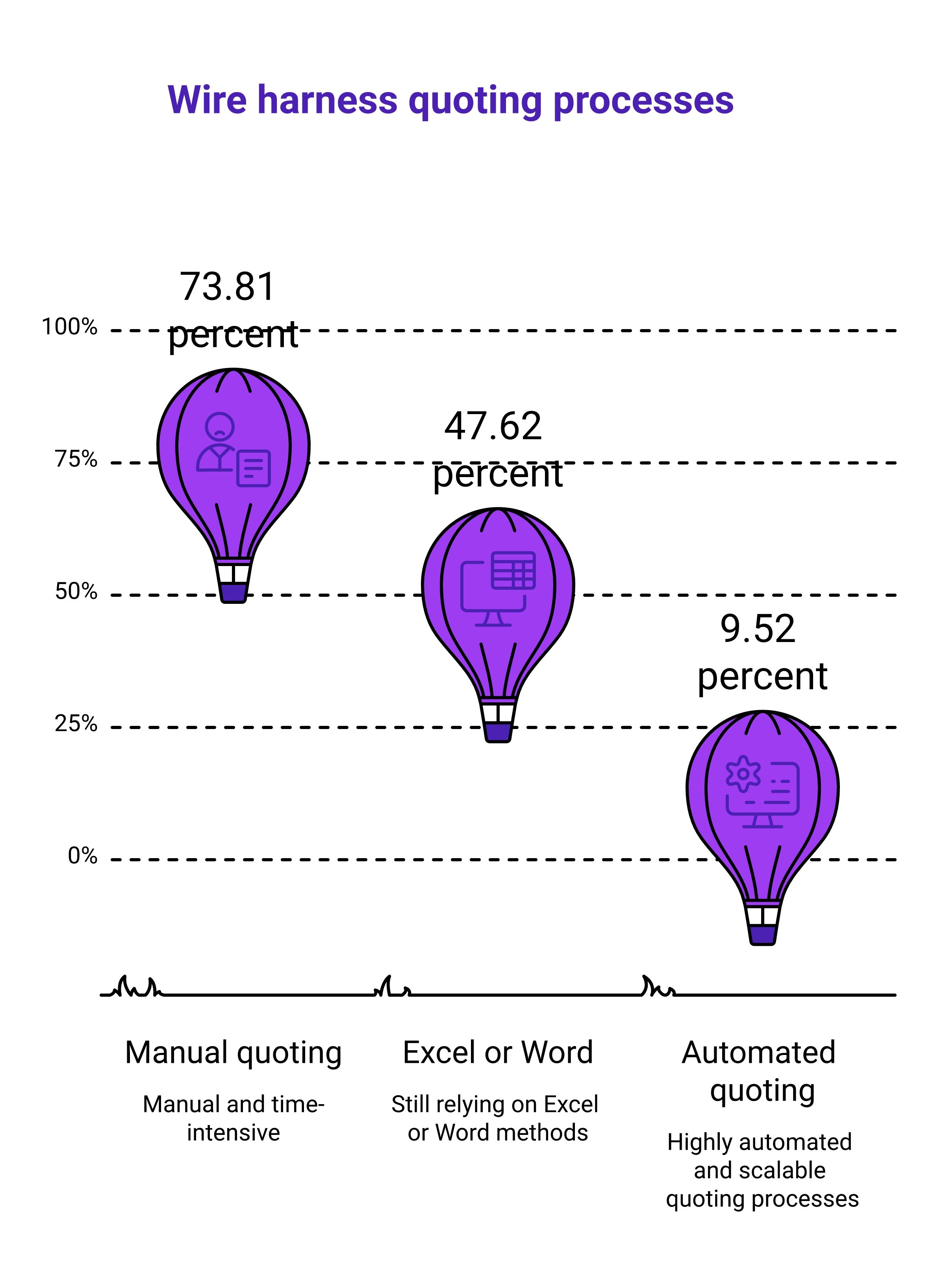
- In WHMA survey results, 73.81% of manufacturers still call quoting manual and time-intensive, while only 9.52% describe it as highly automated and scalable.
- Real-time supplier data, labor templates, and DRC checks reduce quote delays without forcing teams to rip out current systems.
Introduction
A quote response should not bounce from email to spreadsheet to ERP to quoting software and then back into another spreadsheet. In wire harness quoting, that extra typing is where mistakes enter, cycle time stretches out, and margins slip before anyone notices.
The cleanest answer is structured ingestion. Supplier responses get pulled into the quoting system through direct integrations, file imports, and normalization rules that convert raw supplier data into usable BOM lines, pricing, and alternates. That is how wire harness manufacturers keep RFQs moving without re-entering part numbers, prices, or lead times by hand.
This article looks at the practical workflow behind that handoff. It also shows why the process is now a source of speed, not just admin work, for engineering managers, operations managers, and product managers who live inside RFQs, connector tables, wire gauges, and deadline pressure.
Table of Contents
- Why Re-Entry Slows Wire Harness Quoting
- How Supplier Responses Enter the System
- What Gets Normalized Before Pricing
- Where Real-Time Pricing Fits
- Why the Workflow Still Supports Existing Teams
- What Good Quoting Data Looks Like
Why Re-Entry Slows Wire Harness Quoting
Supplier re-entry is expensive because wire harness quotes are not simple line-item exercises. A single assembly can include terminals, seals, cavity plugs, wire colors, coverings, backshells, and connector-specific rules that all need to match the drawing.
WHMA survey data from 42 manufacturers shows the pressure clearly. 73.81% described quoting as manual and time-intensive, 57.14% said BOM completeness is a top challenge, and 47.62% still rely on Excel or Word-based methods. Only 9.52% called their process highly automated and scalable, which leaves a lot of room for software that removes duplicate data entry instead of adding another layer of it.
Cableteque's own quoting material says 90% of RFQs arrive as PDFs and that manual BOM recreation can take 30 to 45 minutes per assembly. That is before sourcing, labor, and review. When a supplier response arrives as an email, a PDF, or a spreadsheet, the wrong system treats it as text. The better system treats it as source data.
How Supplier Responses Enter The System
The fastest path is direct import. Supplier data can enter through PDFs, Excel files, XML, ECAD exports, and supplier APIs, then move into a structured quote record without manual re-keying.
| input type |
what the system captures |
why it avoids re-entry |
| Supplier pdf or spreadsheet |
part number, price, lead time, pack size, notes |
the line item is parsed and mapped into fields automatically |
| Distributor api feed |
availability, current price, stock status, lifecycle flags |
prices refresh inside the quote instead of being copied from email threads |
| Customer part list |
customer part number, mapped mpn, approved alternates |
the system matches known references before a human starts typing |
| Ecad or cad export |
connector callouts, wire lengths, topology, notes |
design data flows into the BOM layer without a second transcription step |
That approach shows up in live product workflows. ECI's May 14, 2025 release said Cableteque can be embedded in quoting and engineering workflows so teams can automatically generate harness BOMs directly from customer design data, with up to 50% reduction in quote turnaround time. The important detail is not the headline number. It is the mechanism: the response data is ingested where work already happens.
What Gets Normalized Before Pricing
Raw supplier replies are only useful after normalization. A quoting system has to translate descriptions, customer part numbers, alternates, and source rules into a consistent internal format before the price calculation begins.
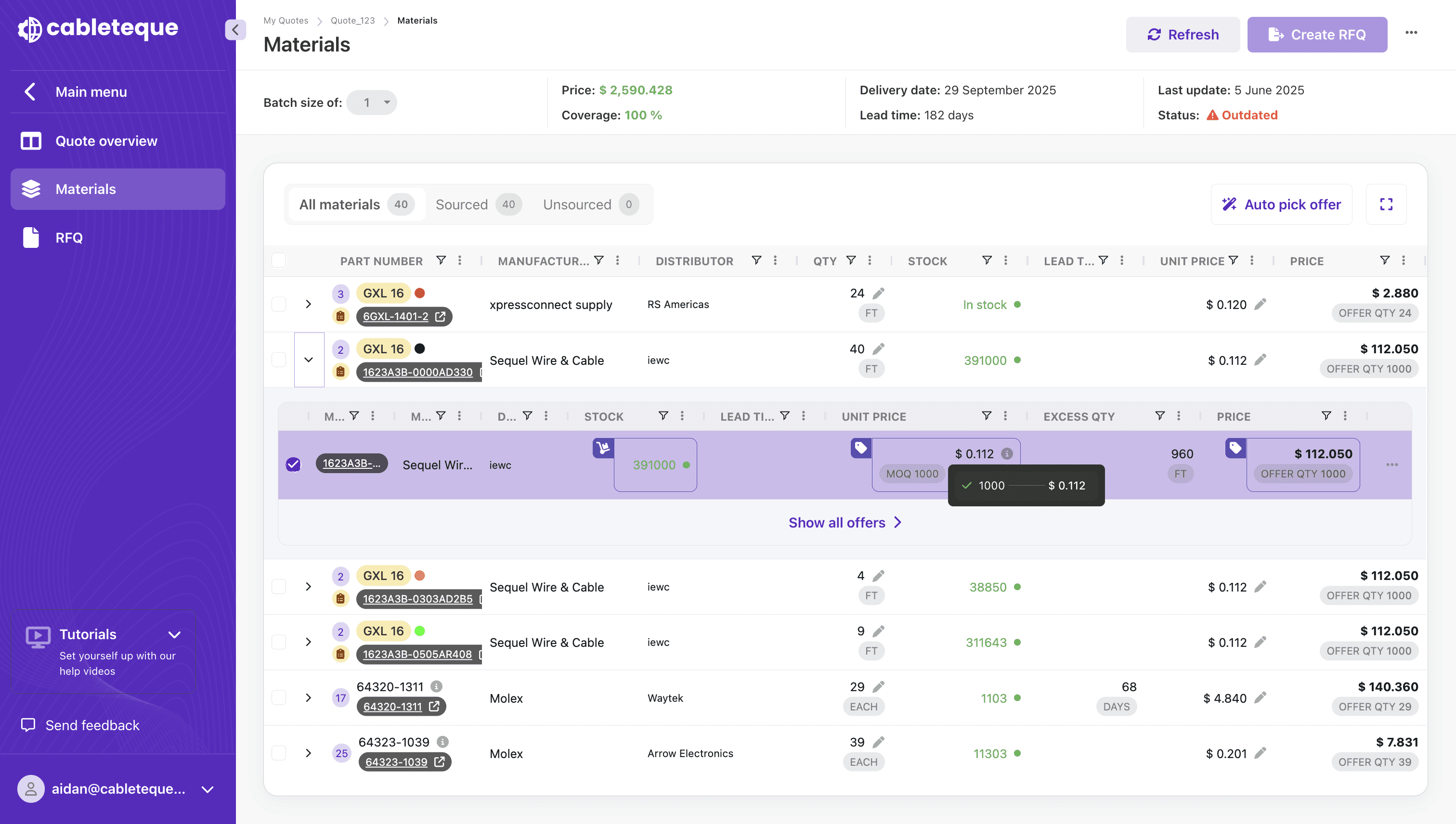
Cableteque's product logic does this in several steps. It stores customer part numbers and maps them to MPNs, applies part conversion rules such as loose piece terminal to reel, adds approved alternates, and lets teams define source preferences by customer, part, or product line. A reply that arrives as free text becomes usable quote data because the system already knows what the shop means by that part.
This is where the manual work usually disappears. If a supplier sends a response for a terminal, the platform can compare it with connector compatibility, wire gauge, approved source, and preferred alternates. It can also catch missing fields early, which matters because the WHMA survey found that 83% of manufacturers encounter customer design errors that affect production at least sometimes.
Where Real-Time Pricing Fits
Real-time pricing is the point where the system stops being a filing cabinet and starts being a quoting engine. Supplier responses do not just sit in a database. They are used to calculate current material cost, availability, and sourcing risk inside the quote.
Cableteque says its component sourcing uses real-time integration with supplier databases and a parts library of more than 2,000,000 components. Its own quoting material also says material sourcing can drop from 3 to 7 days to 2 minutes when real-time APIs are in place, while labor estimation can fall from 30 minutes to 2 hours to 5 minutes. Those are not small changes. They remove the pause between engineering review and commercial response.
Cableteque's blog on wire harness quoting software selection puts it plainly: the best systems deliver PDF drawings in, structured BOMs out, and real-time pricing from distributors. That is the practical test. If a supplier response still needs a person to type it into the quote, the workflow is incomplete.
Why The Workflow Still Supports Existing Teams
The best implementation does not force a shop to tear out its current process on day one. It runs beside existing quoting methods, then proves its value on real RFQs before it replaces anything.
That matters in a shop where quoting touches engineering, purchasing, and operations at the same time. ECI's release also noted native integrations with ECAD tools and file inputs such as pdf, excel, and XML, which means teams can keep their current sources while the system handles the data handoff. The result is less back-and-forth between departments and fewer lost hours chasing a missing supplier reply.
A useful reference point is the wire harness quoting guide. It describes how the job changes when BOM extraction, supplier pricing, and labor estimation all sit in one place. The quote gets built from structured inputs, not from repeated typing.
What Good Quoting Data Looks Like
Good quoting data is consistent, traceable, and ready for margin review. If a supplier response cannot be linked to a customer part, an MPN, a preferred source, and an approved alternate, it is not ready for release.
The strongest systems also keep the quote close to manufacturing reality. Cableteque's harness topology tool traces drawings and calculates exact wire lengths from the PDF, while its labor logic draws from historical data instead of guesswork. That matters because quote accuracy is not only about material cost. It is also about the time and labor hidden inside terminations, splices, shielding, routing, and connector work.
For product managers and operations leaders, the signal is simple. Data entry should happen once. After that, the quoting system should carry the response forward, apply the rules, and keep the quote moving.
A Better Quote Path Starts With The Data Handshake
If supplier responses are still being typed into your quoting system by hand, the bottleneck is already built into the process. The fix is to make the supplier reply arrive as structured data, not as another task for engineering or purchasing to clean up.
That is where a practical wire harness quoting platform earns its place. It takes in the response, normalizes the part information, applies your source rules, and turns the data into a quote without the re-entry loop. Want to see what that looks like in a live workflow?
FAQ
Q: How do wire harness manufacturers avoid typing supplier quote responses into the system twice?
A: They use software that ingests supplier replies through file import, ECAD integration, or distributor APIs. The system then maps the data into quote fields automatically. That reduces duplicate entry and keeps the response tied to the right BOM line. It also lowers the chance of transcription errors on part numbers, pricing, and lead times.
Q: What file types usually work best for this process?
A: PDF, Excel, and XML are common starting points because suppliers already send data in those formats. Some teams also pull data from ECAD exports and live distributor feeds. The best setup accepts multiple formats without forcing a manual rebuild. That is especially useful when one RFQ package arrives as a drawing set and another arrives as a spreadsheet.
Q: Why are part-number mappings so important?
A: Customer part numbers often do not match MPNs, and that gap is where confusion starts. A good quoting system stores both and keeps the mapping available for later use. It can also apply approved alternates and preferred sources. That saves time when the same component shows up across several programs with different naming conventions.
Q: Can this work without replacing the current quoting process?
A: Yes. Many shops run the new system beside the old one during the first phase. That lets the team compare results, check data quality, and keep RFQs moving. It also reduces adoption risk because the shop does not need a full process change on day one. The goal is to remove re-entry first, then expand from there.
Q: What does real-time supplier pricing change in the quote?
A: It keeps the quote tied to current availability and current cost instead of stale spreadsheet values. That matters when lead times or stock levels shift during the day. It also helps purchasing and engineering see the same information at the same time. The quote gets built from the latest supplier response, not last week's saved copy.
About Cableteque
Cableteque combines over three decades of hands-on industry expertise with a commitment to innovation in wire harness software. Founded by Arik Vrobel, our team brings together engineers, operators, and business leaders who deeply understand the challenges related to wire harnesses.
We focus on solving the toughest problems across the entire design-through-manufacturing lifecycle, helping teams work smarter, faster, and with greater precision.
Our company thrives on innovation, inclusivity, and collaboration. We value individuality, sustainability, and making a positive impact-building trust and shared success every step of the way. We are the only company creating software designed by wire harness people, for wire harness people. Our goal is to simplify communication between OEMs and contract manufacturers, streamline operations, and help businesses grow.
Cableteque isn't just a tool; it's an evolving platform built to empower engineers, supply chain specialists, sales teams, and manufacturing professionals to do their best work. Our company thrives on innovation, inclusivity, and collaboration.