Key Takeaways
- Purpose-built wire harness quoting software can estimate labor from operations, not guesswork, which is why it works better than generic estimating tools.
- The best estimates account for cutting, stripping, crimping, splicing, testing, inspection, routing, and connector-specific steps, plus compliance effort under IPC/WHMA-A-620.
- Labor templates and historical quote data cut repeat work and help different estimators produce consistent numbers.
- Faster labor estimation helps wire harness contract manufacturers quote more RFQs, finalize quotes sooner, and protect margin.
- Human review still matters for custom builds, unusual routing, and incomplete drawings, but software can remove most of the manual grind.
Introduction
Can quoting software handle labor estimation for wire harness assemblies? Yes, when it is built for wire harness quoting instead of adapted from generic manufacturing software. The real test is whether it can read the work in the drawing, count the operations, and turn that into a defensible estimate without forcing an engineer to rebuild the package by hand.
That is where most delays start. A BOM tells you what parts are present, but labor comes from what the assembly actually requires, including connector count, wire gauge, terminations, splices, routing, shielding, and inspection. In a shop where RFQs arrive every day, a slow estimate does more than waste time. It pushes quote finalization past the customer's deadline and gives margin away before the job even starts.
Table of Contents
- Why labor estimation is the hard part of wire harness quoting
- What a wire harness labor estimate actually has to include
- How quoting software estimates labor for wire harness assemblies
- Where automation helps most: speed, consistency, and fewer misses
- The limits: when human review still matters
- The bottom line for wire harness manufacturers
- FAQ
Why Labor Estimation Is The Hard Part Of Wire Harness Quoting
Labor is the part of wire harness quoting that breaks generic systems first. A simple build can look manageable on paper, then turn into hours of added time because one connector needs backshell work, another needs shielding, and a third needs extra labeling or test steps.
In the WHMA Innovation Advisory Team survey of 42 contract manufacturers, 73.81% described quoting as manual and time-intensive, even though they rated BOM creation maturity at 4.07 out of 5. That gap tells you where the pain sits. Teams can handle digitized part lists, but labor still depends on tribal knowledge, estimator memory, and the one person who knows how the shop actually builds a certain family of assemblies. That creates bottlenecks, and it also creates risk when that person is out, busy, or moving on.
I have watched a quote lose two days because no one wanted to make the first labor call without a senior engineer checking it. By then, the customer had already moved on or forced a late revision. The result is familiar in this industry: underpriced work, late responses, and a shop that looks slower than it really is.
A useful data point comes from Cableteque's own wire harness quoting software buyer's guide, which says the best systems estimate labor from actual operation counts such as crimps, splices, cuts, routing steps, and connector insertions. That is the difference between a real estimate and a spreadsheet with a labor field.
| What slows the quote |
What the estimator needs |
| Connector complexity |
Operation counts, pinout details, and termination steps |
| Routing and geometry |
Wire lengths, breakouts, bends, loom, and strain relief logic |
| Missing design detail |
Early flags, assumptions, and review tasks |
| Standards pressure |
Inspection effort tied to IPC/WHMA-A-620 |
What A Wire Harness Labor Estimate Actually Has To Include
A credible labor estimate starts with the physical work, not the part number list. Cutting, stripping, crimping, soldering, splicing, bundling, taping, labeling, testing, and inspection all consume time, and each one changes with volume, access, and part type.
Connector variables make the estimate more specific. Pinout, keying, extraction force, mating cycles, backshells, environmental sealing, and connector retention all affect how many steps a builder takes and how often the assembler needs to stop and verify. A harness with many identical terminals is one thing. A mixed assembly with overmolding, shielding, and tight pull-force specs is another.
Geometry matters just as much. Wire lengths, routing, loom, strain relief, bends, breakouts, cable bending radius, and shielding paths all change labor content. That is why how wire harness quoting works in practice is never just a materials exercise. The drawing tells the story, but the topology tells you how much time the build will consume.
Standards also shape the estimate. IPC/WHMA-A-620 is not a footnote. It affects inspection depth, rework tolerance, and the level of process discipline expected in production. In aerospace, automotive, EV, medical, and industrial work, compliance can add steps that a generic ERP labor field will never capture.
A BOM alone is not enough. Without topology, design rules, and build logic, the quote misses the real work. That is why wire harness quoting software must read the assembly, not just price it.
How Quoting Software Estimates Labor For Wire Harness Assemblies
Purpose-built software estimates labor by translating design inputs into operation counts and then assigning time to each operation. Labor templates do most of the heavy lifting. They map connector type, wire gauge, assembly style, and build rules to standard times, which lets estimators start with a defensible baseline instead of a blank screen.
Historical data matters too. When a platform learns from past quotes and actual builds, the estimate gets better at spotting the difference between a simple bench build and a package that will eat setup time, test time, or inspection time. Cableteque says its labor engine uses historical data and can reduce labor estimation from 30 minutes to 2 hours down to about 5 minutes on many quotes.
That speed comes from rule-based logic. If a design has six connectors, twelve crimps, three splices, and two breakout points, the software can populate the operation list automatically. If the drawing uses descriptive language such as "blk tape," the system can map it to the correct part description and keep the estimate tied to actual production logic. The 2026 electrical wire harness market trends report also points to growing pressure for faster, more digital quoting workflows, which is exactly where labor automation fits.
Generic ERP labor fields usually stop at hours per assembly or hours per unit. That is too blunt for wire harness assemblies. Purpose-built EWH quoting software adds operation libraries, topology awareness, and manual override controls so the estimator can adjust unusual jobs without rebuilding the whole quote.
A 2025 survey of 42 wire harness and cable assembly contract manufacturers found that 52.38% see labor and cost estimation tools as valuable, with a 4.27 out of 5 value score. That is a strong signal. The market does not need another spreadsheet. It needs a system that understands the work.
Where Automation Helps Most: Speed, Consistency, And Fewer Misses
Automation pays off first in the hours that disappear from repetitive quote work. If an estimator can drag in multiple PDF BOMs, extract part data, and have labor templates populate operation counts, the team can quote more assemblies without adding headcount.
Consistency is the next gain. Two estimators can look at the same package and still assign different times if one is relying on memory and the other is relying on a shared labor model. Standardized estimation removes that spread. It also makes quote review easier because managers can see which assumptions were applied and why.
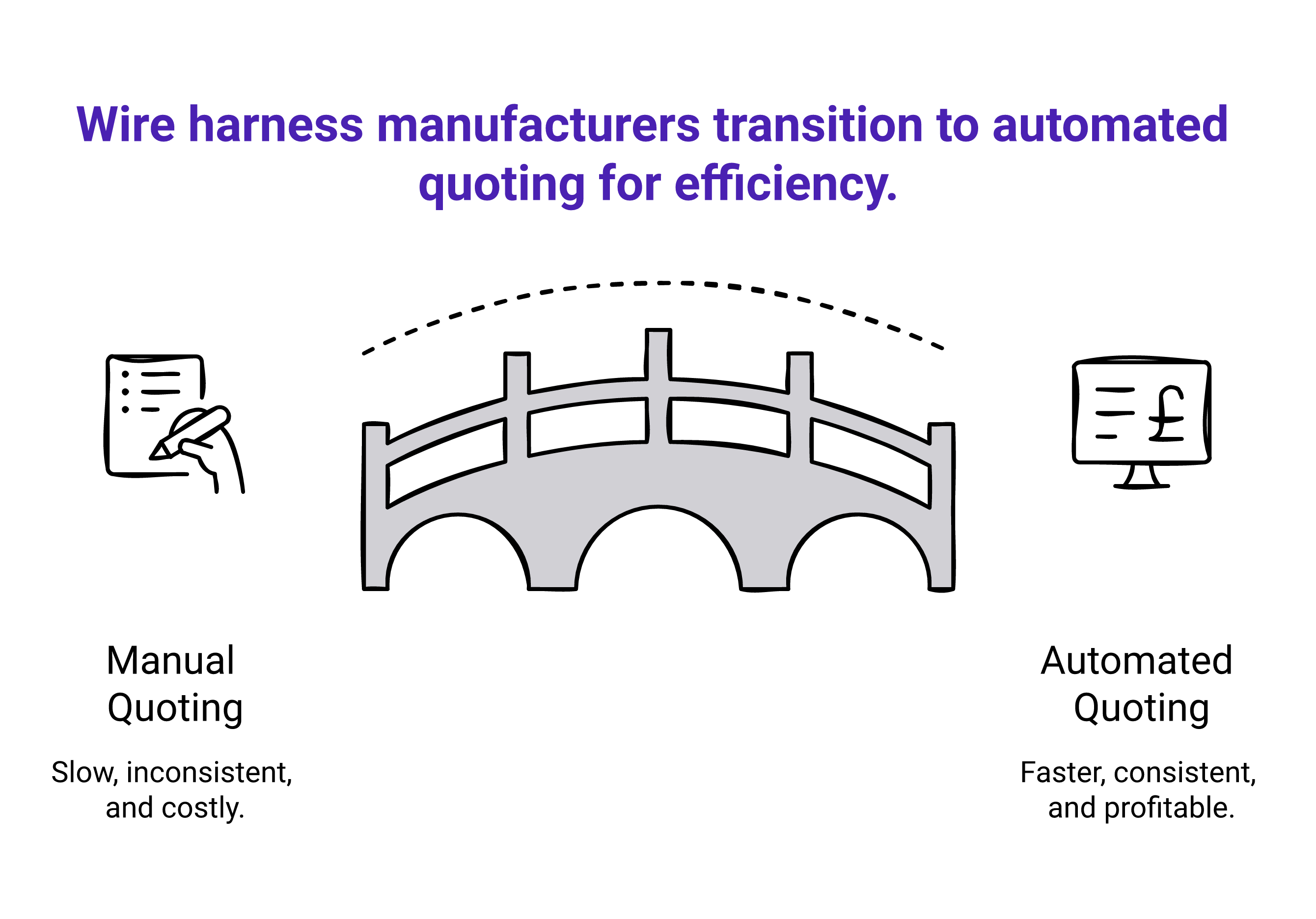
The biggest operational gain is early detection. Missing wire lengths, incomplete connector data, unknown alternates, and inconsistent part numbers show up sooner when the system is reading the design and not waiting for a person to notice the problem. That cuts back-and-forth between engineering, sales, and sourcing. It also shortens quote finalization because fewer packages sit in review with obvious gaps.
Cableteque's automation is built for that exact workflow. Instant design import, AI-powered analysis, and automated component sourcing reduce the manual work that usually surrounds labor estimation, so the estimator can stay focused on exceptions and margin calls. That is where senior judgment still earns its keep.
One line from the WHMA survey says enough: only 9.52% of respondents described their quoting process as highly automated and scalable. Most shops are still carrying too much manual work. The ones that fix labor estimation first usually feel the change fastest.
The Limits: When Human Review Still Matters
Software should not be treated as a black box. Custom builds, new customer standards, unusual routing, and special termination methods still need engineer review. A platform can count operations, but it still has to be checked against the way the shop actually builds and tests the product.
That is especially true for prototypes and low-volume launches. The first estimate for a new family often has incomplete drawings, changing requirements, and source preferences that can shift labor scope. Approved alternates, customer part mappings, and design discrepancies can all change the amount of work before the first assembly is even built.
Compliance adds another layer. If customer documentation is thin or the drawing is inconsistent, the estimate can look complete while still missing inspection or correction time. That is why the best systems flag risk early rather than pretending every package is ready for a one-pass quote.
Cableteque takes that position directly. It reduces manual effort, but it leaves room for expert oversight where the quote actually needs it. That balance matters in wire harness contract manufacturers, where one bad assumption can travel all the way into production.
A 2026 benchmark from USTech Automations on estimating software for electrical contractors shows the broader principle: purpose-built software cuts estimate production time sharply, but only when the workflow matches the job. Wire harness work is even more specific than general electrical estimating, so the fit matters.
The Bottom Line For Wire Harness Manufacturers
Yes, quoting software can handle labor estimation for wire harness assemblies when it is built for the job. The strongest systems combine BOM extraction, sourcing, labor templates, and quote finalization in one workflow, so the estimate reflects the real build instead of a generic labor rate.
That changes business results. Faster labor estimation lets you quote more RFQs, respond before deadlines slip, and reduce dependence on a few senior estimators. It also protects margin by catching complexity earlier, before an underquote reaches the customer or a build hits the floor.
The practical test is simple. If labor still lives in spreadsheets, the process is already slowing the business down. If the team has to ask the same senior engineer to rebuild every complex quote, capacity is being lost to manual work instead of used on high-value decisions.
Cableteque was built to remove that bottleneck. It turns labor estimation from a slow, fragile task into a repeatable part of wire harness quoting, so manufacturers can quote more work, faster, without hiring more estimators.
FAQ
Q: Can quoting software estimate labor accurately for wire harness assemblies?
A: Yes, if the software is built for wire harness work and not general manufacturing pricing. Accurate labor estimation depends on operation counts, routing logic, connector complexity, and standards-based inspection effort. A good system also needs labor templates and historical data so estimates do not depend on one person's memory. For production quoting, the goal is repeatable accuracy, not a rough hourly guess.
Q: Why is labor harder to estimate than materials?
A: Materials come from a BOM, but labor comes from how the assembly is built. Two harnesses can use similar parts and still take very different amounts of time because of splices, shielding, breakouts, testing, or unusual connector requirements. Labor also changes with access, documentation quality, and customer standards. That is why the drawing and topology matter as much as the BOM.
Q: What role do labor templates play in wire harness quoting?
A: Labor templates give estimators a standard starting point for common operations such as cutting, stripping, crimping, taping, and inspection. They reduce guesswork and keep different estimators closer to the same number. Templates also make review faster because managers can see the logic behind the estimate. In busy quoting departments, that consistency is as valuable as speed.
Q: Where should a human still review the estimate?
A: Human review still matters when the build is custom, the drawing is incomplete, or the customer has special routing and compliance requirements. It also matters when approved alternates or source preferences change the scope. Software should flag those issues early, then let an engineer make the final call. That is the right balance between automation and shop-floor reality.
Q: How does this affect quote finalization?
A: Faster labor estimation shortens the path to quote finalization because fewer packages sit in review waiting for missing assumptions. It also reduces rework between engineering, sourcing, and sales. When labor is already populated from the design, the final review becomes about exception handling instead of rebuilding the entire quote. That is where response time improves first.
Q: What is the main advantage of Cableteque for labor estimation?
A: It reduces the manual work that usually surrounds labor estimation and makes the output consistent across quotes. The platform combines instant design import, AI analysis, automated sourcing, and intelligent labor estimation in one workflow. That means estimators spend less time recreating BOMs and more time on exceptions and margin decisions. For wire harness contract manufacturers, that can change how many RFQs the team can handle in a week.
Ready To Replace Spreadsheet Labor Estimates With Faster, Smarter Quoting?
If your team is still counting labor by hand, how many quotes are waiting behind that bottleneck right now? Cableteque turns wire harness quoting into a faster, repeatable process so you can quote more work, protect margin, and keep senior engineers focused on the jobs that need judgment.
About Cableteque
Cableteque combines over three decades of hands-on industry expertise with a commitment to innovation in wire harness software. Founded by Arik Vrobel, our team brings together engineers, operators, and business leaders who deeply understand the challenges related to wire harnesses.
We focus on solving the toughest problems across the entire design-through-manufacturing lifecycle, helping teams work smarter, faster, and with greater precision.
Our company thrives on innovation, inclusivity, and collaboration. We value individuality, sustainability, and making a positive impact, building trust and shared success every step of the way. We are the only company creating software designed by wire harness people, for wire harness people. Our goal is to simplify communication between OEMs and contract manufacturers, optimize operations, and help businesses grow.
Cableteque isn't just a tool, it's an evolving platform built to help engineers, supply chain specialists, sales teams, and manufacturing professionals do their best work. Our company thrives on innovation, inclusivity, and collaboration.
1-1.png?width=190&height=34&name=logo-transparent%20(1)1-1.png)