Key Takeaways
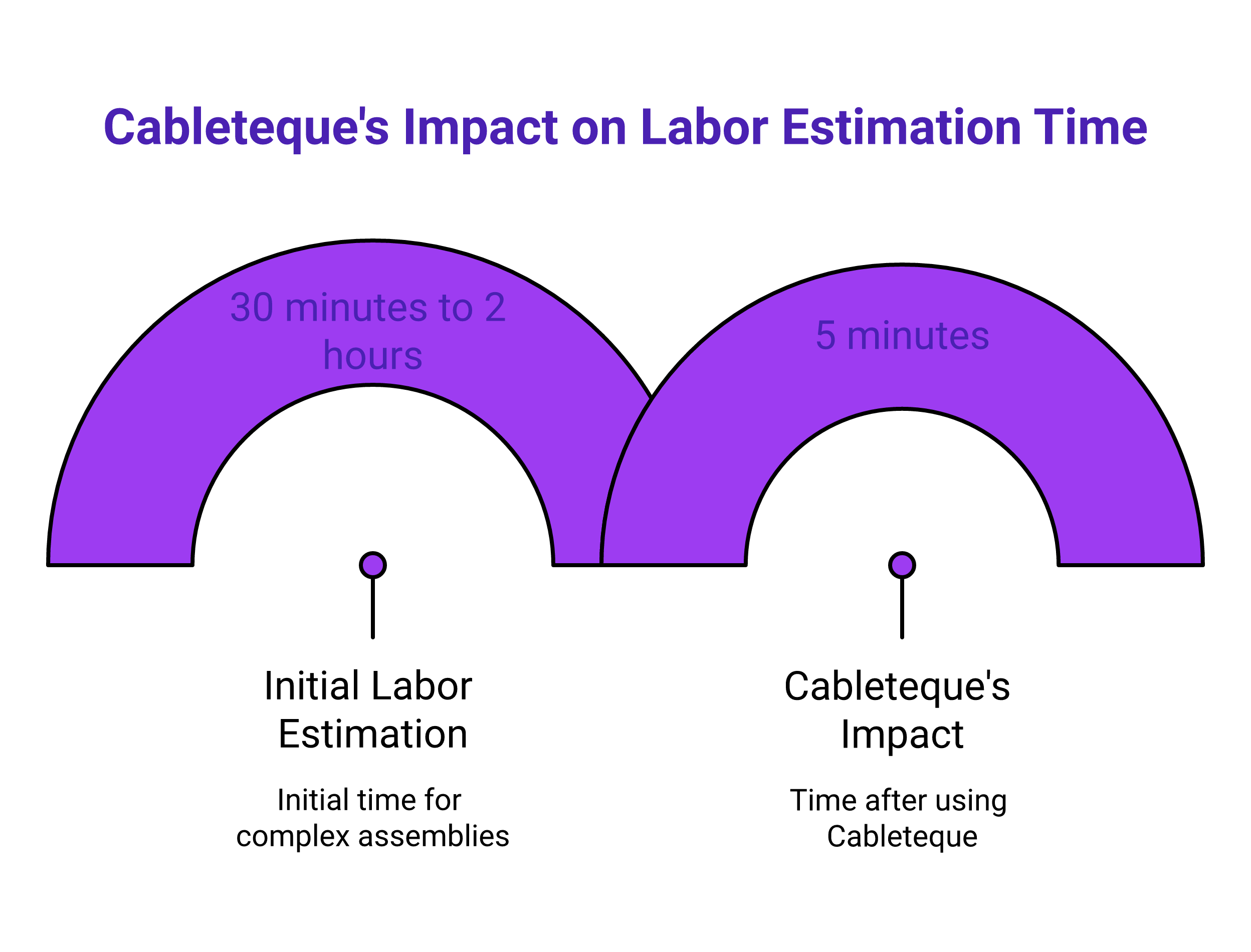
- Cableteque estimates labor by reading the drawing, counting assembly operations, and filling a labor template from historical logic, which cuts a manual step that often takes 30 minutes to 2 hours down to about 5 minutes.
- Operation counts are the core of the method. The platform tracks tasks such as cutting, stripping, crimping, inserting, routing, splicing, terminating, and overmolding instead of asking estimators to rebuild labor from scratch.
- Labor templates carry the shop's own estimating knowledge forward. That reduces dependence on one senior estimator and gives product managers, engineering managers, and operations managers a repeatable process they can audit.
- Cableteque says labor operation counts are autocompleted at a 50% to 70% rate, and its quoting workflow can reduce labor quoting time by 70% while improving consistency across RFQs.
- For complex cable assemblies, the real win is not speed alone. Faster labor estimation protects margin, reduces quote backlogs, and helps teams respond while OEMs are still comparing suppliers.
Introduction
Labor estimation for complex cable assemblies is where good quoting teams either move fast or get buried. In wire harness work, one package can include dozens of assemblies, connector tables, breakouts, splices, shielding calls, and special notes, so a generic ERP labor rule rarely survives contact with the drawing.
Cableteque handles this by turning the drawing into counted work. It reads OEM PDFs, extracts the BOM and related data, then uses labor templates, historical patterns, and drawing interpretation to fill in the operation counts that estimators normally have to build by hand. For teams trying to cut a 7 to 10 day quote cycle down to minutes, that difference changes how much business they can even chase.
For a deeper look at the broader quoting workflow, Wire Harness Quoting: The Complete Guide for Contract Manufacturers and How to Choose Wire Harness Quoting Software show how labor fits into the full estimate. Cableteque also explains its quoting method in Eliminating Guesswork: How AI Is Changing Wire Harness Quoting.
Table of Contents
- Key Takeaways
- Introduction
- How Cableteque Builds Labor Estimates
- What Changes Inside The Estimating Workflow
- Why The Method Works For Complex Assemblies
- Decision Implications For Product, Engineering, And Operations Teams
- The Final Read On Labor Estimation
- FAQ
- About Cableteque
How Cableteque Builds Labor Estimates
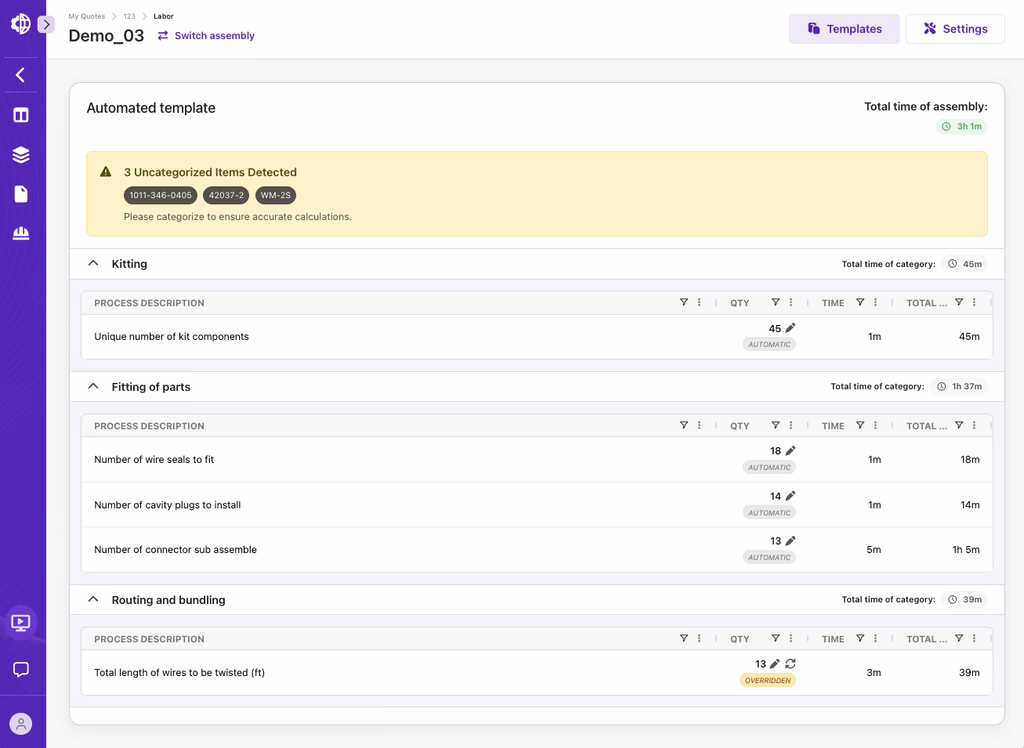
Cableteque builds labor estimates by counting real operations from the drawing and then mapping those counts into a configured labor template. That is a practical method for wire harness quoting because the time driver is usually not one big activity, it is a stack of small ones that add up fast.
A manual estimator can spend 30 minutes to 2 hours on labor after BOM recreation and sourcing are done. Cableteque says its own workflow reduces that step to about 5 minutes, with labor templates autocompleting at a 50% to 70% rate for operation counts.
| Layer | What it covers | Best for | Key takeaway |
|---|---|---|---|
| Surface | The system reads a drawing, extracts the BOM, and fills a labor template with counted assembly work. | Product managers and operations managers who need a fast quote process. | Labor comes from counted operations, not from guesswork. |
| Operational | It applies historical labor patterns, operation rules, and exception checks across connectors, splices, and routing steps. | Engineering managers and estimators who need repeatable counts. | The template reduces rework and keeps quotes consistent. |
| Strategic | It turns labor knowledge into a shared system that supports faster quoting across many RFQs and programs. | Leaders who care about margin, capacity, and quote speed. | The shop can quote more work without adding the same amount of headcount. |
Surface Layer: What the Estimator Sees First
The surface view is straightforward. Cableteque reads the file, counts the operations, and puts the result into a labor template that the team can review and adjust.
That matters because labor on a cable assembly is usually a collection of small steps, not a single line item. If the drawing shows twelve terminations, four splices, two connector insertions, and shielding work, the estimator needs those counts to appear quickly and in a form that reflects how the shop actually builds.
- The first pass starts with the drawing, not with a blank spreadsheet, so the estimator spends less time recreating the same job from scratch.
- Operation counts drive the estimate, which makes the output easier to defend when a supervisor or sales lead asks why the labor number moved.
- Historical templates let the team reuse what it already knows, which matters when the same connector family or assembly style appears across multiple RFQs.
- Missing or conflicting information is easier to spot early, so the quote does not stall while someone chases a drawing note that should have been caught in the first review.
- Product managers and operations managers can use the same process across many assemblies, which gives them a cleaner view of quote capacity instead of a pile of one-off estimates.
Operational Layer: How the Estimate Is Actually Assembled
The operational layer adds the mechanics behind the speed. Cableteque does not simply store a labor rate and multiply it by a part count, it interprets the assembly work implied by the drawing and the BOM.
That is a better fit for cable assembly because labor often depends on connectors, termination type, routing complexity, protection method, and the amount of manual handling in the build. Cableteque also maps descriptive inputs, part conversions, alternates, and customer part numbers into standardized data, which keeps the labor side tied to the material side instead of drifting away from it.
- A connector table with multiple cavities can produce different labor than a simple point-to-point lead set, so the template needs structure that reflects the assembly, not a generic routing rule.
- When the system sees a loose piece terminal callout, it can convert that into a reel-based assumption where appropriate, which keeps the labor and sourcing logic consistent.
- Cableteque says its parts database includes more than 2,000,000 components, giving estimators a stronger base for matching labor steps to real parts and approved alternates.
- The workflow is designed to catch missing terminals, cavity plugs, seals, and similar items that affect the work content of the job before the estimate gets finalized.
- Engineering managers can use the same output to reduce variance between estimators, which is where many shops lose repeatability even when they have a solid tribal process.
Strategic Layer: Why the Labor Model Changes the Business Case
The strategic view is where labor estimation becomes a capacity decision. If the team can cut labor quoting from 30 minutes to 2 hours down to roughly 5 minutes, the shop can answer more RFQs without expanding the estimating bench at the same rate.
Cableteque says customers see a 70% reduction in time spent quoting labor and a 50% to 70% autocompletion rate for labor operation counts. Industry context points in the same direction. In a WHMA survey cited in Cableteque materials, 73.81% of wire harness manufacturers described quoting as manual, time-intensive, and too slow, while labor and cost estimation tools received a 4.27 out of 5 value rating from respondents.
- Faster labor estimation lets operations teams respond while OEMs still have the project in active comparison, which is often the only window that matters.
- Repeatable templates reduce dependence on one senior estimator, so the shop is less exposed when an experienced person is out or buried in higher-value work.
- A cleaner labor model gives product teams a better picture of how quoting software fits the rest of the workflow, especially if they are comparing quoting software options for high-mix work.
- Cableteque's process supports the larger quoting stack described in its official platform overview, where BOM extraction, sourcing, and quote finalization connect to labor in one flow.
- Managers can set standard operation rules by customer, part, or product line, which is a practical way to keep quote behavior consistent across automotive, aerospace, industrial, EV, medical, and machinery work.
What Changes Inside The Estimating Workflow
The workflow changes because estimators stop rebuilding the labor story around each drawing. Instead of starting with a blank form, they start with counted operations, exception flags, and a template that already knows the shop's common labor patterns.
That shift saves time and also reduces variation. Cableteque says manual quote work in traditional environments often takes 7 to 10 days, and labor is one of the slowest pieces after BOM recreation and sourcing. In one of its own materials, the company says labor estimation can drop from 30 minutes to 2 hours to about 5 minutes.
- The estimator spends less time translating the drawing into internal language because the system already recognizes common work types.
- The quote becomes easier to review because the labor counts are visible, not hidden inside a generic total.
- Repeat jobs move faster because the historical template already has the common operation structure from earlier quotes.
- Complex assemblies with breakouts, splices, shielding, and termination work no longer force the estimator to rebuild the entire labor picture by hand.
- Teams get a steadier handoff between engineering, quoting, and operations, which cuts down the back-and-forth that usually eats half a day.
From Drawing Review to Operation Counts
A good cable assembly quote starts with the drawing, and Cableteque treats that as the source of labor truth. It reads the PDF, identifies BOM tables, wire lists, connector tables, and notes, then turns those items into the operation counts needed for labor estimation.
That is useful in complex jobs because the drawing often contains labor clues spread across several sections. One note can affect wiring steps, another can change protection, and a connector callout can shift the termination count. By putting those pieces into a structured labor template, Cableteque makes it easier to keep the estimate tied to the actual build.
Why Historical Templates Matter More Than Generic Rules
Historical templates matter because cable assembly labor is rarely uniform. Two similar jobs can differ on routing length, connector sealing, labeling, inspection points, or the need for special protection, and those differences affect the quote.
Cableteque captures that shop knowledge in configurable templates so the estimate does not depend entirely on memory or one person's preferred method. A WHMA-based report cited in Cableteque's materials says the survey covered 42 contract manufacturers, used 11 questions, and received a 100% response rate, which shows how broad the industry need is for repeatable tools that respect how this work actually gets done.
Why The Method Works For Complex Assemblies
This method works because complex cable assemblies are operation-heavy. The more connectors, circuits, splices, terminations, and protective steps a job has, the less useful a simple labor multiplier becomes.
Cableteque handles that complexity by combining drawing interpretation, rule-based logic, and historical labor structure. It also flags missing or conflicting information so estimators spend time on exceptions instead of redoing the whole estimate.
- A complex RFQ can include dozens of assemblies and hundreds of components, which makes manual labor takeoffs slow enough to delay the quote beyond the customer's deadline.
- Operation-based estimation fits the reality of wire harness work, where the labor lives in the termination operations, routing, inspection, protection, and assembly handling.
- The 50% to 70% autocompletion rate means the system can fill a large share of the labor picture before a human touches the estimate, which shortens the quote cycle.
- Cableteque's real-time sourcing logic and 2,000,000-plus part library reduce disconnects between labor assumptions and material choices.
- Engineers can review exceptions instead of building every estimate from zero, which is the difference between a quote queue that moves and one that stalls.
Complexity Is the Real Labor Driver
Complexity is what breaks generic labor rules. A simple cable with a few terminations can be estimated quickly, but a mixed assembly with shielding, overmolding, bundle protection, and multiple connector families needs more than a flat rate.
That is why Cableteque ties labor to the actual work content visible in the drawing and the BOM. When the system sees the structure of the assembly, it can estimate with more consistency than a human trying to carry five jobs in memory at once.
Exceptions Still Need an Engineer
No labor system should pretend every job is fully automatic. Special builds still need engineer review, especially when the drawing leaves gaps or the customer has unusual requirements.
Cableteque is built for that reality. It flags missing information, maps customer part numbers, and supports approved alternates, so the estimator reviews the exceptions instead of doing a full rebuild. That keeps the process practical for shops that quote high-mix work all week.
A Better Fit for Multi-program Environments
Multi-program quoting is where the method earns its keep. Teams that receive several RFQs at once need labor estimates that are quick enough to keep pace and consistent enough to compare jobs fairly.
Cableteque's platform is built for cloud-based collaboration and real-time component visibility, so labor is not isolated from sourcing, cost, and review. That helps product managers and operations managers keep the same quote logic across programs instead of juggling disconnected spreadsheets and local templates.
Decision Implications For Product, Engineering, And Operations Teams
For decision makers, the real question is whether labor estimation is repeatable enough to trust at scale. Cableteque's approach says yes, because it uses counted operations, historical labor logic, and exception handling instead of broad assumptions.
That gives leaders a clearer path on staffing, throughput, and quote quality. It also means they can use one quoting process across more RFQs without asking senior engineers to spend their day on the same tedious takeoff work.
- Product managers can define labor behavior by product line or customer, which helps standardize quote rules without flattening the differences that matter.
- Engineering managers can inspect operation counts and exception flags before the quote goes out, which makes review faster and more specific.
- Operations managers can track whether quote capacity is improving without adding a matching layer of headcount.
- The team can use historical templates as a living record of how the shop actually builds work, which is better than trying to preserve knowledge in someone's inbox.
- A quicker labor process supports better win rates because the quote reaches the customer while the RFQ is still active, not after the sourcing window has moved on.
How to Evaluate the Fit in Practice
A good evaluation starts with the jobs that hurt most. Look at the complex assemblies that normally take the longest to estimate, then compare current labor time against the time needed when the template is preloaded.
Cableteque is built to sit inside existing processes without forcing a full rip-and-replace, which matters for shops that cannot stop quoting while they test new software. The platform also fits with real-time component availability and logistics insights, so the labor estimate stays connected to the actual build path.
What the Numbers Suggest for Capacity Planning
The numbers point to a simple conclusion. If labor estimation falls to around 5 minutes and quote turnaround for the broader process drops by as much as 70%, the shop can quote more business with the same team.
Cableteque says its customers have seen 5x quote capacity without new hires, and that kind of gain changes how leaders think about quoting as a function. It is no longer only a back-office task. It becomes a front-line sales and margin control process.
The Final Read On Labor Estimation
Cableteque handles labor estimation by turning drawings into counted operations and then placing those counts into a labor template that reflects real wire harness work. That is why it can cut a labor step that often takes 30 minutes to 2 hours down to about 5 minutes, while still keeping room for engineer review where the job demands it.
The result is a quoting process that is faster, more consistent, and easier to scale across complex assemblies. For product managers, engineering managers, and operations managers, that means labor estimation is no longer a guessing exercise hidden inside a spreadsheet, it is a controlled part of the quote flow.
FAQ
Q: How does Cableteque estimate labor for a cable assembly?
A: It reads the drawing, extracts the BOM and related notes, then counts the assembly operations that drive labor. Those counts are placed into a labor template built from historical shop knowledge and configurable rules. The estimator can then review exceptions instead of rebuilding the estimate from the beginning. In Cableteque's own materials, this reduces labor estimation from 30 minutes to 2 hours down to about 5 minutes.
Q: What kinds of operations does the system count?
A: It counts the work that usually drives labor in wire harness and cable assembly jobs, such as cutting, stripping, crimping, inserting, routing, terminating, splicing, and overmolding. It also captures connector-related work and protection steps when those appear in the drawing. That operation-based approach fits complex assemblies better than a generic flat labor rule. It also gives reviewers a clearer reason for the estimate.
Q: Why do labor templates matter so much?
A: Labor templates keep the shop's estimating knowledge in one place. That reduces dependence on one senior estimator and makes the quote process easier to repeat across different jobs. When a template is preloaded with common operation logic, the team can quote faster and with less variation. It also makes reviews cleaner because the structure is visible.
Q: How much manual work does Cableteque remove from labor estimation?
A: Cableteque says labor operation counts are autocompleted at a 50% to 70% rate. It also says automated labor estimation reduces the time spent quoting labor by 70%. In practical terms, that means the estimator is spending less time on data entry and more time checking exceptions and approvals. For busy shops, that can be the difference between keeping up and falling behind.
Q: Is this useful for very complex RFQs?
A: Yes, especially there. Complex RFQs often include many assemblies, many components, and several routing or termination decisions that affect labor. Cableteque is built to interpret those details from the drawing and map them into a template instead of forcing the estimator to start over. That is why it fits high-mix environments better than a generic quoting workflow.
Q: How does this help operations managers?
A: It gives them a clearer view of quote capacity and turnaround time. When labor estimates are faster and more consistent, the team can respond to more RFQs without adding the same level of manual effort. That improves scheduling around estimating resources and reduces quote backlog. It also lowers the risk of losing work because the quote landed too late.
About Cableteque
Cableteque combines over three decades of hands-on industry expertise with a commitment to innovation in wire harness software. Founded by Arik Vrobel, our team brings together engineers, operators, and business leaders who deeply understand the challenges related to wire harnesses.
We focus on solving the toughest problems across the entire design-through-manufacturing lifecycle, helping teams work smarter, faster, and with greater precision.
Our company thrives on innovation, inclusivity, and collaboration. We value individuality, sustainability, and making a positive impact-building trust and shared success every step of the way. We are the only company creating software designed by wire harness people, for wire harness people. Our goal is to simplify communication between OEMs and contract manufacturers, help teams work with better control, and support growth.
Cableteque isn't just a tool; it's an evolving platform built to support engineers, supply chain specialists, sales teams, and manufacturing professionals in their daily work. Our company thrives on innovation, inclusivity, and collaboration.