
Last year, the WHMA Innovation Advisory Team (IAT) ran its first industry survey. This year we ran it again. As co-chair of the IAT, I was curious to see which answers would move and which wouldn't.
First, a caveat. The two surveys aren't identical. Last year's respondents were 42 contract manufacturers. This year's were 23 people across executive, engineering, operations, and quoting roles. That means year-over-year comparisons are directional, not precise. A few-point change may simply reflect who answered.
But when shifts are large, or when answers didn't move at all, I think they're worth paying attention to.
At a glance: 2025 vs 2026
| Finding | 2025 | 2026 |
|---|---|---|
| BOM or design completeness as top challenge | 57% | 70% |
| Quoting limited by incomplete inputs | 50% | 70% |
| Quoting accuracy and speed as an innovation priority | 40% | 65% |
| Design validation as an innovation priority | 52% | 61% |
| Use automated sourcing and quoting tools | 14% | 35% |
| Quoting is highly automated and scalable | 10% | 1/23 |
| Quoting is manual and time-intensive | 74% | 70% |
| Quoting depends on engineer knowledge | 57% | 57% |
| Sourcing difficulty | 48% | 48% |
| Reliance on key people | 29% | 30% |
What's grown: the input problem
BOM or design completeness was the top operational challenge last year, cited by 57% of respondents. This year it's still the top challenge, now cited by 70%.
The same pattern shows up in how people describe their quoting process. Last year, 50% said it was limited by incomplete designs or bad customer information. This year, 70% say it's limited by poor or incomplete inputs.
Both surveys point to the same root cause. More respondents this year point to it.
What's grown: the urgency around quoting
Last year, the top innovation priority was validating customer designs before manufacturing (52%). Quoting accuracy and speed were tied for second at 40%.
This year, quoting accuracy and speed moved to first place, chosen by 65% of respondents. Design validation is a close second at 61%.
I read those two findings together. Manufacturers want faster quotes, and they want confidence that what they're quoting is complete and correct. In practice, those are the same problem.
What's grown: tool adoption, slowly
Last year, 14% of respondents said they use automated tools for sourcing and quoting. This year, 35% do.
That's encouraging. But it hasn't yet translated into scale. Last year, 10% described their quoting process as highly automated and scalable. This year, only 1 of 23 respondents did. Manufacturers are adding tools, but most haven't connected them into an end-to-end workflow.
What hasn't changed
Some answers barely moved:
Manual work. 74% described their quoting process as manual and time-intensive last year. This year it's 70%.
Dependence on engineer knowledge. 57% both years.
Sourcing difficulty. 48% both years.
Reliance on key people. 29% last year, 30% this year.
These are structural problems. They don't shift in twelve months, and they won't shift on their own.
What we asked for the first time
This year's survey also asked questions we didn't ask last year, and some of the most useful findings came from them. I went through them in more detail in five things the 2026 survey told me about quoting, but here's the short version:
Delays. When asked what holds up an RFQ, 70% cite waiting for supplier pricing and lead times, and 61% cite waiting for customer clarification. Only 17% name estimating or engineering work.
Gaps. The most commonly missing items in customer RFQs are manufacturer part numbers (70%), missing or unidentified parts (61%), and customer specifications or workmanship requirements (39%).
A standard. 74% rate a standardized RFQ minimum data checklist as very or extremely useful.
AI. 78% are using, piloting, or evaluating AI or automation in at least one area.
Last year told us the process was slow. This year tells us why, and what the industry would like to do about it.
What I'd like to see next year
The IAT has recommended developing and piloting an RFQ minimum data checklist, and repeating the survey with a larger, more balanced sample. Both matter. A bigger sample will make next year's comparison far more reliable. A checklist will give us something concrete to measure against.
If the input problem is still growing this time next year, we'll know we need to move faster. If it's starting to shrink, we'll know the industry is on the right track.
Manufacturers and customers interested in helping develop the checklist can contact David Bergman at DavidBergman@electronics.org. Full survey results are available at https://emails.electronics.org/links/WHMA-2026-Survey-Results.pdf.
To see how Cableteque helps manufacturers identify missing information as soon as an RFQ arrives, book a demo.
Read the full 2026 WHMA survey findings: WHMA survey findings.
Free 2026 industry report
The State of Wire Harness Operations 2026
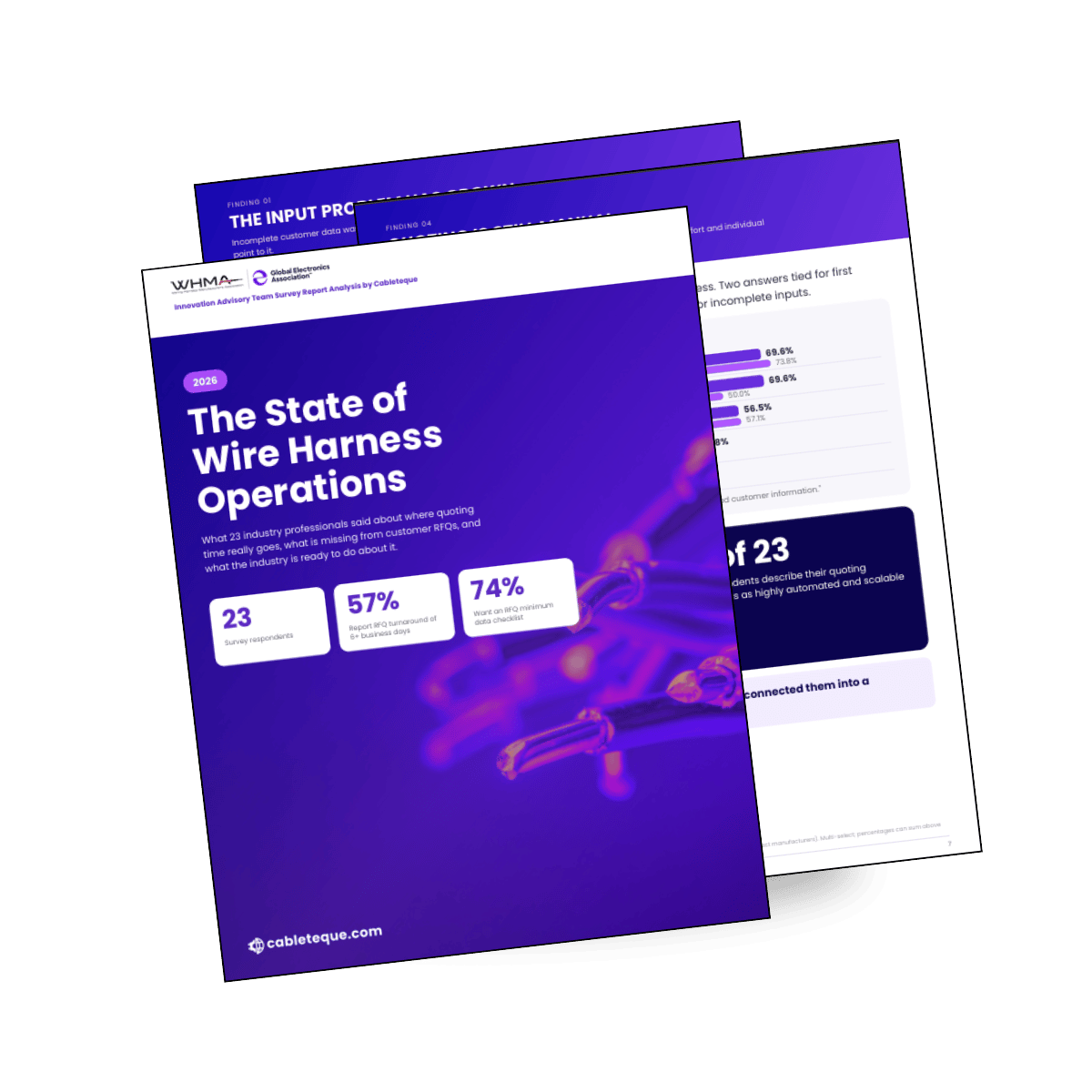
See every year-over-year comparison in one place, with plain charts and what changed since 2025 called out on every page. Find out where quoting time really goes and why 74% of respondents want a shared standard.
Frequently asked questions
What changed between the 2025 and 2026 WHMA surveys?
The input problem grew. BOM or design completeness stayed the top challenge but rose from 57% to 70% of respondents, and the share saying incomplete inputs limit quoting rose from 50% to 70%. Quoting accuracy and speed also became the top innovation priority, and use of automated quoting tools rose from 14% to 35%.
What stayed the same in wire harness quoting?
Manual work, dependence on engineer knowledge, sourcing difficulty, and reliance on key people barely moved. 70% still describe quoting as manual and time-intensive, and 57% say it depends on engineer knowledge in both years.
Can the 2025 and 2026 WHMA survey results be compared directly?
Only as a directional guide. In 2025, 42 contract manufacturers responded. In 2026, 23 people across executive, engineering, operations, and quoting roles responded. Large shifts and answers that didn't move are the most meaningful signals.
What does the WHMA IAT recommend next?
Develop and pilot an RFQ minimum data checklist, then repeat the survey with a larger, more balanced sample so future comparisons are more reliable.