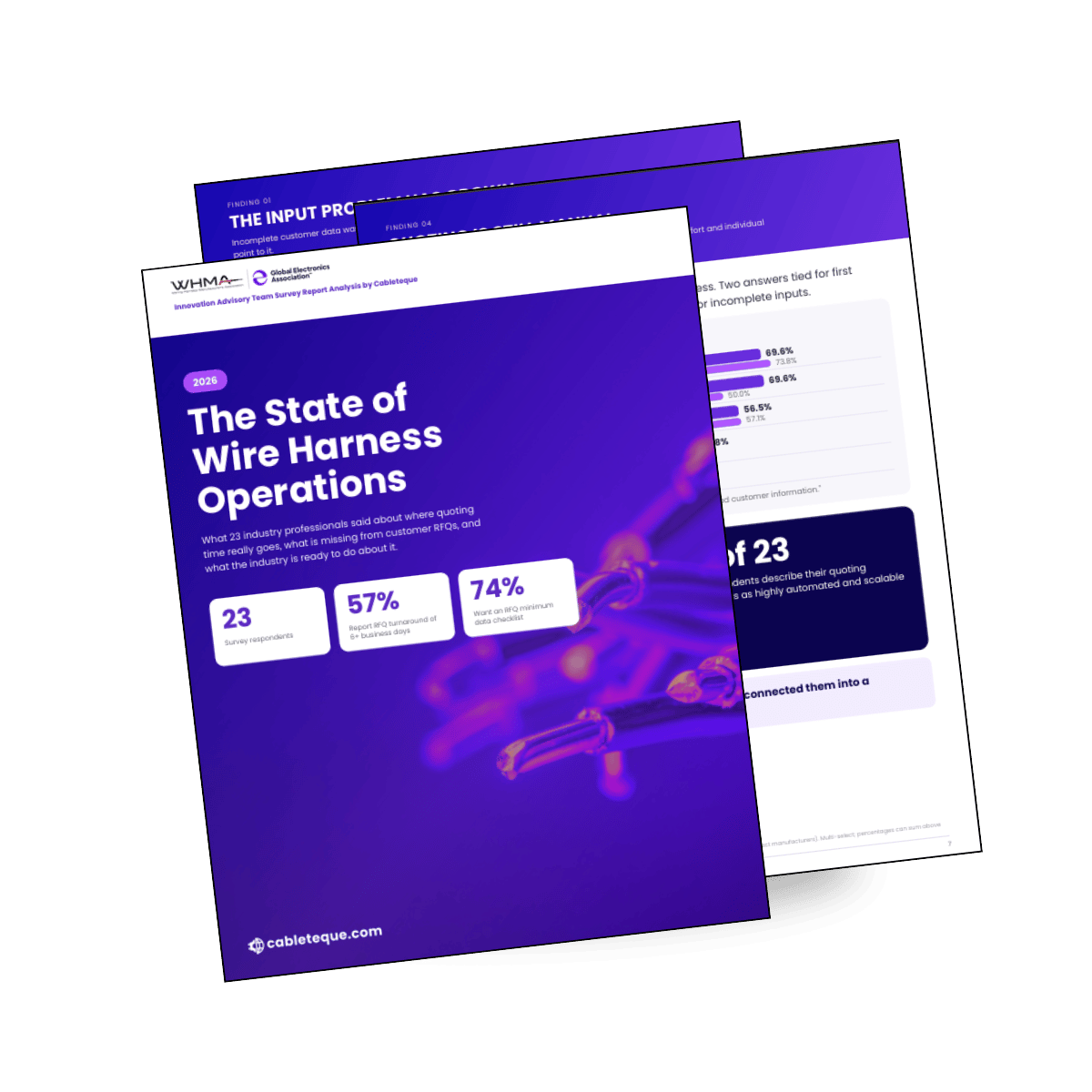
This year, the WHMA Innovation Advisory Team (IAT), which I co-chair with George Jacob of E-Tron Systems, ran its second industry survey. We asked manufacturers about their biggest challenges, how they quote, what tools they use, and where they think innovation would help most.
The sample is small- 23 respondents- and the IAT is clear that the results are directional, not a full picture of the industry. But the answers were candid, and they point in a consistent direction. WHMA has published the full findings here: WHMA survey findings.
Here's what stood out to me.
1. The problem starts before the quote does
The most cited operational challenge was BOM or design completeness, named by 70% of respondents. It was also the top challenge last year. The same share, 70%, say their quoting process is limited by poor or incomplete inputs.
The survey also asked what's typically missing. The answers were manufacturer part numbers (70%), missing or unidentified parts (61%), and customer specifications or workmanship requirements (39%).
None of this is new to anyone who has quoted a harness. What's useful is seeing it confirmed so clearly. The biggest quoting problem isn't inside the manufacturer's four walls. It arrives with the RFQ.
2. Quotes spend more time waiting than being worked on
The most common estimate of active touch time was 3 to 5 hours per assembly. Yet 57% of respondents say an RFQ takes 6 business days or more to turn around.
When we asked what causes the delays, 70% pointed to waiting for supplier pricing and lead times, and 61% to waiting for customer clarification. Only 17% named the estimating or engineering work itself.
I've written about this in more depth for Wire Harness News, so I'll keep it short here. The work isn't the bottleneck. The waiting is.
3. Spreadsheets still run much of the industry
Seventy percent (70%) of respondents use in-house Excel or Word methods for design documentation. More than half (57%) describe their quoting process as dependent on engineer knowledge, and 30% list reliance on key people as a top challenge.
I understand why. Spreadsheets are flexible, familiar, and free. But they also mean much of the industry's know-how lives in individual files and individual heads. When that person is out, busy, or retires, the knowledge goes with them. That's a risk worth taking seriously, not just an efficiency problem.
4. Interest in AI is real, but it's early
78% of respondents are using, piloting, or evaluating AI or automation somewhere in their process. Only 22% say they're doing nothing today.
But look closer: most of that activity is concentrated in one place. Drawing, PDF, and BOM data extraction leads at 70%. Sourcing and part selection follow at 48%, estimating and labor calculation at 44%, and quote generation at 35%. Design package validation, checking whether what the customer sent is actually complete and correct, is at 26%.
And only 1 of 23 respondents describes their quoting process as highly automated and scalable.
The industry has started automating how it reads customer data. The bigger gains will come from automating what happens next: spotting the gaps, connecting to supply chain data, and moving the RFQ forward without waiting days for someone to notice what's missing.
5. The industry wants a standard
This finding encouraged me most. 74% of respondents rate a standardized RFQ minimum data checklist as very or extremely useful. 65% would use one internally to evaluate RFQs, and 57% would share it with or request it from customers.
Developing and piloting that checklist is one of the IAT's recommended next steps. It won't solve every problem, but it would give manufacturers and their customers a shared starting point. Manufacturers and customers interested in helping develop the checklist can contact David Bergman at DavidBergman@electronics.org.
What manufacturers can do now?
You don't need to wait for a standard to start making progress. Three things I'd suggest:
Measure both clocks. Track how many hours you actually spend on a quote and how many days it takes to deliver. The gap between the two tells you where to focus.
Know your most common gaps. Look back at your last 20 RFQs and list what was missing most often. Chances are it's a short list.
Ask all your questions at once. When an RFQ arrives, review it for missing information first, then send every question to the customer at once. One round of clarification is far faster than three.
The survey confirms what many of us already knew from experience. The good news is that the biggest quoting delays are also some of the most fixable.
If you'd like to see how Cableteque helps manufacturers identify missing information as soon as an RFQ arrives, book a demo.
Free 2026 industry report
The State of Wire Harness Operations 2026
Every finding in one place, with plain charts and what changed since 2025 called out on every page. See where quoting time really goes, which RFQ gaps come up again and again, and why 74% of respondents want a shared standard.
Get your copy
Frequently asked questions
What is the WHMA Innovation Advisory Team survey?
It's an annual industry survey run by the WHMA Innovation Advisory Team (IAT). It asks wire harness manufacturers about their biggest challenges, how they quote, which tools they use, and where innovation would help most. 2026 is its second year.
What is the biggest challenge in wire harness quoting?
Incomplete customer inputs. 70% of respondents named BOM or design completeness as their top operational challenge, and 70% say poor or incomplete inputs limit their quoting. The most commonly missing items are manufacturer part numbers, unidentified parts, and customer specifications.
How long does it take to quote a wire harness?
The most common estimate of active work is 3 to 5 hours per assembly. Even so, 57% of respondents say an RFQ takes 6 business days or more to turn around, mostly because of waiting on supplier pricing and customer clarification.
How are wire harness manufacturers using AI?
78% are using, piloting, or evaluating AI or automation somewhere in their process. Most of it is focused on reading drawings, PDFs, and data. Only 1 of 23 respondents describes their quoting process as highly automated and scalable.
What is an RFQ minimum data checklist?
It's a proposed shared standard listing the information an RFQ should include before quoting starts. 74% of respondents rate it as very or extremely useful, and developing one is a recommended next step from the IAT.