
Key Takeaways
- Wire harness quoting starts with incomplete RFQs, so the software must rebuild a usable BOM before it can price anything.
- Generic manufacturing quoting tools usually assume cleaner inputs, standard routings, and less engineering interpretation.
- Speed matters because the WHMA Innovation Advisory Team found that 57% of respondents had elapsed RFQ turnaround of 6+ business days, even when only 3 to 5 hours of active work was needed.
- The biggest gains come from BOM extraction, part normalization, connector logic, wire-length calculation, and labor estimation in one workflow.
- For product, engineering, and operations leaders, the right system reduces quote delays, lowers rework, and protects margin.
Introduction
Wire harness quoting software is different because the job is different. A standard quote can begin with a fairly clean part list and a familiar routing model, but a harness RFQ often arrives as a set of PDFs, partial notes, wire lists, and connector callouts that still need to be interpreted before anyone can price the work.
That is why wire harness quoting, EWH quoting software, and electrical wire harness quoting solutions need more than a cost calculator. They need to answer the practical question of how to make a BOM from messy source data, how to validate part identity, and how to turn wire-length, connector compatibility, and workmanship rules into a defensible quote fast enough to win the job.
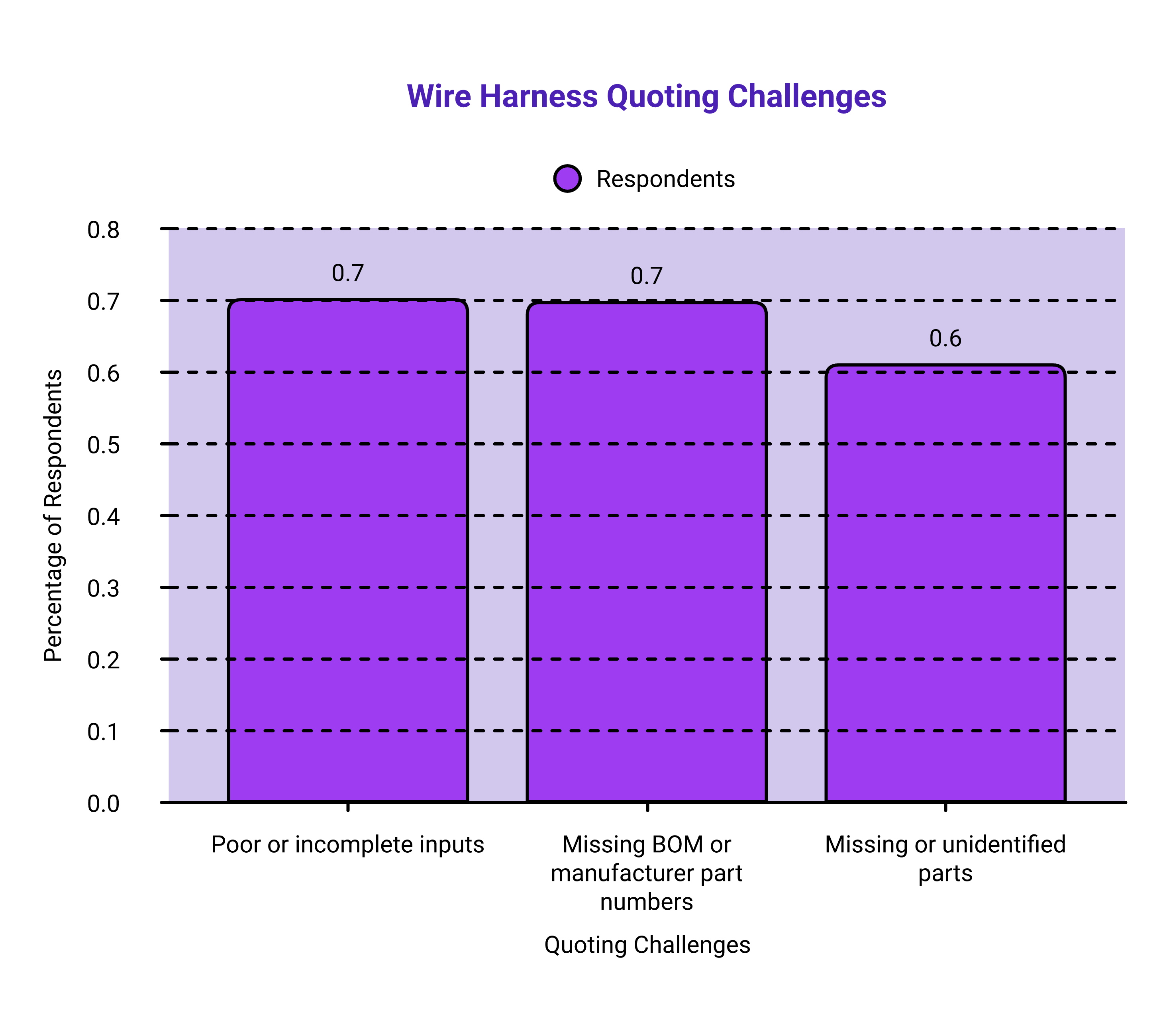
The difference shows up in the numbers. In the 2026 WHMA Innovation Advisory Team survey, 70% of respondents said poor or incomplete inputs limit quoting, up from 50% in 2025. BOM or manufacturer part numbers were missing in 69.6% of cases, and 60.9% of teams reported missing or unidentified parts. That is not a normal pricing task. It is data recovery, engineering judgment, and quoting under deadline pressure.
Table of Contents
- Why Wire Harness Quoting Starts With Bad Inputs
- How Quoting Workflow Differs From Other Manufacturing Tools
- Why Labor, Topology, And Part Identity Change The Math
- What Product, Engineering, And Operations Teams Need From Software
- Why Cableteque Fits This Category
Why Wire Harness Quoting Starts With Bad Inputs
Wire harness quoting begins upstream of pricing. The first step is usually reconstructing the job from incomplete RFQs, customer drawings, and markup-heavy PDFs, then translating that material into a clean BOM that the team can trust.
That is where generic manufacturing tools usually lose value. They can price known parts and standard operations, but they do not naturally resolve shorthand descriptions, customer part numbers, alternates, wire gauges, connector tables, or topology-specific wire lengths.
The WHMA Innovation Advisory Team survey makes the input problem plain. Among the 23 industry professionals in the 2026 survey, 69.6% cited BOM and manufacturer part numbers as the most common RFQ gap, while 60.9% pointed to missing or unidentified parts. Customer specs or workmanship requirements were missing in 39.1% of requests, and wire-list or connectivity data was absent in 26.1%.
That is why the first real job is interpretation. A quote team has to decide whether "blk tape" means black Tesa 3/4 inch tape, whether a loose piece terminal should become a reel, and whether the connector callout matches the wire gauge and seal set in the drawing. If the software cannot do that work, the estimator still has to.
How Quoting Workflow Differs From Other Manufacturing Tools
Wire harness quoting is not a single pricing event. It is a chain of tasks that includes BOM recreation, part normalization, sourcing, labor estimation, and internal review, often with the estimator waiting between each step for customer clarification or supplier response.
A generic manufacturing quote engine usually assumes the estimate begins with clearer inputs and a more stable parts structure. In wire harness work, the software has to absorb drawings, PDFs, and BOM fragments, then preserve the engineering intent long enough to price the assembly correctly.
The 2026 WHMA Innovation Advisory Team survey shows why that distinction matters. It reported only 3 to 5 hours of active work for the most common quoting pattern, yet 57% of respondents still experienced elapsed RFQ turnaround of 6+ business days and 30% needed more than 10 business days. Waiting for supplier pricing or lead times affected 69.6% of teams, and waiting for customer clarification affected 60.9%.
That delay profile is very different from a shop quoting machined parts or repetitive assemblies. In those environments, the bottleneck is often pricing logic. Here, the bottleneck is also the reconstruction of the work itself.
The Workflow Difference Shows Up In The Hand-offs
The quote passes through more people and more judgment calls than most manufacturing estimates. Engineering checks connector fit, wire length, protective covering, and compliance requirements, while operations checks labor assumptions and supplier availability.
Generic tools often stop at material cost and a margin formula. Wire harness quoting software has to keep moving through source preference rules, approved alternates, and part equivalencies without breaking the thread of the estimate.
Why Labor, Topology, And Part Identity Change The Math
Wire harness labor is not just a time standard. It depends on breakout count, termination operations, braiding, bundling, splicing, test requirements, and assembly difficulty across the full drawing.
Topology changes the estimate as much as the part list does. Wire length, routing path, connector orientation, and bundle diameter affect material use and labor in ways that a generic quote template usually does not capture.
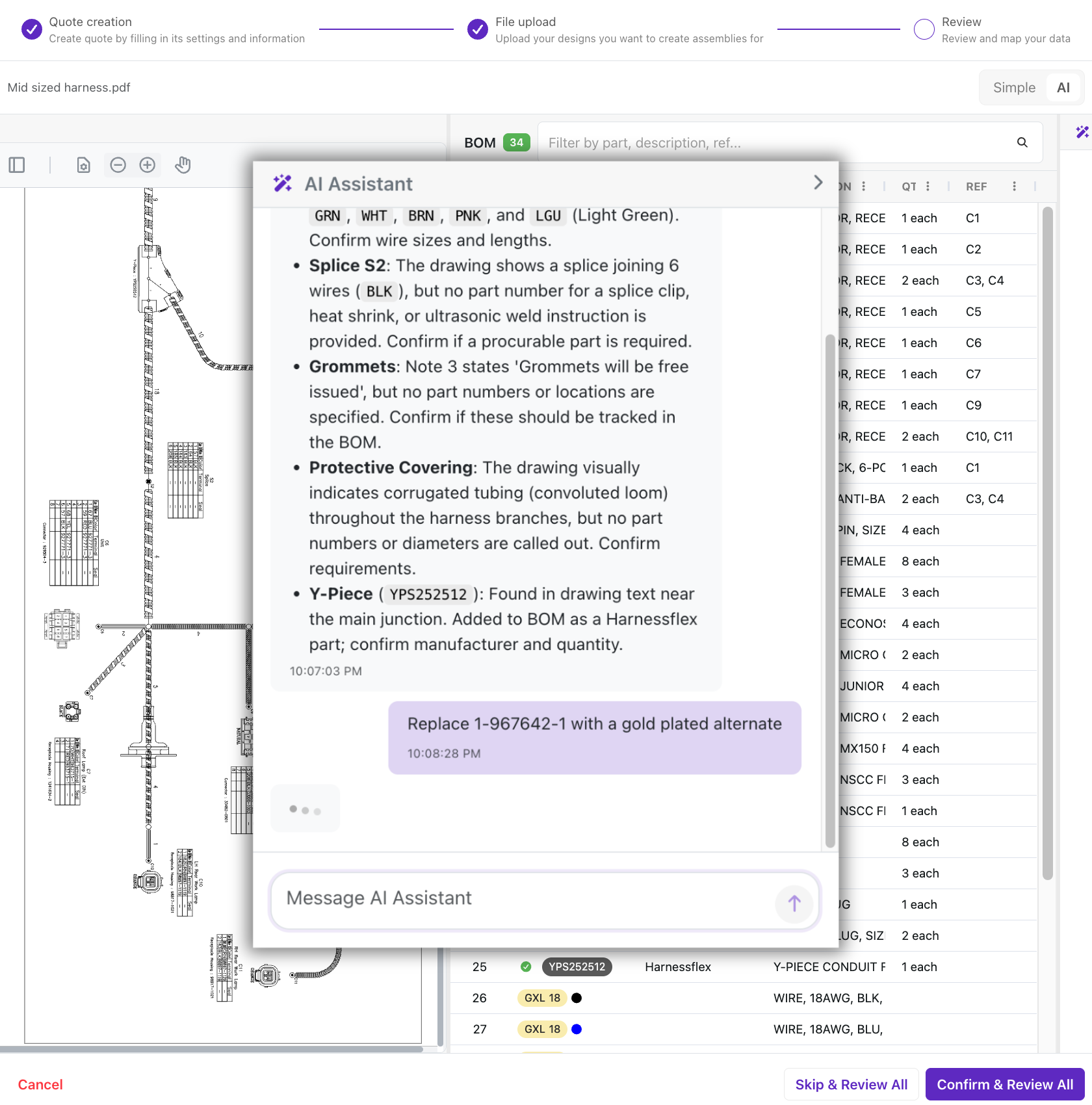
Cableteque's internal materials point to that gap directly. The platform uses harness topology logic to trace drawings and calculate exact wire lengths from the PDF, and it calculates protective covering requirements from bundle diameter logic. It also stores customer part numbers, maps them to MPNs, and applies approved alternates and part equivalencies.
That matters because part identity is often hidden inside customer language. A quote team may know the requested assembly by house terminology, but the purchasing step still needs the correct manufacturer part number, connector family, plating choice, and mating details before the quote is defensible.
The 2026 survey backs up the need for that kind of logic. Fifty-six point five percent said quoting depends on engineer knowledge, 69.6% described the process as manual and time-intensive, and only 4.3% called it highly automated and scalable. When a process still depends on tribal knowledge, the software has to capture that knowledge instead of assuming it exists in the system already.
The Best Systems Capture Engineering Judgment
A quote platform for wire harness work has to carry the shop's rules, not just its prices. It should normalize descriptions, apply conversion rules, and flag missing data before the estimator spends an hour cleaning up a dead-end request.
That is the practical difference. The software is not only measuring cost. It is preserving the decisions that keep the quote buildable.
What Product, Engineering, And Operations Teams Need From Software
Product managers need speed, traceability, and a way to keep quote quality consistent across different customers and program types. Engineering managers need a system that reduces repetitive review and catches missing data before it becomes a late-stage correction.
Operations managers need throughput and less dependence on a few senior estimators. If only a small group knows how to decode every RFQ, the quoting department becomes fragile, and the backlog shows it fast.
The WHMA Innovation Advisory Team survey found that 64.29% of respondents cited cost or budget constraints as the primary barrier to adoption, followed by compatibility with existing systems at 57.14% and lack of internal resources at 52.38%. That is why the better tools have to work alongside current processes rather than force a disruptive cutover.
Cableteque's materials emphasize that point through non-disruptive adoption, cloud-based collaboration, and practical manufacturing alignment. In internal customer outcomes, the company reports up to 70% faster quote turnaround, 5x quote capacity without new hires, and as much as 96% reduction in BOM creation time on complex quotes.
The Operational Test Is Simple
If the system saves time but forces the team to rebuild its workflow, adoption stalls. If it reads the source package, extracts the BOM, applies part rules, and shortens review, the team can keep moving.
That is why this category is about more than software features. It is about preserving quoting capacity when RFQs pile up and deadlines do not move.
Why Cableteque Fits This Category
The product is built around the exact failure points that generic quoting tools miss. It starts with instant design import from OEM PDFs, then moves into AI-assisted analysis, automated sourcing, labor estimation, and instant quote generation.
Cableteque's own product materials describe automatic BOM extraction, part normalization, supplier pricing integration, and harness topology logic. Those functions matter because they attack the real delay chain, which is incomplete inputs, manual recreation, supplier wait time, and slow internal review.
One customer case in the company's materials reduced an 18-hour complex quote to 45 minutes. That is the kind of shift that changes how many RFQs a team can touch in a week without adding headcount.
For teams looking at how to make a BOM from a drawing instead of a clean ERP export, the distinction is obvious. Wire harness quoting software must read messy engineering information, map it to manufacturing reality, and return a quote that the shop can build without a long repair cycle.
The Category Needs A Different Kind Of Tool
A generic estimator can price a list. A wire harness system has to read the assembly.
That includes connector compatibility, wire gauge, insulation, seals, alternates, compliance checks, and wire-length logic. It also includes the practical pressure of quote turnaround, since the WHMA survey found that 57% of respondents had elapsed turnaround of 6+ business days while only 3 to 5 hours of active work were needed in the common pattern.
What This Means For The Next Quote Cycle
If your quoting team still spends most of its time reconstructing BOMs, chasing missing data, and checking part identity by hand, the software category you need is different from generic manufacturing quoting. The right system should read the RFQ, fill the gaps, and carry the estimate to the finish line with less manual repair.
That is the point where speed, accuracy, and consistency start to move together. When quote teams can spend less time cleaning up inputs and more time pricing real work, the business wins more of the jobs it can actually build.
FAQ
Q: Why do wire harness quotes take longer than other manufacturing quotes?
A: They usually start with incomplete RFQs, not clean part lists. The team has to reconstruct the BOM, resolve part identities, and calculate wire-length and topology-specific needs before pricing can begin. Supplier lead times and customer clarification also add waiting time, which the WHMA Innovation Advisory Team survey showed was a major delay driver. That makes the workflow slower than quoting many standard manufactured parts.
Q: What makes wire harness quoting software different from generic quoting tools?
A: It has to do more than calculate cost. It must extract BOM data from PDFs, map customer part numbers to MPNs, apply alternates, and handle wire-specific details like connector compatibility and bundle logic. Generic quoting tools often assume the input data is already clean and complete. Wire harness software has to clean the data first.
Q: Why is part normalization so important in this process?
A: Quoting teams often receive shorthand descriptions, house language, or partial part references. If the software cannot turn those into accurate purchased parts, the quote will need extra manual review and the risk of error rises. Part normalization also helps purchasing and engineering speak the same language. That reduces back-and-forth later in the process.
Q: How does topology affect the quote?
A: Topology changes wire length, routing, bundle diameter, and labor. A straight part count does not capture those variables. In wire harness work, a quote that ignores topology can understate material and labor needs. Software that traces the drawing and calculates wire-length logic gives a more realistic estimate.
Q: What should product and operations leaders look for first?
A: Start with the steps that consume the most time and create the most rework. BOM recreation, missing part resolution, sourcing, and labor estimation are usually the biggest drains. Leaders should also look for systems that fit into existing workflows without forcing a full process reset. Adoption goes faster when the software reduces manual effort on day one.
Q: How does faster quoting affect margin?
A: Faster quoting helps teams respond before the RFQ window closes or the customer moves on. It also reduces the chance that a senior estimator becomes the bottleneck for every difficult package. When the team spends less time on manual cleanup, it can handle more quotes with more consistency. That usually improves both win rate and pricing discipline.
About Cableteque
Cableteque combines over three decades of hands-on industry expertise with a commitment to innovation in wire harness software. Founded by Arik Vrobel, our team brings together engineers, operators, and business leaders who deeply understand the challenges related to wire harnesses.
We focus on solving the toughest problems across the entire design-through-manufacturing lifecycle, helping teams work smarter, faster, and with greater precision.
Our company thrives on innovation, inclusivity, and collaboration. We value individuality, sustainability, and making a positive impact, building trust and shared success every step of the way. We are the only company creating software designed by wire harness people, for wire harness people. Our goal is to simplify communication between OEMs and contract manufacturers, streamline operations, and help businesses grow.
Cableteque isn't just a tool; it's an evolving platform built to empower engineers, supply chain specialists, sales teams, and manufacturing professionals to do their best work. Our company thrives on innovation, inclusivity, and collaboration.
If your team is still rebuilding every RFQ by hand, what would 30-minute quoting change first: capacity, margin, or response time?