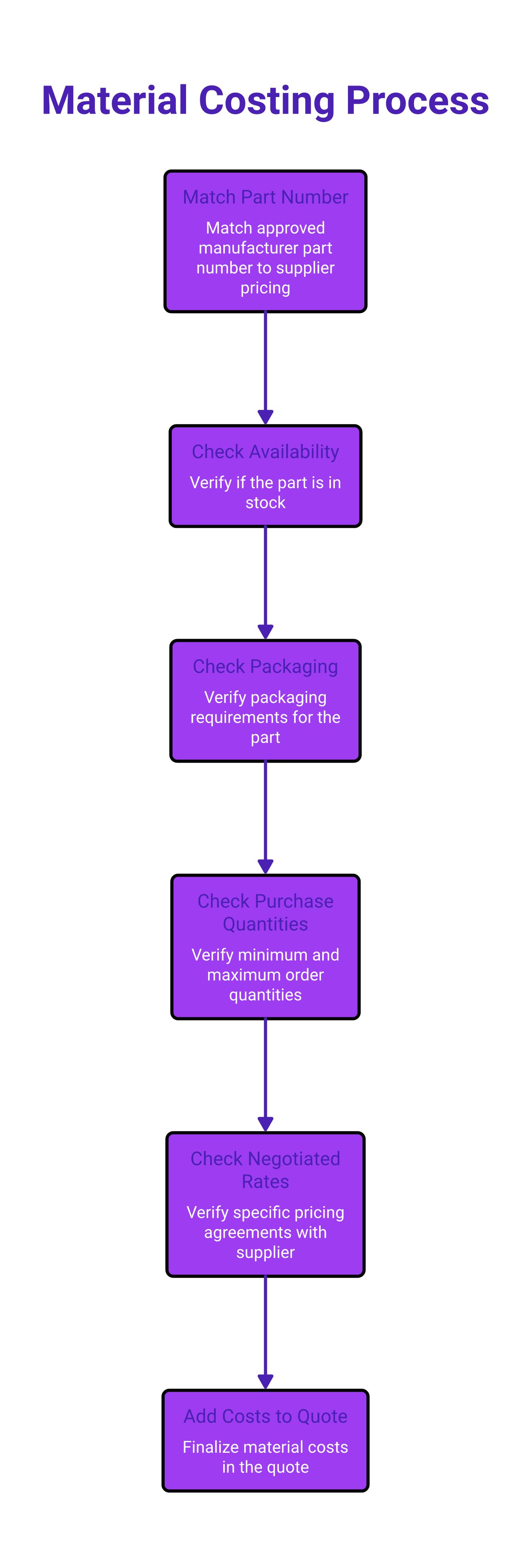
- Connect distributor pricing to approved manufacturer part numbers before calculating material costs.
- Compare availability, packaging, purchase quantities, and negotiated rates together.
- Configure approved suppliers and customer sourcing preferences before testing live quotes.
- Give estimators a defined process for missing prices, unavailable stock, and supplier responses that need review.
You're ready to finish a cable assembly quote, but the material costs still need checking. Purchasing has one distributor's spreadsheet. Engineering has another supplier's connector number. The price in the estimate came from an earlier job, and nobody has confirmed whether that quantity remains available. Every unresolved line delays the customer response.
We handle real-time material pricing through distributor API connections that bring current pricing and availability into the quoting workflow. Those connections support negotiated customer rates, while sourcing rules define approved suppliers and preferences. The estimate starts with identified parts, connects them to supplier information, and carries material costs into the broader quote calculation.
For manufacturing engineers, the important question is whether each returned price describes something the shop can actually purchase and build. Packaging, terminal compatibility, wire quantities, and customer approvals all affect that decision. A current price attached to the wrong purchasing assumption still produces an unreliable estimate.
How Supplier Pricing Enters the Estimate
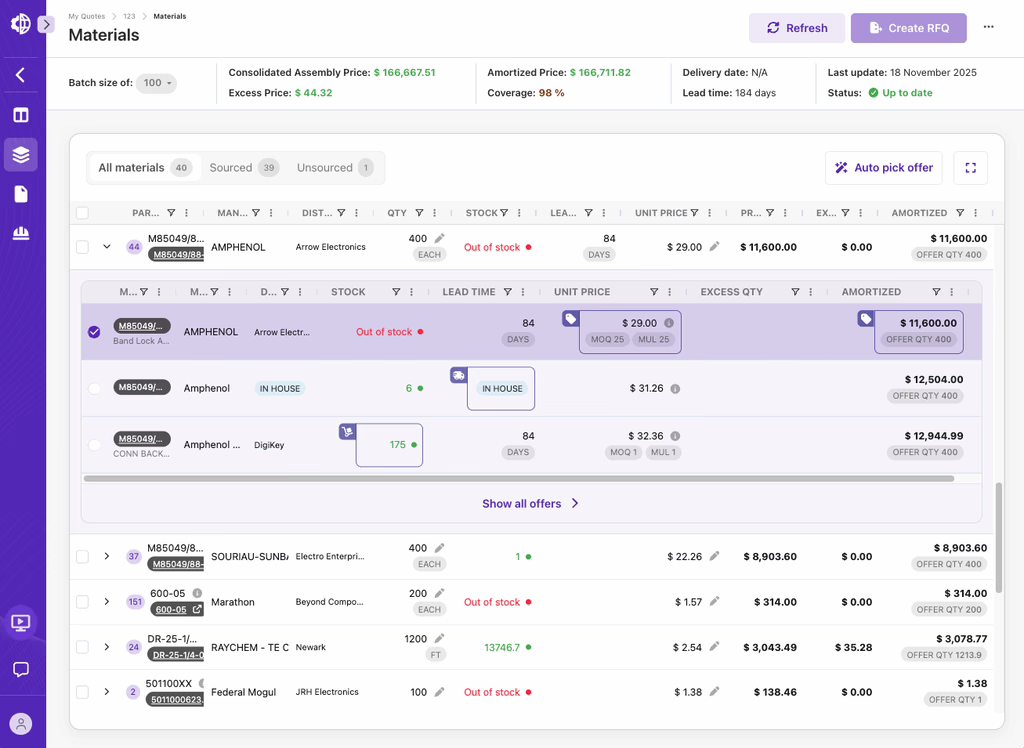
Distributor APIs supply current pricing and availability during material sourcing. We support customer contract pricing and bonded stock within that workflow. This gives estimators access to account-specific purchasing conditions when the relevant supplier connection and account configuration support them.
We describe the sourcing workflow on our material sourcing page. The practical sequence starts with a standardized BOM, continues through supplier matching, and ends with reviewed material costs feeding the estimate. Material sourcing sits alongside labor estimation, overhead, and margin decisions.
Our published product context describes a components database containing more than 2,000,000 parts. That library supports engineering interpretation; live supplier connections provide purchasing information. During evaluation, ask which distributors support account pricing and how the system handles a connection that returns incomplete information.
Correct Part Identification Comes First
Accurate supplier comparisons require the same manufacturer part number, purchasing unit, and approved specification. We map customer part numbers to manufacturer part numbers, apply stored conversion rules, and retain approved alternates. Those rules reduce repeated interpretation across incoming RFQs.
A description such as “blk tape” needs an approved purchasing identity before sourcing can produce a useful result. Loose-piece terminals and reeled terminals also carry different manufacturing implications. Crimp tooling, applicator availability, and production volume belong in that decision.
We describe up to 96% less manual input in the broader quoting process. This is a company-reported outcome, with results dependent on the incoming package and configuration. Review extracted quantities and units before accepting prices, especially where drawings mix wire lengths, assembly quantities, and purchased package sizes.
What Multiple Sources Change for Managers
Multiple distributor connections let managers evaluate purchasing choices against availability and sourcing restrictions. We support approved vendor list controls and source preferences by customer, part, or product line. These settings keep supplier selection connected to purchasing policy.
For engineering managers, an alternate needs a recorded approval path. Operations managers need visibility into whether the quoted material supports the promised build schedule. Product managers need clear assumptions when availability changes after quotation.
Use the following comparison during evaluation. Each row identifies information worth checking; it does not imply every distributor supplies every field through its API.
| Comparison point |
Review question |
| Account pricing |
Does the response reflect the negotiated purchasing account? |
| Purchase quantity |
Do price breaks and packaging match the required volume? |
| Availability |
Can the available quantity support the planned release? |
| Supplier approval |
Does the source meet customer purchasing restrictions? |
Where Stale Pricing Damages the Quote
Stale pricing separates the estimate from the purchase order that follows it. An estimator can calculate labor correctly and still commit the shop to an inadequate material allowance. Purchasing then inherits a cost target that current supplier responses cannot support.
The discussion of changing wire and cable pricing models provides useful context for reviewing price assumptions. At the assembly level, check conductor specifications, purchased lengths, and quantity breaks together. Treat freight, minimum buys, and excess inventory as explicit review items.
We discuss purchasing pressures in our 2026 market outlook. For each quote, record the material assumptions that purchasing must revisit before release. A supplier response provides information at retrieval; inventory reservation and price validity require separate confirmation.
What to Verify During Evaluation
Test the complete path from customer BOM to reviewed material total using a recent assembly package. Include customer part numbers, approved alternates, reeled terminals, and an unavailable component. These details expose configuration gaps that a clean demonstration package can hide.
1. Confirm distributor coverage and account access. Ask which connections return negotiated pricing and how credentials receive authorization.
2. Check quantity handling. Follow assembly demand through wire units, package quantities, price breaks, and any excess purchasing requirement.
3. Define exception ownership. Assign missing prices to purchasing and uncertain substitutions to engineering, with clear release authority.
4. Compare the finished estimate against the existing process. Record elapsed time, unresolved lines, and changes made during review.
We position 30-minute quoting against a traditional 7-10-day process. Treat that statement as a workflow objective when designing the trial. Measure performance on the shop's actual RFQs, including difficult supplier responses and engineering questions.
The custom cable assembly cost guide is another useful prompt for discussing cost categories. Keep the trial focused on whether material assumptions survive purchasing review. Speed becomes useful when the resulting quote can support an executable order.
Bring a Real BOM to the Review
Bring a recent BOM, purchasing terms, and supplier restrictions to a sourcing demonstration. Ask the team to trace a connector from customer description through manufacturer identification, distributor response, purchasing quantity, and final material cost. Repeat that exercise with a terminal and a wire item. Record every intervention needed before approval, then use those findings to define configuration work and acceptance criteria for implementation with your engineering and purchasing teams.
FAQ
Q: How does real-time distributor pricing work?
A: We connect the sourcing workflow to distributor APIs for current pricing and availability. Supplier coverage depends on the available connections. Account configuration determines access to negotiated purchasing conditions. During evaluation, request a demonstration using the distributors and accounts used by the shop.
Q: Can the system use negotiated contract prices?
A: We support customer contract pricing in the material sourcing workflow. Confirm which supplier connections support the relevant account arrangements. Compare returned values against an authorized purchasing account during testing. Resolve differences before accepting the sourcing configuration.
Q: Does current availability guarantee stock for production?
A: An availability response describes the information returned when sourcing runs. Inventory reservation requires separate confirmation. Purchasing should check availability again before committing an order or delivery date. Set a review rule for quotes that remain open beyond the supplier's staed validity period.
Q: How should approved alternates be handled?
A: We support approved alternates and part equivalencies. Engineering should define acceptance criteria and record customer restrictions. Purchasing can then compare permitted sourcing options. Any proposed substitution outside those rules needs approval before quote release.
About Cableteque
Cableteque combines over three decades of hands-on industry expertise with a commitment to innovation in wire harness software. Founded by Arik Vrobel, our team brings together engineers, operators, and business leaders who deeply understand the challenges related to wire harnesses.
We focus on solving the toughest problems across the entire design-through-manufacturing lifecycle, helping teams work smarter, faster, and with greater precision.
Our company thrives on innovation, inclusivity, and collaboration. We value individuality, sustainability, and making a positive impact-building trust and shared success every step of the way. We are the only company creating software designed by wire harness people, for wire harness people. Our goal is to simplify communication between OEMs and contract manufacturers, streamline operations, and help businesses grow.
Cableteque isn’t just a tool; it’s an evolving platform built to empower engineers, supply chain specialists, sales teams, and manufacturing professionals to do their best work. Our company thrives on innovation, inclusivity, and collaboration.