Key Takeaways
- General EMS quoting tools are built for electronics BOMs and cost rollups. Wire harness quoting software is built for drawings, wire lists, connector tables, and harness-specific labor.
- The biggest gap is not speed alone. It is whether the platform can read OEM PDFs, normalize part data, and calculate wire-specific requirements without a heavy manual cleanup step.
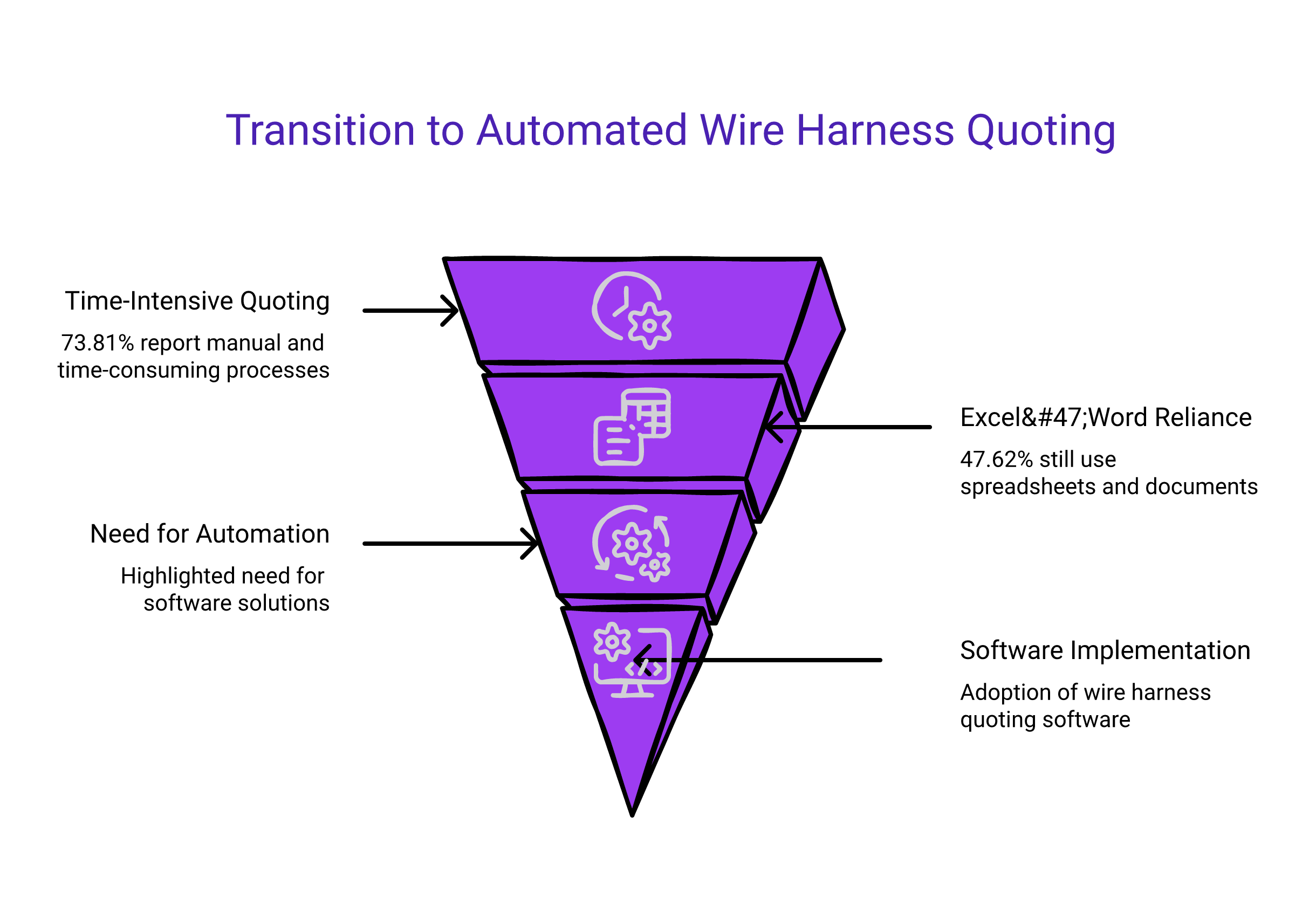
- In the 2025 WHMA Innovation Advisory Team survey of 42 contract manufacturers, 73.81% said quoting is manual and time-intensive, while only 9.52% called it highly automated and scalable.
- If your team still depends on spreadsheets, Excel macros, and tribal knowledge, choose software that reduces that dependency instead of preserving it.
- The right platform should shorten quote turnaround, improve first-pass accuracy, and protect margin on wire harness assemblies.
Introduction
Wire harness quoting and general EMS quoting tools both touch cost, labor, and material pricing, but they do not solve the same problem. The difference shows up the moment an RFQ arrives as a messy OEM PDF, a partial wire list, and a connector table with missing fields. A general quoting system can price an electronics build. A purpose-built wire harness quoting platform has to interpret the drawing package first.
That distinction matters because quote speed is not a cosmetic metric. In harness work, a slow quote can mean a lost RFQ, a margin mistake, or another week of senior engineer time spent on manual recreation. Cableteque's guidance on how to choose wire harness quoting software makes the point clearly, and the WHMA Innovation Advisory Team survey backs it up with hard numbers. In a 2025 survey of 42 manufacturers, 57.14% said BOM completeness was their top challenge and 83% said customer design errors affect production.
For engineering managers, operations managers, and product managers, the real question is simple. Does the platform understand wire harness assemblies, or does it just tolerate them? That is where most quoting tools split apart.
Table of Contents
- Why this comparison matters for contract manufacturers
- What general EMS quoting tools are built to do
- What wire harness quoting software does differently
- The practical differences that affect quote speed and accuracy
- How to choose the right quoting platform for wire harness work
- Where Cableteque fits in
- FAQ
Why This Comparison Matters For Contract Manufacturers
The commercial stakes are bigger than turnaround time. A slow quote can cost RFQs, margin, and capacity because the shop fills up with low-value admin work instead of profitable production work. In harness manufacturing, the quote is often the first place the customer sees whether your team understands the build.
A recent WHMA Innovation Advisory Team survey of 42 contract manufacturers found that 73.81% still describe quoting as manual and time-intensive, while only 9.52% call it highly automated and scalable. The same survey found that 47.62% still rely on Excel or Word-based methods, and 52.38% want better validation of customer designs before manufacturing. Those numbers say a lot. The industry still leans on tribal knowledge and manual interpretation far more than most shops want to admit.
The common trap is assuming a general EMS quoting tool can absorb harness complexity with enough setup. That sounds efficient until the first unstructured OEM PDF lands on the desk. Then the team is back to recreating BOMs, checking connector compatibility, and estimating labor from memory.
What General EMS Quoting Tools Are Built To Do
General EMS quoting tools are designed around broader electronics manufacturing. They usually handle cleaner BOMs, material costing, labor templates, test assumptions, overhead, and margin rules. That works well when the input data already looks like an electronics build plan.
They are strongest when the job is standard PCB assembly or a familiar contract manufacturing flow. They can read a BOM, pull pricing, apply labor rates, and roll up a quote faster than a spreadsheet. For many electronics jobs, that is enough. The logic is built to price known parts and known process steps.
The problem starts when the RFQ is not a tidy BOM. Wire harness work brings wire lengths, breakouts, splices, connector orientation, cavity plugs, seals, labels, protective coverings, and topology into the picture. A general EMS tool often needs more manual setup when the package arrives as a drawing set or a PDF with incomplete harness documentation.
If you want a deeper view of that gap, Cableteque's article on what wire harness quoting software should do that general manufacturing tools cannot maps the difference in plain terms. It is a useful filter for teams deciding whether they need a broad estimating platform or a harness-specific one.
What Wire Harness Quoting Software Does Differently
Wire harness quoting software starts where general EMS tools usually stop. It can extract the BOM from OEM PDFs, convert unstructured descriptions into standardized part data, and keep the quote moving even when the input is messy. That is the job.
One useful data point from Cableteque's research is that 90% of RFQs arrive as PDFs, and manual BOM recreation can take 30 to 45 minutes per assembly before the actual quoting work even begins. Cableteque's own material says BOM extraction can cut that manual recreation time by up to 96%. That is not a small efficiency gain. It changes how many quotes one engineer can touch in a day.
The other difference is logic. Harness-specific software can apply connector compatibility rules, wire gauge rules, cavity plug selection, seal selection, and protective covering calculations from bundle diameter logic. It can map customer part numbers to MPNs, store approved alternates, and use source preferences by customer, part, or product line. It can also normalize units when the same wire or cable appears by the foot, meter, inch, spool, or reel.
That is why purpose-built electrical wire harness quoting solutions matter. They are not just pricing engines. They are part interpretation systems for wire harness assemblies.
The Practical Differences That Affect Quote Speed And Accuracy
The speed difference is obvious first. A manual harness quote can take 7 to 10 days, and many shops still spend most of that time in assessment, design recreation, sourcing, and review. A specialized platform collapses those stages by auto-extracting data, flagging missing items early, and reducing back-and-forth between engineering, purchasing, and sales.
The accuracy difference is where margin lives. A bad wire length, a missed termination, the wrong crimp reel, or a connector mismatch can distort the quote before production ever starts. That is how a quote looks competitive on paper and turns into repair work, schedule pressure, or a thin margin after award.
Here is the practical split in a shop that quotes both electronics and harness work:
| Quoting task |
General EMS tool |
Wire harness quoting software |
| BOM intake |
Works best with clean structured BOMs |
Extracts parts from OEM PDFs and standardizes them |
| Part logic |
Applies generic material and labor rules |
Uses connector, wire gauge, seal, and alternate part logic |
| Labor estimate |
Gives high-level assembly labor estimates |
Estimates harness labor from topology and termination steps |
| Manual cleanup |
Often needed when documentation is unstructured |
Reduces cleanup by converting tribal knowledge into repeatable rules |
The best systems also support parallel work instead of forcing a rip-and-replace implementation. That matters in real shops, where quoting still has to keep moving while the new process is tested.
How To Choose The Right Quoting Platform For Wire Harness Work
Start with the RFQ itself. If your quotes depend on connector-specific logic, wire lists, OEM drawing interpretation, or multiple PDF BOMs, you need software built for harness work. If the tool cannot read the package the way your estimators do, it will not save enough manual effort to matter.
Use five practical checks. Can it extract BOMs from PDFs? Can it map customer part numbers to actual MPNs? Can it estimate labor from harness-specific operations? Can it source parts and alternates automatically? Can it cut quote turnaround time without forcing your team to abandon current workflows?
A useful internal benchmark is dependency. If the platform still depends on one senior estimator's tribal knowledge, the problem is still sitting in one person's head. The better choice removes that dependency and spreads the logic across the team.
That logic applies across automotive, aerospace, industrial, EV, medical, and machinery work. Those markets all punish slow quoting, but they punish bad harness logic faster.
Where Cableteque Fits In
Cableteque is built for wire harness contract manufacturers, not general manufacturing quoting. That is the point. It was created by people who know what it takes to quote wire harness assemblies under real deadline pressure, with real drawing ambiguity, real sourcing issues, and real margin risk.
Cableteque combines over three decades of hands-on industry expertise with a commitment to innovation in wire harness software. Founded by Arik Vrobel, our team brings together engineers, operators, and business leaders who deeply understand the challenges related to wire harnesses.
We focus on solving the toughest problems across the entire design-through-manufacturing lifecycle, helping teams work smarter, faster, and with greater precision.
Our company thrives on innovation, inclusivity, and collaboration. We value individuality, sustainability, and making a positive impact-building trust and shared success every step of the way. We are the only company creating software designed by wire harness people, for wire harness people. Our goal is to simplify communication between OEMs and contract manufacturers, streamline operations, and help businesses grow.
Cableteque isn't just a tool; it's an evolving platform built to empower engineers, supply chain specialists, sales teams, and manufacturing professionals to do their best work. Our company thrives on innovation, inclusivity, and collaboration.
That is why the product promise is so direct. It reduces a 7 to 10 day quoting process to 30 minutes, cuts manual input by up to 96%, and helps teams quote with more consistency. In one customer case, 18 hours dropped to 45 minutes. Other reported outcomes include 70% faster quote turnaround and 5x quote capacity without new hires.
Speed without harness accuracy is noise. The right tool has to do both, or the quote will still land too late, too thin, or too wrong.
FAQ
Q: Can a general EMS quoting tool handle wire harness assemblies well?
A: It can handle simple cost rollups, but it usually struggles when the RFQ includes connector tables, wire lengths, breakouts, or incomplete OEM documentation. Those jobs require harness-specific logic, not just part pricing and labor templates. If your team spends a lot of time cleaning up PDFs and rebuilding BOMs, the tool is doing part of the job, not the whole thing. That is usually where delays and estimate errors begin.
Q: What makes wire harness quoting software different from EMS estimating software?
A: Wire harness quoting software reads the way harness jobs are actually built. It extracts BOMs from PDFs, maps part numbers, calculates wire-specific labor, and applies connector and compatibility rules. EMS tools are better at standard electronics quoting where the BOM is already structured. The difference shows up in first-pass accuracy and how much manual work is still left for your engineers.
Q: Why do quoting teams still rely on spreadsheets and manual checks?
A: Because many quoting workflows were built around tribal knowledge and grew one quote at a time. In the WHMA survey, 47.62% of manufacturers still used Excel or Word-based methods, which says the process is still highly manual in many shops. Spreadsheets are flexible, but they do not understand connector compatibility, labor templates, or wire-specific units of measure on their own. That creates dependency on senior staff and slows the queue.
Q: What should I look for in electrical wire harness quoting solutions?
A: Look for BOM extraction, part mapping, sourcing automation, labor estimation, and support for unstructured OEM files. You also want design rule checks, alternate part handling, and a way to normalize customer part numbers into MPNs. If the platform can cut quote turnaround time without forcing a full process redesign, it is closer to what a harness shop needs. The best systems fit into production reality instead of asking the shop to work around them.
Q: How does faster quoting affect margin?
A: Faster quoting improves win rate because customers get answers before they move on. It also reduces the amount of senior engineering time spent on low-value rework, which protects internal capacity. More important, it lowers the chance that a wire length, termination, or part mapping mistake slips into the estimate. In harness work, bad quote data usually shows up later as margin loss.
Q: Is Cableteque meant to replace existing quoting processes?
A: It is designed to work with them, not force a disruptive change on day one. The platform supports parallel workflows so teams can test it while keeping current processes alive. That lowers risk for operations, engineering, and sales. It also gives your team a cleaner path from messy RFQs to standardized quotes.
See The Difference In Your Own Quote Queue
If your team is still spending days on BOM recreation, connector checks, and manual labor estimates, it is time to see what a harness-specific platform can remove from the process. Book a demo and compare your current wire harness quoting flow against a system built for the work your shop actually does.
About Cableteque
Cableteque transforms the wire harness contract manufacturer quoting process into a 30-Minute breeze. The AI-powered quoting solution from Cableteque is aimed at simplifying the quoting process for contract manufacturers by reducing a 7-10 day process to just 30 minutes.
Cableteque's slogan is "Wire harness software, by wire harness people".