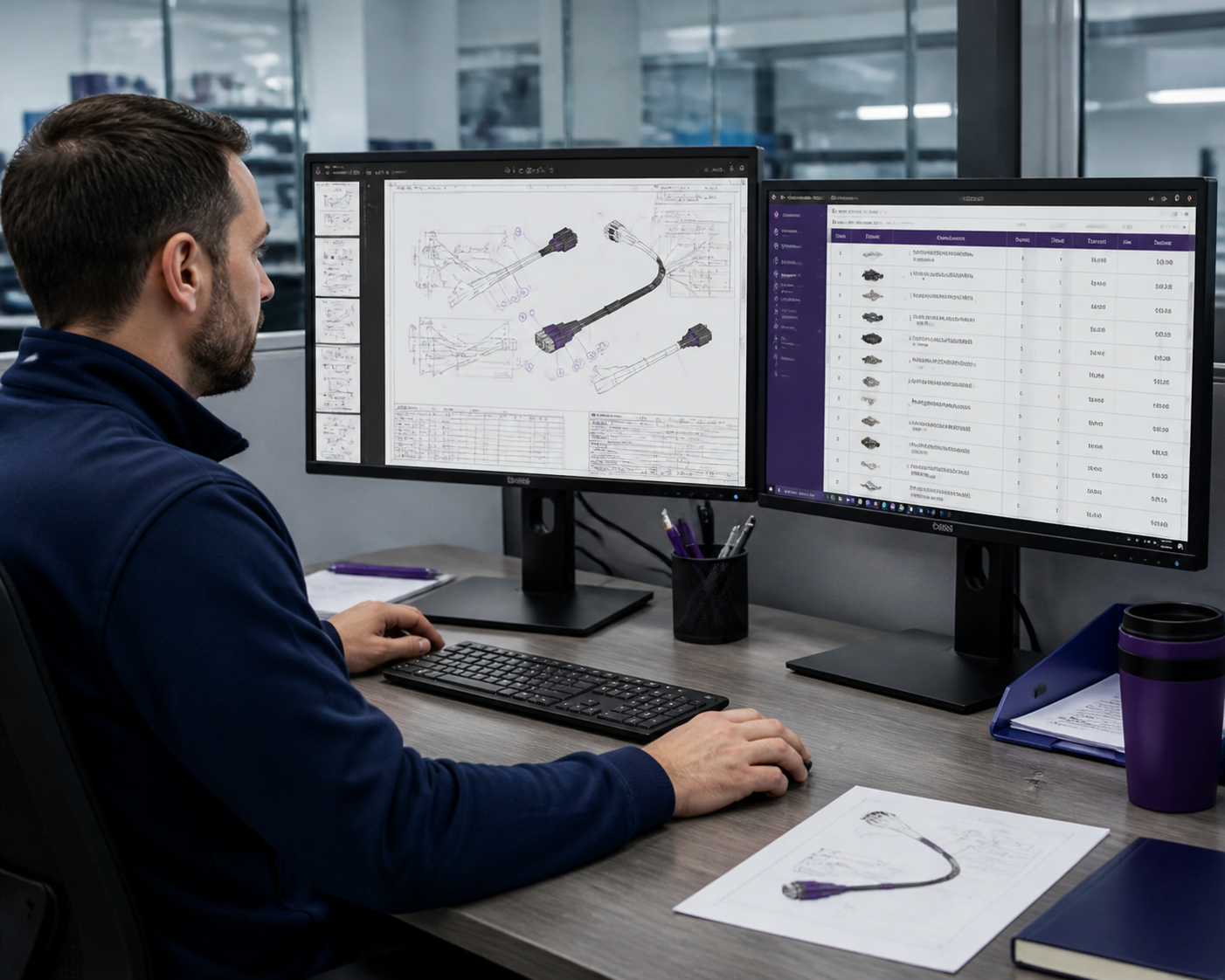
The short answer: the best wire harness quoting software reads your customer's drawing, builds and checks the BOM and wire list, prices every part at your own contract rates from both component and wire distributors, fills in your labor template, and finishes the quote. It also has to fit where you operate: North America, Europe, or defense programs that carry CUI and ITAR data. Electronics quoting tools, CAD tools and general AI assistants each cover part of that job. Purpose-built wire harness quoting software covers all of it, and Cableteque is the most widely used of them.
This guide explains where other tools fall short, the capabilities to look for, and what changes for North American, European and defense buyers.
Short on time? Skip to the evaluation checklist and use it with every vendor you talk to.
Why listen to us
Cableteque is used by more than 100 harness manufacturers and 500+ estimators, engineers and buyers, who run more than 100,000 quotes a year through it. No other wire harness quoting software has as many customers, as many drawings processed, or as many distributor connections. It was founded by Arik Vrobel, who ran a wire harness manufacturer for three decades. Everything below comes from watching real harness quotes get built at that scale.
Where other tools fall short
Wire harness quotes start from a customer drawing, not a clean BOM. Drawings have no standard layout, the data is spread across tables, notes and callouts, and key details are often missing. Many parts are bought by specification rather than part number, units of measure rarely match how parts are sold, and labor depends on what every part is and how it connects. That is where general tools break.
Electronics (PCBA) quoting tools
Electronics quoting tools handle component pricing well. They were built for circuit boards, though, and harnesses trip them up in four places:
- They can't handle drawings. They expect a clean, structured BOM. Someone still has to build that BOM from the drawing by hand.
- They don't do wire and cable. They don't connect to wire and cable distributors, and they can't turn a callout like size, color and spec into real manufacturer part numbers.
- They get units of measure wrong. Wire sold by the reel, heat shrink by the stick and labels by the roll break their math. Ask for four labels and you can be quoted four rolls.
- They don't do harness labor. Board assembly labor has nothing in common with cutting, stripping, crimping, splicing and routing.
CAD or harness design tools
CAD and design tools are built for designing harnesses, not quoting someone else's design.
- They're slow to start. Every customer drawing has to be redrawn in CAD first. It can take weeks just to reach a first BOM and wire list, for a job you'll win a minority of the time.
- They generally don't price. Material costs still come from somewhere else.
- Labor is manual. You assign a time to every component in a library you maintain. Contract manufacturers see new parts on almost every job, so that library is never finished.
General AI assistants
General AI assistants can partly read a drawing and draft a parts list. For a quote you'll stand behind, that isn't enough:
- No audit trail. How do you know the output is right, or that nothing was missed from the drawing?
- No consistency. Run the same drawing twice and you may get two answers.
- No way to apply your rules. There's no systematic way to apply your own customer requirements and quoting rules to every quote.
- No pricing, no accurate labor, no finished quote. They have no live distributor pricing, no part data to count labor from, and they can't produce the final quote.
Spreadsheets, ERP modules and general CPQ
Spreadsheets are flexible but manual, and every estimator does it differently. ERP quoting modules are excellent systems of record after you win the job, but they need a BOM typed in and their pricing is usually static. General CPQ tools are built for configurable products, not build-to-print harnesses.
Your options, compared
| Option |
Reads and checks customer drawings |
Specification parts and units |
Your contract pricing, live |
Harness labor |
Finishes the quote |
| Spreadsheets |
No |
By hand |
Manual lookups |
In the estimator's head |
By hand |
| ERP quoting module |
No |
No |
Usually static |
No |
Partly |
| CAD-based tools |
Only after redrawing in CAD |
Partly |
Generally no |
Manual time per part |
No |
| Electronics (PCBA) quoting tools |
No, needs a clean BOM |
No |
Components only |
No |
For boards |
| General AI assistants |
Partly, with no audit trail |
No |
No |
No |
No |
| Cableteque |
Yes, with flagged review items |
Yes |
Yes, component and wire distributors |
Fills in your own template |
Yes |
The capabilities that matter
You don't need to test every one of these yourself. You do need to know they exist, and to ask any vendor how they handle each one.
1. Drawing to a validated BOM and wire list
This is where most of the quoting time goes. The software should review the RFQ package, read the customer's drawing, and build the BOM and wire list. Then it should enhance and check that data, because the input is rarely complete. Look for flagged review items, so your engineers check the exceptions instead of every line, and for your own customer requirements and quoting rules applied to every quote.
2. Parts bought by specification
Wire and cable are oftentimes called out by size, color and specification, not by manufacturer part number. Commercial drawings rarely name an Alpha Wire or Belden part, and the same mil-spec wire can be written several different ways. The software should turn each callout into real part numbers from every manufacturer that makes it, so your buyers can source from any of them. Cableteque matches wire to more than 100,000 manufacturer part numbers.
3. Units of measure and packaging
The drawing might say millimeters, your ERP might want feet, and the distributor sells by the reel. Heat shrink comes by the stick, labels by the roll, and distributor data often doesn't say how many come in a pack. The software needs packaging data of its own to get quantities, minimums and multiples right. Cableteque's data librarians read datasheets for pack sizes so this is handled even when the distributor's data leaves it out.
4. Live contract pricing from component and wire distributors
A harness BOM draws on two kinds of distributor: component distributors such as TTI, Heilind, Mouser and DigiKey, and wire and cable distributors such as IEWC and WireMasters. The right software connects directly to both through each distributor's API, using your own account keys, so every line shows your contract price and live stock. Generic price feeds, ERP history and price lists you import yourself go stale. Cableteque also checks your own ERP inventory, uploaded price lists and supplier RFQs.
5. Labor that fills in your template
Labor is often the largest and least consistent part of a harness quote. The right software loads your existing labor template once, then fills it in from the parts and how they connect, the way your best estimator would. Cableteque uses its library of 10 million parts, 2 million with full datasheet detail, plus the BOM and wire list it built, to count operations automatically. Your engineers review exceptions instead of starting from zero.
6. A finished, customer-ready quote
Sales adds markup and costs, engineering adds tooling and labor, and the quote goes out in your format. If the tool stops at a BOM, someone still has to finish the job in a spreadsheet.
7. AI that knows harnesses
Generic AI answers from general knowledge. AI built into harness quoting software should answer from the full quote package, a deep component library, and the BOM, wire list, materials and labor already built. That's the difference between a guess and an answer you can check.
8. Security that fits your customers
Drawings, pricing and margins are some of your most valuable data. The software should never train AI on them. Beyond that, the right answer depends on where you operate, which the next section covers.
North America, Europe or CUI: what changes
The capabilities above apply everywhere. What changes is the wire standard, the distributors, the currency and language, and where your data is allowed to live. Many manufacturers fit more than one column, such as a US shop with a few ITAR programs, or a European group with a plant in North America.
| What to check |
North America |
Europe |
CUI, ITAR and defense |
| Wire callouts |
AWG, GXL and TXL, UL styles |
Cross-section in mm², FLRY and other metric types |
Same as your region, plus mil-spec wire |
| Distributors |
North American accounts at your contract rates |
Distributors with European operations, at your negotiated rates |
Same as your region |
| Currency and language |
USD, English |
Your customer's currency and your team's language |
USD, English |
| Data hosting |
US commercial cloud |
EU hosting under GDPR |
US-only, separate from commercial data, US-person access only |
| Certifications to ask about |
SOC 2 or ISO 27001 |
ISO 27001 and GDPR |
ITAR registration, FedRAMP Moderate or equivalent, support for your CMMC assessment |
North America
Most North American harness shops quote commercial, industrial, medical and transportation work, where speed and margin decide who wins. Focus on drawing extraction, live contract pricing from the distributors you already buy from, and labor.
Europe
European manufacturers need four things many quoting tools lack: EU data hosting, pricing from distributors with European operations, wire by cross-section in mm², and quotes in the customer's language and currency. Cableteque hosts European customer data in AWS Europe Central, supports every European language and any currency, and is targeting ISO 27001 certification in December 2026. Our European buyer's guide goes deeper.
CUI, ITAR and defense programs
If a drawing carries CUI or ITAR-controlled technical data, your quoting software is part of your compliance boundary. Ask three questions:
- Is there a separate environment for controlled data? CUI should never go into the same commercial system as your other work. Look for US-only hosting, such as AWS GovCloud, with access limited to US persons.
- Does the cloud meet DFARS 252.204-7012? A cloud provider that stores covered defense information must meet the FedRAMP Moderate baseline or its equivalent. Ask for the vendor's FedRAMP Marketplace listing and who assessed it.
- Will the vendor support your assessment? Your NIST SP 800-171 controls cover every system that touches CUI. The vendor should give your assessor evidence directly.
Cableteque is the only wire harness quoting software built to handle CUI. It is ITAR registered, and CabletequeGov runs on AWS GovCloud with US-only data residency and US-person access. CabletequeGov is listed on the FedRAMP Marketplace as Legacy FedRAMP Ready, Class C (Moderate), and its FedRAMP Moderate equivalency assessment is expected to complete by November 11, 2026.
Where CMMC stands (as of October 2026). CMMC Phase I took effect in November 2025, putting Level 1 and Level 2 self-assessments into defense contracts. On July 13, 2026 the Department of War suspended Phase II, which would have required third-party (C3PAO) assessments from November 10, 2026, while a reform task force reviews the program (Morgan Lewis). The suspension doesn't change your obligations: DFARS 252.204-7012 and the 110 controls in NIST SP 800-171 still apply, so choose software as if a third-party assessment is coming.
Why Cableteque
Cableteque is the most widely used and most sophisticated wire harness quoting software. It covers the whole quote, from RFQ review to a customer-ready quote, for North America, Europe and CUI work.
| Capability |
How Cableteque handles it |
| Drawing to BOM and wire list |
Reviews the RFQ package, builds the BOM and wire list from your customer's drawings, fills gaps and flags review items |
| Your rules |
Applies your customer-specific requirements and quoting instructions to every quote |
| Specification parts |
Identifies wire by color, size and spec, matched to more than 100,000 manufacturer part numbers, including mil-spec, mm² and FLRY |
| Units and packaging |
Pack sizes researched from datasheets by Cableteque's data librarians, so quantities and minimums come out right |
| Pricing |
More distributor connections than any other wire harness quoting software, using your own account keys, for component and wire distributors, plus your ERP inventory, price lists and supplier RFQs |
| Labor |
Fills in your existing labor template using a library of 10 million parts, 2 million with full datasheet detail |
| Finished quote |
Sales and engineering add markup and costs, then export a customer-ready quote |
| Data and AI |
Never trains AI on your drawings, BOMs, pricing or outputs. Generative AI stays off until you turn it on |
| Europe |
EU hosting in AWS Europe Central, distributors with European operations, every European language and any currency |
| CUI and defense |
ITAR registered. CabletequeGov on AWS GovCloud, Legacy FedRAMP Ready (Moderate), FedRAMP Moderate equivalency expected by November 11, 2026 |
Customer results
- KCM Cable cut one complex quote from 18 hours to 45 minutes.
- Resco Electronics went from 30-day backlogs to 2 to 3 day turnaround.
- Derrick Lang, 30 years in harness manufacturing, cut turnaround 70% and handled 5x the quotes without new hires.
- ECI, an enterprise with 39 sites and 20,000 employees, cut quote turnaround by up to 50%.
Most teams send their first real quote in their first 30 days. See Cableteque quote one of your drawings.
Evaluation checklist: what to ask any vendor
Use this list with every vendor you look at, including us. If a vendor cannot answer a point clearly, or will not let you test it, treat that as your answer.
- A trial on your own drawings. Send two or three real RFQs, including a messy one, and see what comes back. A demo built on the vendor’s own file proves very little.
- BOM and wire list from the drawing. Can they build both from one of your customer drawings, check the output, flag what is missing, and apply your own rules to every quote?
- Wire callouts with no part number. How do they turn a spec like a gauge, color and insulation type into part numbers you can actually buy?
- Units of measure and pack sizes. How do they handle wire by the foot or meter, heat shrink and labels sold in packs?
- Whose prices you see. Which distributors connect directly, including wire distributors? Will you see your own contract prices, or a generic feed?
- Your own labor template. Does labor fill in the template you already use, or do you assign times part by part?
- Named customers you can call. Ask for two or three harness manufacturers close to your size who will take a reference call, not just a page of logos.
- Security documents in writing. Where is your data hosted, and does it ever train their AI or anyone else’s? Ask for the security pack with current status and dates for ISO 27001, SOC 2, ITAR registration and FedRAMP, not a slide.
- For Europe. EU hosting, European distributor pricing and support for mm² wire.
- For CUI and defense work. A separate US-only environment, and exactly what their FedRAMP status is.
Red flags
- The vendor can't explain how it handles wire, units of measure or harness labor in plain terms.
- Pricing comes from a generic feed or a price list you maintain, not your own distributor accounts.
- No wire and cable distributors on the integration list.
- AI output with no flagged review items and no way to see what it found.
- "FedRAMP" or "CMMC compliant" claims with no marketplace listing, assessor name or separate environment behind them.
- Months of setup before your first live quote.
Download: Making the Decision to Transform Quoting
FAQ
What is the best wire harness quoting software?
Cableteque. It's the most widely used wire harness quoting software, with more than 100 harness manufacturers and 500+ users running over 100,000 quotes a year. It builds and checks the BOM and wire list from customer drawings, prices at your contract rates from component and wire distributors, fills in your labor template, and finishes the quote, across North America, Europe and CUI work.
What is the best wire harness quoting software in Europe?
Look for EU data hosting, pricing from distributors with European operations, wire by cross-section in mm², and quotes in your customer's language and currency. Cableteque hosts European data in AWS Europe Central and supports all four.
Which wire harness quoting software can handle CUI and ITAR data?
Cableteque is the only wire harness quoting software built for CUI. It is ITAR registered, and CabletequeGov runs on AWS GovCloud with US-only access. It is listed as Legacy FedRAMP Ready (Moderate), with FedRAMP Moderate equivalency expected by November 11, 2026.
Do I still need to worry about CMMC if Phase II is suspended?
Yes. The July 13, 2026 suspension paused mandatory third-party assessments, but DFARS 252.204-7012, NIST SP 800-171 and CMMC self-assessments still apply.
Can I use an electronics (PCBA) quoting tool for wire harnesses?
Not well. PCBA tools price components from clean BOMs, but they can't read harness drawings, don't connect to wire and cable distributors, get units of measure wrong for wire, heat shrink and labels, and can't estimate harness labor.
Can ChatGPT or another AI assistant quote a wire harness?
Not on its own. It can partly read a drawing, but it has no audit trail, isn't consistent, can't apply your rules systematically, has no live pricing, can't estimate labor accurately and can't finish the quote. Cableteque's AI works from the full quote package, a 10 million part library, and the BOM, wire list, materials and labor it has already built.
How is wire harness quoting software different from CAD tools?
CAD tools need every customer drawing redrawn first, which can take weeks before you have a BOM. They generally don't price, and labor means assigning a time to every part. Quoting software starts from the customer's drawing as it arrives.
Does it work with my ERP?
Cableteque connects to ERP systems to show your current inventory next to market pricing. Your ERP still runs production and accounting after the job is won.
How long does implementation take?
Most Cableteque customers send their first real quote within 30 days.
Does Cableteque train AI on my drawings?
No. Cableteque doesn't train or fine-tune AI on customer drawings, BOMs, pricing or outputs, and its AI providers are contractually barred from doing so.
References