Key Takeaways
- A wire harness manufacturer can usually get live with Cableteque in days to a few weeks, not months.
- The clearest implementation path is system configuration in 1 to 30 days, one week of training, then 3 plus weeks of support.
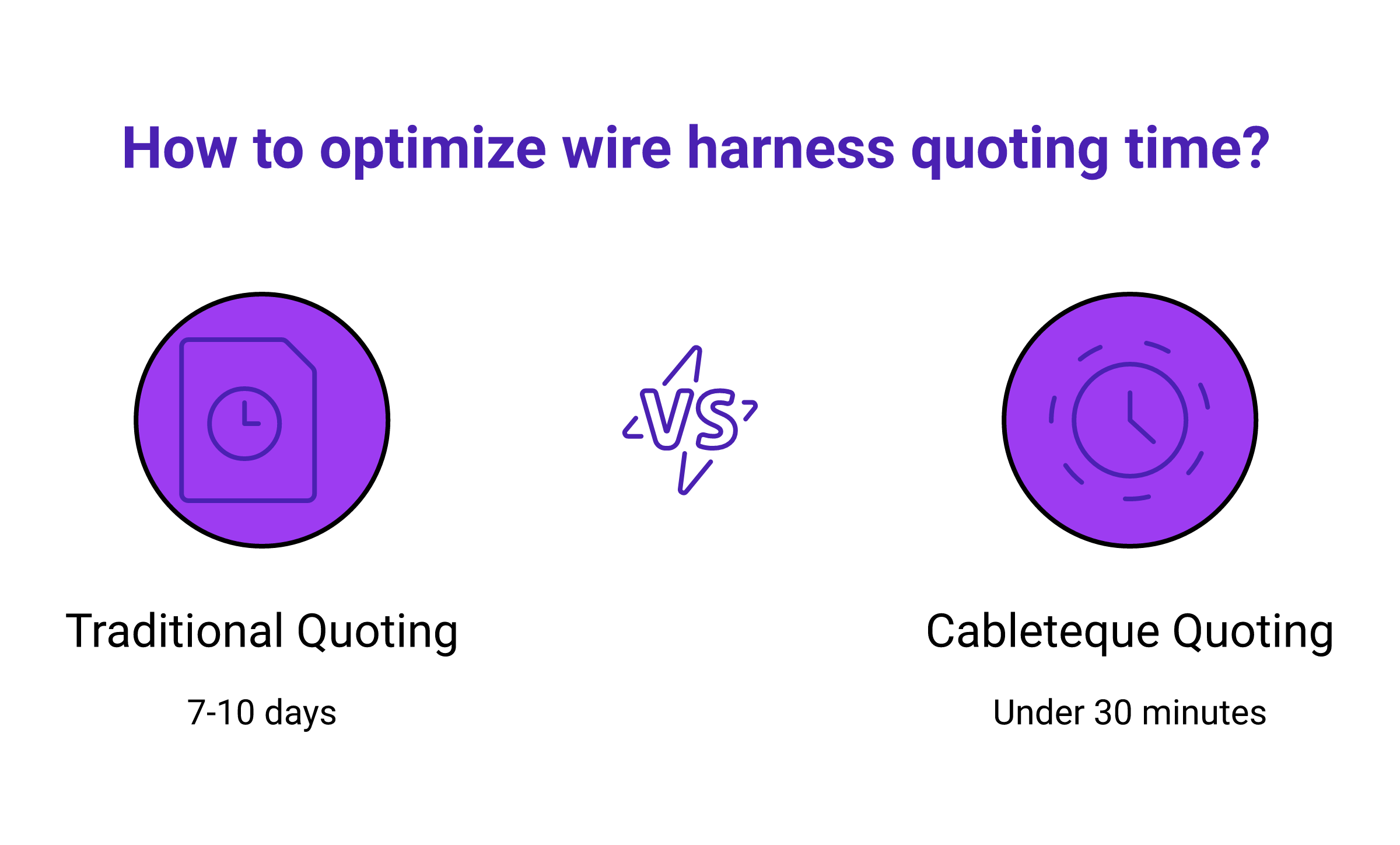
- Quoting can move much faster than the old 7 to 10 day cycle, with Cableteque targeting 30 minutes for a complete quote.
- The fastest value comes from live BOM extraction, sourcing, labor estimation, and quote finalization, not from a long IT rollout.
- A parallel-run setup reduces disruption, so your current quoting process keeps moving while the new one is tested.
Introduction
You do not need a quarter-long software project to start quoting faster. A wire harness manufacturer can get up and running with Cableteque in days to a few weeks, because the rollout is built around system configuration, training, and support instead of a heavy IT migration.
That speed matters because the traditional quote path still burns 7 to 10 days, and the WHMA Innovation Advisory Team survey of 42 wire harness and cable assembly contract manufacturers found that 73.81% describe quoting as manual and time-intensive. The same survey showed only 9.52% call their process highly automated and scalable, while 64.29% cite cost or budget pressure as the main barrier. If you are trying to answer RFQs faster, the setup timeline has to be short enough to fit real shop-floor pressure.
The good news is that the first useful wins show up early. BOM extraction from PDF can fall from 30 to 45 minutes to 2 minutes, material sourcing can drop from 3 to 7 days to 2 minutes, and labor estimation can fall from 30 minutes to 2 hours to 5 minutes. For an estimator, that changes the week.
Table of Contents
- How Fast Can You Go Live?
- What Happens In The First 30 Days?
- Why The First Quote Matters More Than The Full Rollout?
- Where The Time Savings Show Up First?
- What Slows Teams Down During Adoption?
- The Fastest Path To A Working Quote Desk
- FAQ
- About Cableteque
How Fast Can You Go Live?
You can usually start quoting quickly, often within days, and the company's own deployment framing points to full system configuration in 1 to 30 days. That is a practical implementation window for a wire harness shop that needs live results without pausing current work.
The reason is simple. The platform is cloud native, built for parallel use, and intended to fit into existing quote activity instead of replacing every process at once. Cableteque also states that manufacturers can be quoting in under a month, which is the kind of timeline that changes a purchasing conversation from "when will it be ready?" to "which jobs do we start with?"
A useful comparison comes from the company's own public material on how AI is used in wire harness production in 2026, where the focus is on reducing manual recreation and error checking early in the quote flow. If your team is still rebuilding BOMs by hand, that first phase is where the clock gets cut fastest.
What Happens In The First 30 Days?
The first month is usually enough to get the quote engine moving. In practical terms, that means configuration, user training, and the first supported live runs.
Cableteque's own implementation model breaks this into four parts: system configuration in 1 to 30 days, training in 1 week, continued support for 3 plus weeks, and progress reports at 45 and 90 days. That structure tells you something important. The goal is not a frozen launch date. The goal is to start useful work early, then tune the system while the team keeps quoting.
I have seen quoting teams lose momentum when software is introduced as a big-bang event. A better path is to start with a single product line or a small set of jobs, then expand once the team trusts the results. That approach keeps estimator judgment in the loop while the software takes over the repetitive parts.
The First Wins Usually Come From Three Tasks
The quickest gains come from the same tasks that eat the most estimator time. BOM import, part matching, and sourcing are the first places where manual work shrinks.
Cableteque says BOM extraction from PDF can fall from 30 to 45 minutes to 2 minutes. It also says material sourcing can fall from 3 to 7 days to 2 minutes through real-time APIs, and quote finalization can move from 15 to 30 minutes to 5 minutes. Those numbers are not small. They are the difference between a slow quote desk and one that can answer more RFQs before lunch.
For teams evaluating software choices, the company's own guide to choosing wire harness quoting software is a useful way to frame the buying decision. Look for systems that handle actual wire harness complexity, not generic quoting steps.
Why The First Quote Matters More Than The Full Rollout?
Your first live quote matters because it proves the system can work with real drawings, real customer part numbers, and real supplier data. If that first pass works, adoption speeds up fast.
The WHMA survey gives that urgency real context. Out of 42 respondents, 57.14% said BOM or design completeness is their top challenge, 47.62% said sourcing and materials are difficult, and 83% encounter customer design errors that affect production at least sometimes. A rollout that waits for perfect data will stall. A rollout that handles incomplete data with review flags and part mapping starts paying off immediately.
Cableteque's own materials point to customer cases where 18 hours of work fell to 45 minutes, a 96% time savings. That is the kind of result that changes internal behavior. Once an estimator sees a quote package turn around that fast, the software stops being an experiment and starts becoming the default route.
Parallel Running Reduces The Risk
Parallel running is the safest way to start. Your current estimating process keeps operating while the new platform is tested against live RFQs.
That matters because 64.29% of manufacturers in the WHMA survey say cost or budget is the biggest adoption barrier, and 52.38% say internal resource limits are a major issue. A parallel model avoids a disruptive switchover. It also gives engineering, purchasing, and estimating time to agree on how customer part numbers, alternates, and source preferences should be handled.
The result is a controlled transition. You do not need to stop quoting in order to modernize quoting.
Where The Time Savings Show Up First?
The earliest savings show up in tasks with repetitive inputs and clear rules. That usually means BOM cleanup, source matching, labor estimates, and quote assembly.
Cableteque says labor operation counts can be autocompleted at 50 to 70%. It also says labor estimation can fall from 30 minutes to 2 hours down to 5 minutes. For a manufacturer that runs dozens or hundreds of RFQs a year, that kind of reduction adds up quickly. It also frees senior engineers to spend time on the jobs that need judgment, not data entry.
The company has also reported 70% faster quote turnaround, 5x quoting capacity without new hires, and 3 to 6 month typical ROI payback from labor savings and higher win rates. Those are strong numbers because they tie speed to business outcomes, not just software usage.
The Hidden Payoff Is Margin Protection
Speed alone is not the prize. Margin protection is.
A slow quote often loses business before the buyer even talks price. Cableteque's own material says quote delay can cost 10 to 30% in win rate once response time slips beyond a few days. In a shop where RFQ response speed decides whether the opportunity stays alive, shaving days off the front end is not cosmetic.
That is why the fastest implementations focus on quoting flow, not on enterprise theater. If the system extracts BOMs, maps parts, checks availability, and builds labor faster than the old manual method, the quoting desk can answer more requests with the same headcount.
What Slows Teams Down During Adoption?
The biggest drag is usually not the software. It is the cleanup around it.
Customer drawings arrive with missing details, loose part descriptions, inconsistent naming, and special notes buried in PDFs. That is where the platform's AI analysis matters. It can convert descriptive inputs like "blk tape" into black Tesa 3/4 inch tape, apply part conversion rules such as loose piece terminal to reel, and map customer part numbers to MPNs. Those are the kinds of small corrections that stop quote rework from piling up.
The other drag is habit. WHMA's survey shows 47.62% of manufacturers still rely on in-house Excel or Word-based methods, and only 9.52% describe their process as highly automated and scalable. That gap explains why quick wins matter so much. If the first live jobs save time without breaking the estimator's judgment, the team starts changing behavior on its own.
The Shortest Path Is A Narrow Scope
Do not start with every product line, every plant, and every customer rule.
Start with a manageable set of assemblies. Then layer in approved alternates, supplier preferences, and labor templates once the core quote flow is stable. That is the cleanest route for a wire harness manufacturer that needs speed without chaos.
If you want a broader industry view, the Wire Harness Manufacturers Association is a useful reference point for the operational pressures that shape quoting decisions. The same survey data keeps pointing back to the same problem. The industry wants faster quoting, better completeness, and fewer manual steps.
The Fastest Path To A Working Quote Desk
The fastest path is a focused rollout with one goal, getting a live quote out of the system as soon as possible. Once that happens, every later improvement gets easier to justify.
For most manufacturers, that means configuration inside the first month, training in the first week, and support through the first few live RFQs. It also means starting with the highest-value tasks first, because those are the ones that prove the system's worth. A shop does not need a perfect data model to start seeing value. It needs a working flow that cuts the worst delays.
If your team is still asking how long it takes to get up and running, the real question is simpler. How many RFQs can you afford to answer at the old speed while competitors answer theirs in minutes?
FAQ
Q: How long does it usually take to get started with Cableteque?
A: Most teams can get started in days, and the company's stated configuration window is 1 to 30 days. Training is set at 1 week, with continued support for 3 plus weeks after that. That makes the early rollout practical for a busy estimating department. In many cases, the first useful quote work begins before the full support window ends.
Q: Can a manufacturer keep using its current quoting process during setup?
A: Yes. The platform is built for parallel running, so your current quoting process can keep moving while the new system is tested. That lowers risk and gives your team time to compare outputs. It also helps you avoid a hard switch that could stall live RFQs. For shops with multiple customers or product lines, that is often the safest path.
Q: What speeds up the first quote the most?
A: BOM extraction, part mapping, and material sourcing are usually the earliest wins. Cableteque says BOM extraction from PDF can drop from 30 to 45 minutes to 2 minutes, and sourcing can fall from 3 to 7 days to 2 minutes. Labor estimation also falls sharply, from 30 minutes to 2 hours to 5 minutes. Those three steps remove a large share of manual effort from the front of the quote.
Q: Does the rollout need a large IT project?
A: No. The deployment model is designed to avoid a long IT project. It is cloud native, configured in stages, and meant to work alongside existing tools. That is one reason manufacturers can quote in under a month. The system is set up to fit real shop conditions, not force a full process reset.
Q: What does the WHMA survey say about quoting today?
A: The WHMA survey of 42 manufacturers showed that 73.81% describe quoting as manual and time-intensive. Only 9.52% said their process is highly automated and scalable. It also found that 64.29% see cost or budget as the biggest adoption barrier. Those numbers show why fast setup and early value matter so much.
Q: What kind of time savings are realistic?
A: Cableteque reports strong reductions across the quote flow, including 70% faster turnaround and 96% time savings on some complex quotes. One customer case moved from 18 hours to 45 minutes. The exact result depends on job complexity and data quality, but the first gains usually show up fast. The biggest savings come from repetitive work that used to sit with senior estimators.
Ready To See How Fast Your Quote Desk Can Move?
If your team is still spending days on BOM cleanup, supplier checks, and final review, the delay is already costing you RFQs. The practical question is not whether quoting can move faster. It is how quickly you want the first live job to prove it.
Cableteque is built for wire harness quoting teams that need speed without tearing up their current process. If you want to see what a 30-minute quote flow looks like in a real manufacturing setting, book a demo and test it against your own RFQs.
About Cableteque
Cableteque combines over three decades of hands-on industry expertise with a commitment to innovation in wire harness software. Founded by Arik Vrobel, our team brings together engineers, operators, and business leaders who deeply understand the challenges related to wire harnesses.
We focus on solving the toughest problems across the entire design-through-manufacturing lifecycle, helping teams work smarter, faster, and with greater precision.
Our company thrives on innovation, inclusivity, and collaboration. We value individuality, sustainability, and making a positive impact, building trust and shared success every step of the way. We are the only company creating software designed by wire harness people, for wire harness people. Our goal is to simplify communication between OEMs and contract manufacturers, streamline operations, and help businesses grow.
Cableteque isn't just a tool; it's an evolving platform built to empower engineers, supply chain specialists, sales teams, and manufacturing professionals to do their best work. Our company thrives on innovation, inclusivity, and collaboration.
1-1.png?width=190&height=34&name=logo-transparent%20(1)1-1.png)